
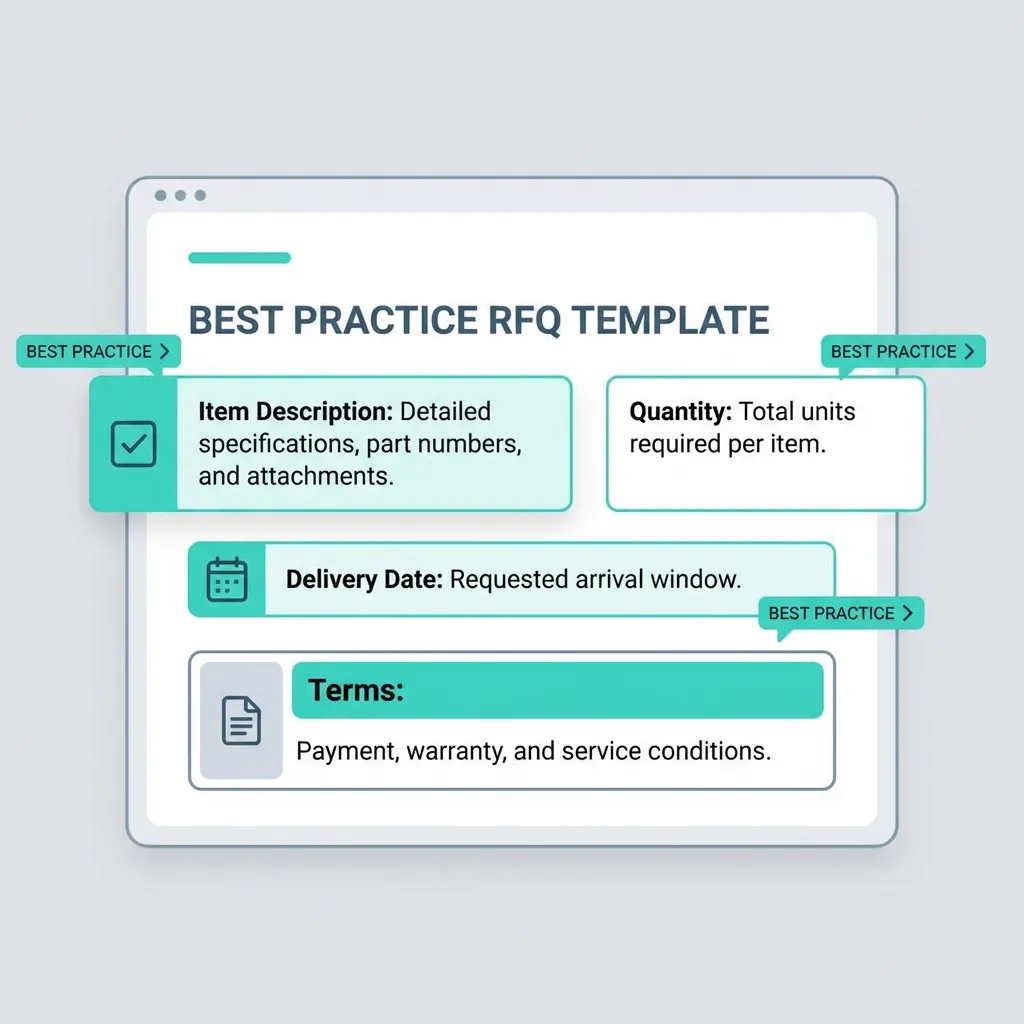
How to Write an RFQ (Template)
Learn how to write an effective RFQ that gets accurate, comparable pricing. Includes RFQ template and best practices.
Rhea Kapoor
Head of Procurement Research, SpecLens
- 850+companies trust SpecLens
- 99%extraction accuracy
- 8 hrssaved per comparison
- AES-256encrypted · GDPR compliant
A Request for Quotation (RFQ) is the most efficient way to get competitive pricing when you know exactly what you want. Unlike RFPs that evaluate solutions, RFQs focus on price comparison for defined specifications.
But a poorly written RFQ invites problems—inconsistent quotes, hidden fees, and apples-to-oranges comparison confusion. The research on custom-manufacturing quote accuracy finds that fewer than 25% of rapid quotes are even accurate enough to compare.
This comprehensive guide shows you how to write RFQs that generate accurate, comparable pricing — start from our free RFQ template if you'd rather not start from scratch.
What Is an RFQ?
An RFQ is a formal request for pricing from qualified vendors for specific goods or services.
RFQ vs. RFP vs. RFI
Understanding when to use each:
| Document | Purpose | Use When |
|---|---|---|
| RFI (Request for Information) | Gather market intelligence | Exploring options, early research |
| RFP (Request for Proposal) | Evaluate solutions and vendors | Complex needs, solution selection |
| RFQ (Request for Quotation) | Get pricing for defined specs | Specifications are clear, price is primary |
For more on document types, see our RFI vs RFQ vs RFP Guide.
When to Use an RFQ
RFQ is appropriate when:
| Criteria | Description |
|---|---|
| Specifications are defined | You know exactly what you want |
| Price is the primary differentiator | Qualified vendors are similar |
| Quantity is known | You can specify volume |
| Delivery is standard | Normal logistics apply |
| Quality is established | Standard or specified quality level |
Pro Tip: If you're still exploring options or need vendor guidance, use RFI or RFP first.
Benefits of a Well-Written RFQ
| Benefit | Description |
|---|---|
| Comparable quotes | Apples-to-apples pricing |
| Complete pricing | All costs visible |
| Faster process | Clear requirements, quick responses |
| Better negotiation | Understand pricing structure |
| Audit compliance | Documented competitive process |
RFQ Preparation Phase
Before writing the document, foundational work ensures success.
1. Internal Needs Assessment
Don't guess at requirements—verify them:
- End Users: What specifically do they need? What are the "must-haves" vs. "nice-to-haves"?
- Technical Team: Are there specific brands, materials, or compatibility requirements?
- Logistics: What are the receiving constraints (dock height, hours, forklift availability)?
- Finance: What is the budget? Are there capital vs. expense considerations?
2. Vendor Pre-Qualification
Ideally, send RFQs only to vendors you would be willing to buy from.
Pre-qualification criteria:
- Financial stability
- Quality certifications (ISO, etc.)
- Geographic coverage
- Past performance/references
- Capacity to deliver your volume
Sending to unqualified vendors wastes their time and yours.
3. Market Pricing Research
Have a baseline before you start:
- What is the rough market price?
- Are commodity prices (steel, oil, chips) currently volatile?
- Is there a supply shortage?
This context helps you evaluate the quotes you eventually receive.

RFQ Structure
Essential Components
Every RFQ should include:
| Section | Purpose |
|---|---|
| Introduction | Context, buyer information |
| Requirements overview | What you're buying |
| Detailed specifications | Exactly what's needed |
| Quantities | How much of each item |
| Delivery requirements | When and where |
| Pricing format | How to structure the quote |
| Terms and conditions | Business requirements |
| Submission instructions | How to respond |
| Timeline | Key dates |
| Contact information | For questions |
Detailed Specifications
The heart of the RFQ—be precise:
| Spec ID | Description | Specification | Required |
|---|---|---|---|
| SPEC-001 | Material | 316 stainless steel | Yes |
| SPEC-002 | Dimensions | 100mm x 50mm x 25mm ±0.5mm | Yes |
| SPEC-003 | Weight | Max 2.5 kg | Yes |
| SPEC-004 | Surface finish | Ra ≤ 1.6 μm | Yes |
| SPEC-005 | Certification | ISO 9001 compliant | Yes |
Specification Best Practices
| Do | Don't |
|---|---|
| Use measurable specifications | Use vague descriptions |
| Specify tolerances | Leave precision ambiguous |
| Reference standards (ASTM, ISO) | Assume shared understanding |
| Include drawings/diagrams | Describe complex shapes in text only |
| Note equivalents if accepted | Limit to single brand without justification |
Quantity Requirements
| Item | Quantity | Notes |
|---|---|---|
| Widget A | 500 units | Initial order |
| Widget B | 250 units | Initial order |
| Annual estimated volume | 2,000 units/year | For pricing consideration |
Volume considerations:
- Initial order quantity
- Annual estimated volume
- Minimum order quantities acceptable
- Order frequency
- Volume discount tiers if applicable
Delivery Requirements
| Requirement | Specification |
|---|---|
| Delivery location | [Address] |
| Incoterms | FOB Destination / DAP / etc. |
| Lead time required | X weeks from order |
| Packaging requirements | [If specific] |
| Partial shipments | Accepted / Not accepted |
Pricing Format
Standardize how vendors quote:
| Item | Description | Unit Price | Extended Price (Qty × Unit) |
|---|---|---|---|
| 1 | Widget A (500 units) | $____ | $____ |
| 2 | Widget B (250 units) | $____ | $____ |
| 3 | Shipping | N/A | $____ |
| 4 | Other fees (specify) | N/A | $____ |
| Total Quote | $____ |
Critical: Require all costs be listed. Ask vendors to explicitly confirm "no additional fees beyond those listed."
Terms and Conditions
| Term | Specification |
|---|---|
| Payment terms | Net 30 / Net 60 / etc. |
| Warranty | Minimum requirements |
| Returns | Policy requirements |
| Quote validity | Days quote must be held |
| Insurance | Requirements if applicable |
| Compliance | Regulatory requirements |
Submission Requirements
| Element | Specification |
|---|---|
| Submission deadline | Date and time (include timezone) |
| Submission format | Email / Portal / Mail |
| Required documents | Quote form, certifications, etc. |
| Questions deadline | Cut-off for inquiries |
| Contact for questions | Name, email, phone |
RFQ Communication Protocol
How you manage communication during the open RFQ period affects the quality of responses and fairness of the process.
Managing Vendor Questions
Vendors will (and should) have questions.
Best practices for Q&A:
- Single Point of Contact: Designate one person to handle all communication to prevent mixed messages.
- Written Only: Require questions in writing to maintain a trail.
- Shared Answers: If a vendor asks a clarifying question that changes the scope, share that answer with ALL vendors. This ensures a level playing field.
- Deadlines: Enforce the "questions due by" date so you aren't fielding inquiries an hour before the submission deadline.
Amendments and Addenda
If you discover a mistake in your specs or need to change a requirement:
- Issue a formal "Addendum" document
- Send it to all invited vendors simultaneously
- If minimal time remains, extend the submission deadline to allow them to adjust their quotes
Case Study: The Cost of Ambiguity
📋 Real-World Example
The Situation: A manufacturing manager needed 50 custom brackets fabricated.
The Bad RFQ:
"Quote for 50 steel brackets per attached drawing. Needed ASAP."
The Result:
- Vendor A quoted $2,500 (using mild steel, standard shipping)
- Vendor B quoted $5,000 (using high-grade tool steel, expedited 2-day manufacturing)
- Vendor C quoted $1,500 (using scrap steel, 6-week delivery)
The Problem: Quotes varied by 300% and were totally incomparable.
The Good RFQ:
"Quote for 50 brackets per drawing #1234, Rev B.
• Material: A36 Hot Rolled Steel
• Finish: Black Oxide
• Tolerance: ±0.010 inches
• Delivery: Required by [Date] to [Zip Code]
• Pricing: Include shipping."
The Result (Good RFQ):
- Vendor A quoted $2,600
- Vendor B quoted $2,850
- Vendor C quoted $2,400
Outcome: Precise, comparable quotes allowed for immediate decision based on price and vendor reliability.
Best Practices
Be Specific
Ambiguity creates comparison problems:
| Vague | Specific |
|---|---|
| "High quality" | "ASTM A123 Grade B" |
| "Fast delivery" | "Delivery within 2 weeks" |
| "Competitive pricing" | "Quote per unit with volume tiers" |
| "Standard packaging" | "Individual boxes with foam protection" |
Require Standard Format
When vendors quote differently, comparison is difficult:
| Problem | Solution |
|---|---|
| Different units | Specify units for quotes |
| Bundled vs. itemized | Require line-item pricing |
| Various terms | Specify required terms |
| Hidden fees | Require complete fee disclosure |
Include Volume Scenarios
If volume might vary, request tier pricing:
| Volume Tier | Request Pricing For |
|---|---|
| Minimum | Smallest likely order |
| Base | Expected typical order |
| Maximum | Largest potential order |
| Annual contract | If ongoing relationship |
Common RFQ Mistakes
Being Too Vague
| Mistake | Consequence |
|---|---|
| "High quality materials" | Different interpretations, incomparable quotes |
| "Reasonable delivery" | Varying lead times quoted |
| "Standard packaging" | Different protection levels |
Omitting Cost Categories
| Omission | Consequence |
|---|---|
| Not requesting shipping | Quotes incomparable until shipping added |
| Not mentioning setup fees | Surprise costs after selection |
| Not asking about minimums | Order flexibility issues |
Insufficient Timeline
| Problem | Consequence |
|---|---|
| Too short to respond | Fewer quotes received |
| No questions period | Incomplete quotes |
| Rushed evaluation | Comparison errors |
Evaluating RFQ Responses
Compliance Check
First, verify responses meet requirements:
| Checkpoint | Acceptable | Not Acceptable |
|---|---|---|
| All specs addressed | Complete response | Missing specifications |
| Required format used | Pricing table provided | Alternative format |
| Deadline met | On time | Late submission |
| Required documents | All included | Missing certifications |
Price Comparison
Standardize the response side-by-side with our Quote Comparison Template; for full lifecycle cost, run shortlisted vendors through the free TCO Calculator.
| Comparison Element | Method |
|---|---|
| Unit pricing | Direct comparison |
| Total pricing | Sum all costs |
| Volume pricing | Compare at your volume |
| Total cost of ownership | Include shipping, fees, ongoing costs (see TCO calculator guide) |
Post-RFQ Negotiation
The RFQ gives you the data, but the process isn't over — see our vendor negotiation strategies for the full playbook.
- Verification: Confirm the lowest bidder hasn't missed something. "Your quote is significantly lower than others—can you confirm your understanding of [Key Spec X]?" (Watch for RFP/RFQ response red flags here.)
- Leverage: If your preferred vendor is slightly more expensive, you now have hard data. "We prefer to work with you, but we have a qualified bid at X. Can you meet us halfway?"
- Final Terms: Lock in pricing agreements for a set period (e.g., "Pricing valid for 12 months") to prevent price creep after the initial order.
Write RFQs That Work
A well-written RFQ generates the competitive, comparable pricing you need for confident purchasing decisions. Invest time in clear specifications and standard formats — pair this with a specification gap analysis on every response — it pays back in better vendor responses and easier evaluation.
Free RFQ Template → | Quote Comparison Template → | RFI vs RFQ vs RFP Guide →
Frequently Asked Questions
Related Articles
RFI vs RFQ vs RFP Explained
Learn the differences between RFI, RFQ, and RFP documents. Understand when to use each procurement request type for effective vendor engagement and selection.
RFP Evaluation Matrix Template
Learn how to build an RFP evaluation matrix for objective vendor proposal scoring. Includes weighting guide, scoring scales, and downloadable template.
RFP Compliance Checklist
Use this RFP compliance checklist to verify vendor proposals meet your requirements. Systematic verification for fair evaluation.
RFP Response Red Flags to Watch
Learn to spot RFP response red flags that indicate vendor problems. Identify warning signs to avoid bad vendor selections.