
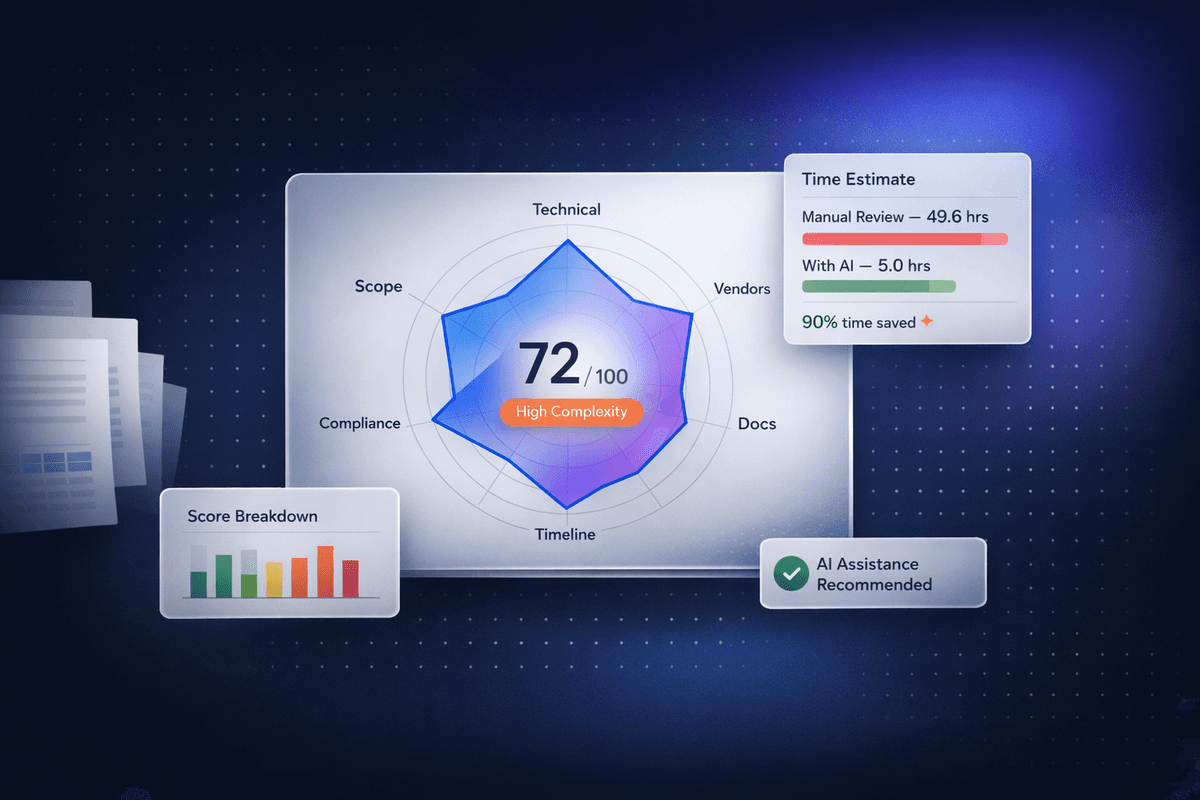
The RFP Complexity Analyzer scores any RFP or RFQ for review complexity and estimates how long manual vendor evaluation will take. Complex RFPs with 50+ requirements and multiple technical sections can take 8–12 hours per vendor to evaluate manually — this tool identifies which documents warrant AI-assisted comparison and which can be processed with standard templates.
RFP/RFQ Complexity Analyzer
Score the complexity of your procurement, estimate manual review time, and see how AI can help. All calculations are fully transparent.
How specialized or technical are the requirements?
Size and breadth of the procurement
How tight is the evaluation deadline?
Regulatory, legal, or certification requirements
High
Requires senior oversight and structured evaluation framework
Manual Review
4.6 days
~36.7 hours total
With SpecLens AI
4 hrs
~3.7 hours total
Time Saved
33.0 hours
Consider AI Assistance
SpecLens can help you compare vendor specs in minutes, not hours. Explore all our free procurement tools.
View pricing plansScoring Methodology
How we calculate RFP complexity — fully transparent
Score =
(Technical × 25%) + (Scope × 20%) + (Vendors × 15%) +
(Documentation × 20%) + (Timeline × 10%) + (Compliance × 10%)
Each factor is scored 1-10 based on user inputs. Weights are based on government procurement evaluation standards (DAU, DOE).
Manual Hours = Total Pages × 2.5 min/page × Vendors × Complexity Multiplier
AI Hours = Manual Hours × (1 - 90%)
Manual Review Benchmark
2.5 minutes per page for technical document review (legal/procurement standard)
AI Efficiency
90% time reduction based on AI tender analysis research (ContraVault, Shadhinlab)
| Source | Year | Finding | Used For |
|---|---|---|---|
| Loopio / APMP 2026 RFP Trends & Benchmarks | 2026 | Average RFP response time: 25 hours; 64% complete in 10 days or less; based on 1,500+ companies and 250,000+ RFPs | Response time & volume benchmarks |
| NIGP — RFP Global Best Practices | 2024 | RFP complexity frameworks and best practice guidance for public procurement solicitations | Complexity scoring framework |
| GovLoop / Euna Solutions | 2024 | Average 4 vendor submissions per RFP project | Default vendor count |
| McKinsey & Company | 2025 | AI agents could make procurement functions 25–40% more efficient; repurposing teams from routine tasks to strategic decisions | AI efficiency improvement benchmark |
| CIPS — Procurement Specifications Guide | 2024 | Effective procurement specifications cover functional requirements, technical standards, quality criteria, compliance, and commercial terms | Specification complexity dimensions |
| DAU (Defense Acquisition University) | 2024 | Complexity factors: technical risk, performance risk, labor mix, contract type | Complexity factor definitions |
| US Department of Energy | 2024 | Past performance evaluated by similarity in size, scope, and complexity | Evaluation criteria framework |
| RFP Timeline Research | 2024 | RFP evaluation phase: 1-4 weeks typical, most unpredictable phase | Timeline estimation |
When to Use AI-Assisted RFP Evaluation
Not every RFP needs AI. Use your complexity score to decide the right approach.
AI recommendation: Optional — saves time but not critical
AI recommendation: Recommended — reduces errors and saves 3–5x time
AI recommendation: Strongly recommended — manual process comparison
Example: A healthcare IT department evaluating 5 EMR vendors against a 200-page RFP with HIPAA compliance requirements scores ~72 on the complexity scale. Manual evaluation: 6+ work days. With AI-assisted comparison: under 1 day.
RFP Complexity by Industry
Typical complexity ranges based on APMP procurement frameworks and industry compliance requirements. Use these to benchmark your score.
| Industry | Typical Score |
|---|---|
| Healthcare | 60–80 |
| Aerospace & Defense | 70–90 |
| Construction | 45–65 |
| IT & Data Center | 50–70 |
| Manufacturing | 50–70 |
| Energy & Utilities | 60–80 |
Ranges are directional benchmarks based on APMP complexity frameworks and typical industry compliance requirements. Actual complexity depends on specific project scope and requirements.
Frequently Asked Questions
Common questions about RFP complexity scoring and vendor evaluation time.
What is an RFP Complexity Analyzer?
An RFP Complexity Analyzer evaluates the technical and structural complexity of a Request for Proposal (RFP) or Request for Quotation (RFQ). It analyzes factors such as the number of technical specifications, vendor qualification requirements, compliance clauses, evaluation criteria, and attachments — producing a complexity score used to estimate manual review time, prioritize procurement resources, and determine whether AI-assisted vendor evaluation would provide significant time savings.
What makes an RFP complex?
RFP complexity is driven by five key dimensions: (1) Specification depth — number of distinct technical requirements and measurable parameters; (2) Vendor qualification requirements — certifications, financial thresholds, experience criteria; (3) Compliance burden — regulatory, legal, and contractual clauses each vendor must address; (4) Evaluation criteria — number of scored dimensions and weighting complexity; (5) Document volume — total page count and number of required attachments. Aligned with APMP (Association of Proposal Management Professionals) best practices, each dimension is weighted and aggregated into a composite complexity score from 1 to 10.
How does complexity score affect RFP review time?
According to APMP benchmarks, manual RFP review time scales significantly with complexity. A low-complexity RFP (score 1–3, fewer than 20 requirements) takes 1–2 hours per vendor to evaluate. A medium-complexity RFP (score 4–6, 20–50 requirements) takes 3–6 hours per vendor. A high-complexity RFP (score 7–10, 50+ requirements with multiple compliance layers) can take 8–16+ hours per vendor. For a 5-vendor evaluation at high complexity, total manual review time can reach 40–80 hours — the equivalent of a full work week.
How can I reduce RFP complexity?
To reduce RFP complexity and evaluation burden: Consolidate requirements by eliminating duplicate or overlapping specifications; Simplify evaluation criteria by focusing on must-have vs. nice-to-have dimensions; Use standardized evaluation templates aligned with industry frameworks like APMP or NIGP classification codes; Limit attachments by specifying maximum page counts for vendor responses; and Adopt AI-assisted evaluation tools like SpecLens to reduce per-vendor review time from hours to minutes regardless of complexity level.
Is the RFP Complexity Analyzer free to use?
Yes, the RFP Complexity Analyzer is completely free. No account, login, or signup is required. Enter your RFP details and get an instant complexity score with estimated review time per vendor and AI-powered recommendations for streamlining your evaluation process.
How many vendors should I evaluate in an RFP?
According to GovLoop research, the average RFP receives 4 vendor submissions. Best practice is to evaluate 3–5 vendors for most procurements: fewer than 3 limits competition and negotiating leverage, while more than 6 increases evaluation time exponentially without proportional improvement in outcome quality. For high-complexity RFPs (score 7+), consider a two-stage process — shortlist vendors via an RFI before issuing the full RFP to 3–4 qualified candidates.
What is the difference between an RFP, RFQ, and RFI?
An RFI (Request for Information) gathers general vendor capabilities and is used for market research before defining requirements. An RFQ (Request for Quotation) solicits pricing for well-defined specifications with minimal evaluation criteria. An RFP (Request for Proposal) is the most complex — it requests detailed technical proposals, requires evaluation across multiple weighted criteria, and typically involves compliance and qualification requirements. The RFP Complexity Analyzer is designed for RFPs and complex RFQs that require multi-dimensional vendor evaluation. For a deeper dive, see our complete RFI vs RFQ vs RFP guide.
Learn More About RFP Evaluation
Deep-dive guides on RFP scoring, evaluation frameworks, and procurement best practices.
Deep dive into how complexity dimensions are weighted and scored using APMP methodology.
Write clearer, less complex RFPs that get better vendor responses and faster evaluation.
Weighted scoring templates for consistent, objective vendor evaluation across complex RFPs.
Ensure every vendor response meets your mandatory compliance and regulatory requirements.
Warning signs to watch for when reviewing vendor proposals — vague answers, missing specs, and more.
When to use each procurement document type and how complexity differs across RFIs, RFQs, and RFPs.
Complete Your Procurement Workflow
The RFP Complexity Analyzer is one step in a data-driven procurement process. Use these free tools together to evaluate vendors faster.
Generate CIPS-aligned specification checklists before writing your RFP. Ensures you capture every requirement.
Create a checklistConvert your time savings into dollar savings. Uses BLS wage data to calculate the ROI of procurement automation.
Calculate ROIGo beyond purchase price. Calculate Total Cost of Ownership including maintenance, training, and disposal costs.
Calculate TCO