
AI in Procurement: The Complete 2026 Guide
Complete guide to AI in procurement. Learn how AI transforms sourcing, spec analysis, vendor evaluation, and automation.
Priya Sharma
Procurement Technology Lead, SpecLens
- 850+companies trust SpecLens
- 99%extraction accuracy
- 8 hrssaved per comparison
- AES-256encrypted · GDPR compliant
Key takeaways
- AI improves procurement across 5 areas: spec extraction, vendor comparison, RFP/RFQ drafting, contract review, and spend analytics.
- Organizations report 50% shorter procurement cycles and 15-30% lower costs after AI adoption.
- AI augments procurement professionals — it automates data entry so teams can focus on negotiation, supplier strategy, and risk.
- Implement AI in 5 phases: assess, select, pilot, integrate, scale and govern — most teams see ROI within 3-6 months.
- Mitigate AI risks (hallucinations, bias, data privacy) with enterprise-grade tools, human review checkpoints, and clear governance policies.
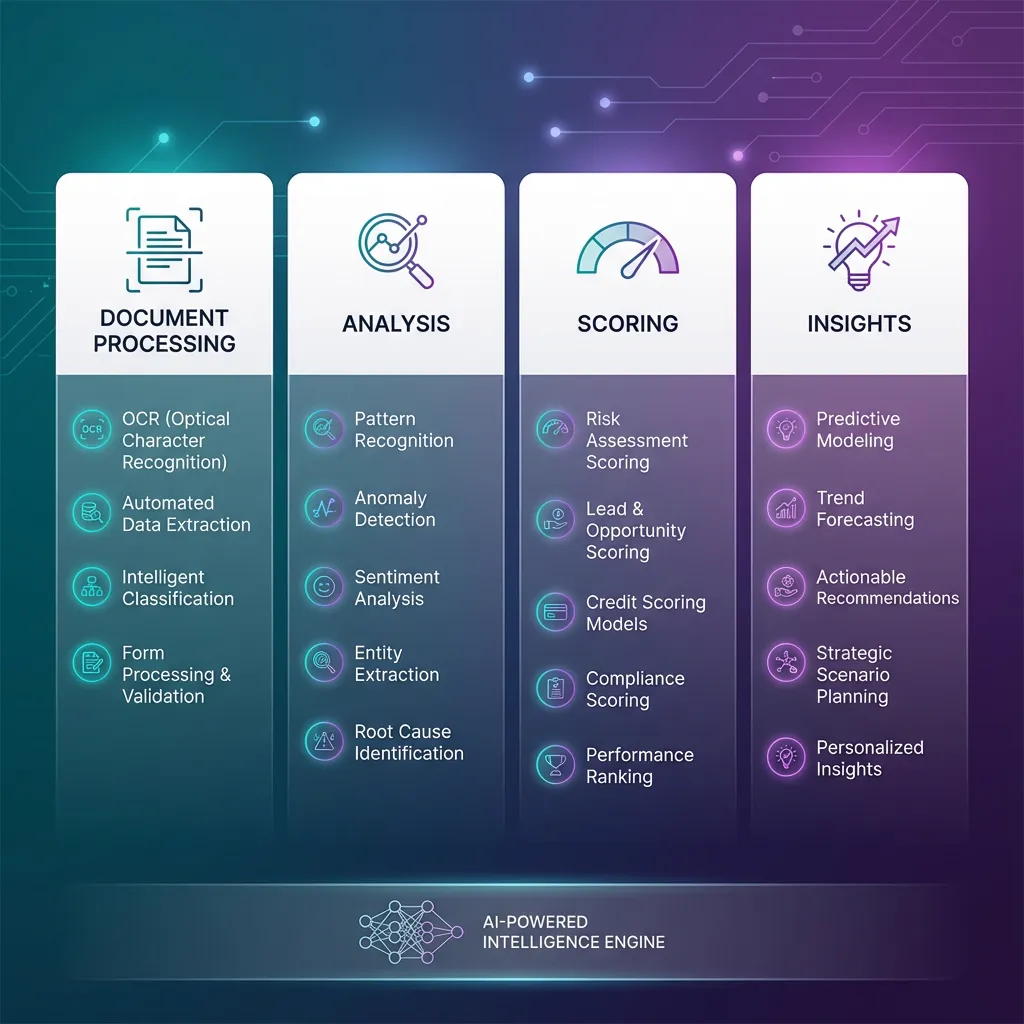
Artificial intelligence is transforming procurement—from how we find vendors to how we analyze proposals to how we make decisions. But separating meaningful AI applications from marketing hype requires understanding what AI can actually do and where it adds real value. For a head-to-head on the major assistants, see ChatGPT vs Claude vs Copilot for procurement.
This comprehensive guide covers practical AI applications in procurement, implementation considerations, and how to evaluate AI procurement tools. For the autonomous-agent layer beyond chatbots, jump to our agentic AI in procurement guide.
The AI Procurement Revolution
What's Actually Changed
AI enables capabilities that weren't practically possible before:
| Traditional Approach | AI-Enabled Approach |
|---|---|
| Manual document review | Automatic extraction and understanding |
| Spreadsheet comparisons | Intelligent comparison with normalization |
| Human-dependent analysis | Consistent, tireless processing |
| Sequential processing | Parallel processing at scale |
| Experience-based decisions | Data-informed recommendations |
| Reactive risk management | Predictive risk identification |
Why Now?
Several factors converged to make AI practical for procurement:
| Factor | Impact |
|---|---|
| Large Language Models | Can understand and process natural language documents |
| Cloud computing | Processing power available on demand |
| Data availability | Training data from procurement processes |
| Integration capability | APIs to connect with existing systems |
| Cost reduction | AI services increasingly affordable |
The Value Proposition
AI in procurement delivers:
| Benefit | Mechanism |
|---|---|
| Time savings | Automate manual analysis |
| Consistency | Same analysis every time |
| Scalability | Handle volume without proportional effort |
| Accuracy | Reduce human error |
| Insight | Pattern recognition across data |
| Speed | Compress evaluation timelines |
AI Applications in Procurement
Document Analysis
AI excels at reading and understanding procurement documents — and the gap between traditional OCR and AI-native extraction is wider than most teams realize (see OCR vs AI document analysis):
Specification Extraction
- Read vendor datasheets in any format
- Identify and extract technical specifications
- Normalize units and terminology
- Create structured comparison data
Proposal Analysis
- Parse long proposals for key information
- Match responses to requirements
- Identify gaps and non-compliance
- Summarize for evaluation
Contract Review
- Identify key terms and clauses
- Flag unusual or risky provisions
- Compare to standard terms
- Track obligations
Vendor Comparison
AI transforms how we compare product specifications across vendors, and how procurement teams build AI vendor scoring systems on top of that:
| Capability | Description |
|---|---|
| Multi-vendor normalization | Align different formats and terminology |
| Side-by-side matrices | Automatic comparison table generation |
| Gap detection | Identify what's missing across vendors |
| Specification scoring | Objective capability comparison |
| Requirements mapping | Match vendor responses to your needs |
Spend Analysis
AI analyzes procurement spend patterns:
| Analysis | Insight |
|---|---|
| Category identification | Classify spend by type |
| Maverick spending | Identify off-contract purchases |
| Savings opportunities | Find consolidation possibilities |
| Price trending | Track pricing changes |
| Vendor performance correlation | Link spend to outcomes |
Market Intelligence
AI can process external information:
| Intelligence Type | Application |
|---|---|
| Supplier risk monitoring | Track news, financial indicators |
| Price benchmarking | Compare to market rates |
| Vendor landscape | Identify alternative suppliers |
| Regulatory changes | Monitor compliance requirements |
| Innovation tracking | Discover new solutions |
Risk Assessment
AI predicts and identifies risks — pair this with the human-driven framework in our vendor risk assessment framework:
| Risk Area | AI Capability |
|---|---|
| Supplier risk | Financial, operational indicators |
| Price risk | Volatility prediction |
| Compliance risk | Regulatory change monitoring |
| Delivery risk | Lead time and availability forecasting |
| Quality risk | Defect prediction from patterns |
How AI Changes Procurement Workflows
Sourcing
Before AI:
- Manually research potential vendors
- Collect and review capability information
- Create shortlist through discussion
- Significant time investment per category
With AI:
- AI identifies potential vendors from databases
- Automatic capability extraction and comparison
- Data-driven shortlist recommendation
- Hours instead of days
Specification Comparison
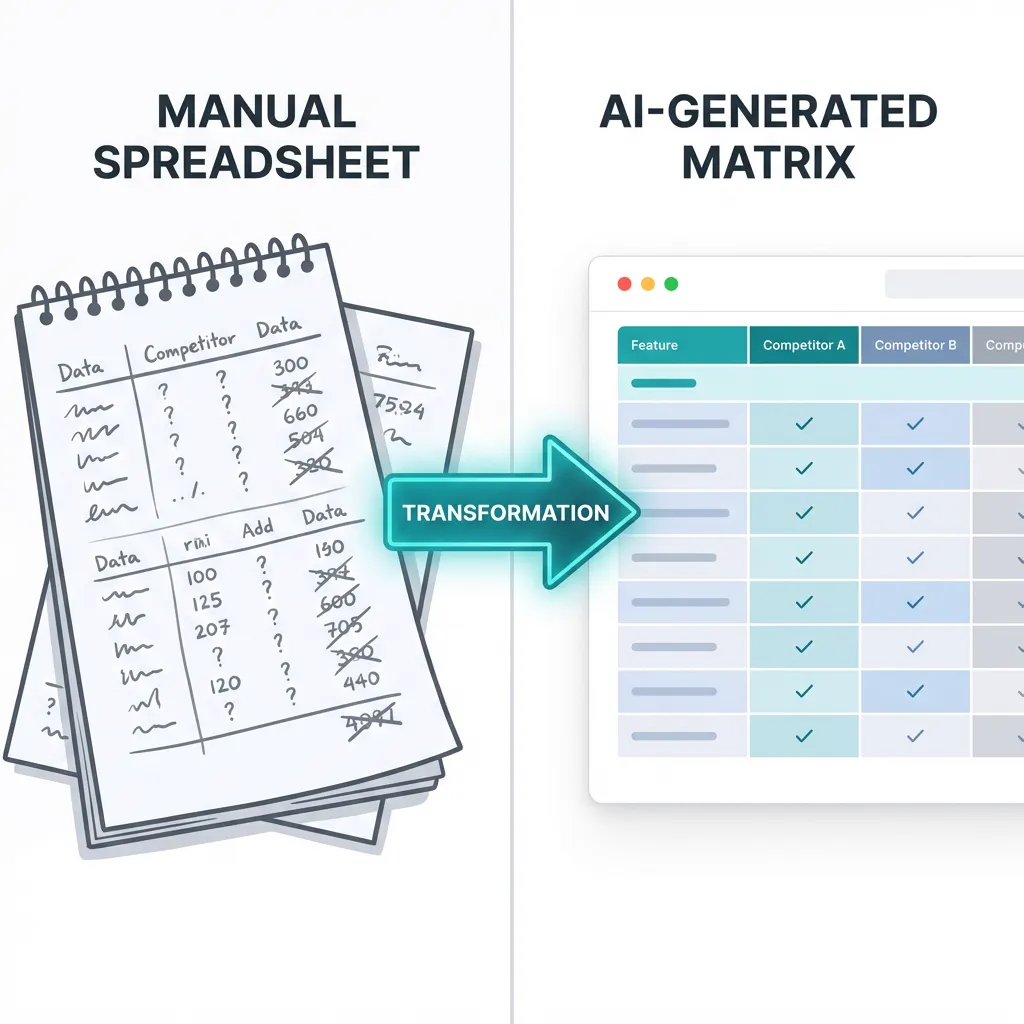
Before AI (the manual workflow we break down in vendor datasheet comparison methods):
- Receive vendor datasheets (different formats)
- Manually extract specifications to spreadsheet
- Normalize units and terminology
- Create comparison matrix
- Identify gaps manually
- 4-8 hours per vendor
With AI:
- Upload vendor documents
- AI extracts and normalizes specifications
- Comparison matrix generated
- Gaps highlighted automatically
- 15-30 minutes total
- Savings: 85-95%
Proposal Evaluation
Before AI:
- Read through entire proposal
- Track requirements manually
- Note compliance status
- Create evaluation summary
- Repeat for each vendor
With AI:
- Upload all proposals
- AI maps to requirements
- Compliance status generated
- Key information extracted
- Summary and comparison provided
Implementing AI in Procurement
Assessment Phase
Before implementing AI, understand your situation — Deloitte found 74% of procurement leaders say their data isn't AI-ready, so start with procurement AI data readiness:
| Question | Why It Matters |
|---|---|
| What processes are most manual? | Prioritize high-impact areas |
| Where is quality suffering? | AI can improve consistency |
| What data do we have? | AI needs data to work |
| What systems exist? | Integration requirements |
| What skills does the team have? | Training needs |
| What's our risk tolerance? | Deployment approach |
Common Implementation Approaches
For a buyer's-guide view of platforms in each row below, see best procurement software 2026.
| Approach | Description | Best For |
|---|---|---|
| Point solution | Single-purpose AI tool | Specific pain point |
| Platform enhancement | Add AI to existing platform | Current system investment |
| Full platform | AI-native procurement platform | Major transformation |
| Build custom | Develop proprietary AI | Unique requirements |
Change Management
AI implementation changes how people work:
| Concern | Response |
|---|---|
| Job replacement fear | Reframe as enablement, not replacement |
| Skill gaps | Training and support |
| Trust in AI | Transparency about how AI works |
| Process change | Clear benefits communication |
| Quality concerns | Human oversight maintained |
Measuring Success
Track AI implementation results — and quantify the savings ahead of time with our free Procurement ROI Calculator (methodology in the Procurement Automation ROI Guide):
| Metric | How to Measure |
|---|---|
| Time savings | Before/after process time |
| Accuracy improvement | Error rate comparison |
| Coverage increase | More vendors evaluated |
| User adoption | Tool usage metrics |
| Decision quality | Outcome tracking |
| ROI | Value delivered vs. investment |
AI Limitations in Procurement
Understanding limitations prevents disappointment and misuse.
What AI Doesn't Do Well
| Limitation | Implication |
|---|---|
| Subjective judgment | Still needs human decision-making |
| Relationship assessment | Can't evaluate vendor fit |
| Novel situations | Trained on patterns, struggles with unique |
| Negotiation | Human skill still required |
| Strategic decisions | AI informs but doesn't replace judgment |
| Context outside data | Can't know what's not in documents |
Data Quality Dependency
AI is only as good as its inputs:
| Data Issue | Impact |
|---|---|
| Incomplete documents | Incomplete extraction |
| Poor document quality | Extraction errors |
| Inconsistent data | Comparison challenges |
| Missing context | Misinterpretation possible |
| Outdated information | Inaccurate conclusions |
Hallucination Risk
AI can generate incorrect information — which is why SpecLens links every extracted spec back to its source page (see also GenAI for vendor comparison on hallucination-resistant approaches):
| Risk | Mitigation |
|---|---|
| Invented details | Verify against source documents |
| Confident wrong answers | Always validate important claims |
| Pattern extrapolation | Check that inferences are valid |
Best practice: Use AI as draft/acceleration, not as final authority.
Evaluating AI Procurement Tools
Questions to Ask Vendors
| Question Category | Specific Questions |
|---|---|
| Capability | What exactly can the AI do? How accurate? |
| Data | What data is used for training? Is my data used? |
| Security | How is data protected? Where is it processed? |
| Integration | What systems does it connect to? |
| Validation | How can I verify AI outputs? |
| Transparency | Can I see how conclusions are reached? |
| Support | What training and support is provided? |
| Roadmap | What's the development direction? |
Red Flags
| Warning Sign | Concern |
|---|---|
| "Magic" claims | Overstated capabilities |
| No accuracy metrics | Can't measure what they won't quantify |
| Opaque processing | Can't verify how it works |
| No source citations | Can't validate claims |
| Requires all your data | Privacy and security risk |
| No human override | Over-reliance on AI |
SpecLens: AI for Specification Comparison
SpecLens applies AI specifically to the specification comparison challenge:
| Capability | How It Works |
|---|---|
| Document upload | Any format: PDF, Word, Excel |
| Specification extraction | AI reads and structures data |
| Normalization | Units and terminology aligned |
| Comparison matrix | Side-by-side vendor view |
| Gap detection | Missing specs highlighted |
| Source citation | Every extraction linked to source |
Why specification comparison?
This is where manual effort is highest and AI value is clearest:
- Documents are in different formats
- Terminology varies across vendors
- Manual comparison takes hours
- Errors are easy to make
- Consistency is hard to maintain
The Future of AI in Procurement
Emerging Capabilities
| Capability | Status | Potential |
|---|---|---|
| Autonomous negotiation | Early research | AI-assisted negotiation |
| Real-time market pricing | Emerging | Dynamic price optimization |
| Predictive vendor issues | Developing | Proactive risk management |
| Natural language procurement | Improving | Conversational interfaces |
| Cross-system intelligence | Evolving | Unified procurement insight |
How to Prepare
| Preparation | Action |
|---|---|
| Data quality | Clean and structure procurement data |
| Process documentation | Understand current workflows |
| Skills development | Build AI literacy in team |
| Pilot experience | Start small, learn, expand |
| Vendor relationships | Discuss AI-enabled processes |
AI Ethics and Bias in Algorithms
Algorithms can be biased. Procurement must not blindly follow the machine.
The "Historical Data" Problem:
If you train an AI on 10 years of your company's data, and you never hired minority-owned businesses in those 10 years, the AI learns that "Good Vendor = Not Minority Owned."
Mitigation: Use models trained on diverse, global datasets, or "blind" scoring where vendor identity is hidden from the scoring algorithm.
Explainability (XAI):
You must be able to explain why the AI flagged a vendor as high risk. "Computer says no" is not an acceptable audit response. Demand tools that show the "Why" (features contributing to the score).
Predictive Analytics for Supply Chain Resilience
Descriptive AI tells you what happened. Predictive AI tells you what will happen — see supply chain resilience strategy 2026 for the full playbook.
Financial Distress Prediction:
Before a vendor goes bankrupt, they pay bills late, lose key staff, and get sued. AI monitors thousands of data points to give you a "Distress Score" 6 months before the collapse.
Geopolitical Risk:
AI monitors news and weather. "A typhoon is forming near your Tier 2 chip supplier in Taiwan. Estimated delay: 4 weeks."
Action: Use this 3-day head start to secure inventory from your backup supplier in Mexico before your competitors do.
Data Quality: Garbage In, Garbage Out
AI amplifies data quality issues. If your historical PO data says "Vendor A" in one system and "Vendor A Inc." in another, the AI sees two vendors.
The Data Clean-Up Mandate:
Before deploying AI, you must execute a Master Data Management (MDM) strategy.
- Standardization: UNSPSC codes for all items.
- Hierarchy: Linking "IBM France" and "IBM USA" to "IBM Parent."
- Enrichment: Adding DUNS numbers to every record.
Without this, your AI insights will be statistically hallucinations.
The Future Workforce: The "Prompt Engineer" Buyer
The job description of a buyer is changing.
- Old Skill: Excel Wizardry.
- New Skill: Prompt Engineering.
- The Role: Buyers will become "Procurement Architects." They won't write the RFP; they will design the process that the AI uses to write the RFP. They will audit the AI's logic, not its math. This shifts the career path from "Administrative" to "Strategic" much earlier in a professional's tenure.
Start Your AI Procurement Journey
AI transforms procurement from manual data processing to insight-driven decision making. Start with high-impact, low-risk applications like specification comparison, then expand as capabilities and confidence grow. For an industry-specific lens, see our AI Equipment Procurement Guide and procurement intake management — the front-door layer most teams add next.
See How SpecLens Works → | SpecLens Features → | Free Specification Checklist Generator →
References
- 1.Gartner — Procurement & Sourcing Operations Research — Generative AI and large language model adoption in procurement and sourcing
- 2.McKinsey Global Institute — AI & Analytics Insights — AI adoption in business operations and procurement transformation
- 3.ISM — Institute for Supply Management — Procurement technology adoption and AI in supply management
Frequently Asked Questions
Related Articles
Agentic AI in Procurement: Beyond ChatGPT (2026 Guide)
GenAI is in Gartner's Trough of Disillusionment. Agentic AI is the real shift — learn how autonomous procurement agents work, which platforms are leading, and why 74% of teams can't use them yet.
How to Compare Vendor Proposals with AI: 2026 Playbook
A 7-step AI-assisted workflow for vendor proposal comparison — replacing 8 hours of manual matrix-building with roughly 20 minutes of citation-backed analysis. Tool tradeoffs, normalization, gap analysis.
AI Vendor Scoring Systems
Learn how AI vendor scoring systems work for objective evaluation. Balance automation with human judgment for better procurement.
ChatGPT vs Claude vs Copilot for Procurement
Compare ChatGPT, Claude, and Copilot for procurement. Learn which AI works best for document analysis and vendor evaluation.