
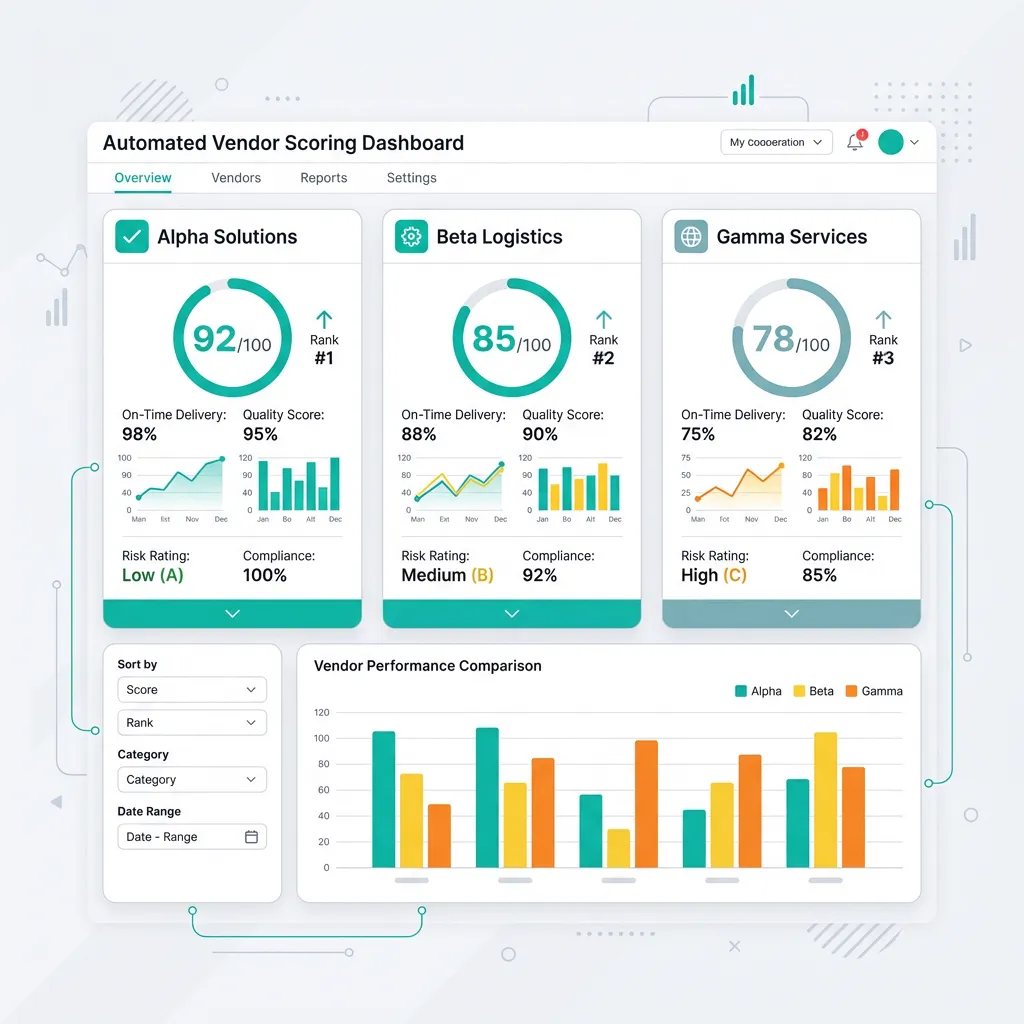
AI Vendor Scoring Systems
Learn how AI vendor scoring systems work for objective evaluation. Balance automation with human judgment for better procurement.
Priya Sharma
Procurement Technology Lead, SpecLens
- 850+companies trust SpecLens
- 99%extraction accuracy
- 8 hrssaved per comparison
- AES-256encrypted · GDPR compliant
Human evaluation of vendors is subjective, inconsistent, and time-consuming. Different evaluators weight factors differently. The same evaluator may score differently on different days. Fatigue, familiarity, and first impressions all introduce bias. (Reduce that variance first with the structured framework in RFP evaluation matrix scoring before adding AI on top.)
AI-powered scoring systems promise objectivity, speed, and consistency. But how do they actually work, when should you trust them, and what are their limitations? (For broader context: AI in procurement: complete 2026 guide and agentic AI in procurement; for the data-quality prerequisite, procurement AI data readiness.)
Why Vendor Scoring Matters
The Challenge of Objective Evaluation
| Problem | Impact |
|---|---|
| Volume | Organizations evaluate dozens of vendors per category—manual evaluation doesn't scale |
| Consistency | Same vendor, different day = different score |
| Evaluator variance | Different people score same vendor differently |
| Order effects | First vs. last evaluated affects judgment |
| Bias | Familiarity, presentation quality, and recency affect scores |
The Cost of Poor Vendor Selection
| Problem | Cost Impact |
|---|---|
| Performance shortfall | Missed requirements, workarounds |
| Reliability issues | Downtime, disruption |
| Support failures | Unresolved problems, delays |
| Integration difficulties | Additional costs, project delays |
| Vendor failure | Replacement, transition costs |
Key Insight: Better scoring = better selection = better outcomes.
How AI Vendor Scoring Works
Data Inputs
| Data Type | Examples | Source |
|---|---|---|
| Specifications | Technical specs, performance data | Datasheets, proposals |
| Pricing | Unit prices, TCO components | Quotes, pricing sheets |
| Qualifications | Experience, certifications | Self-disclosure, verification |
| Compliance | Requirement response completeness | RFP responses |
| Historical | Past performance, ratings | Internal records, references |
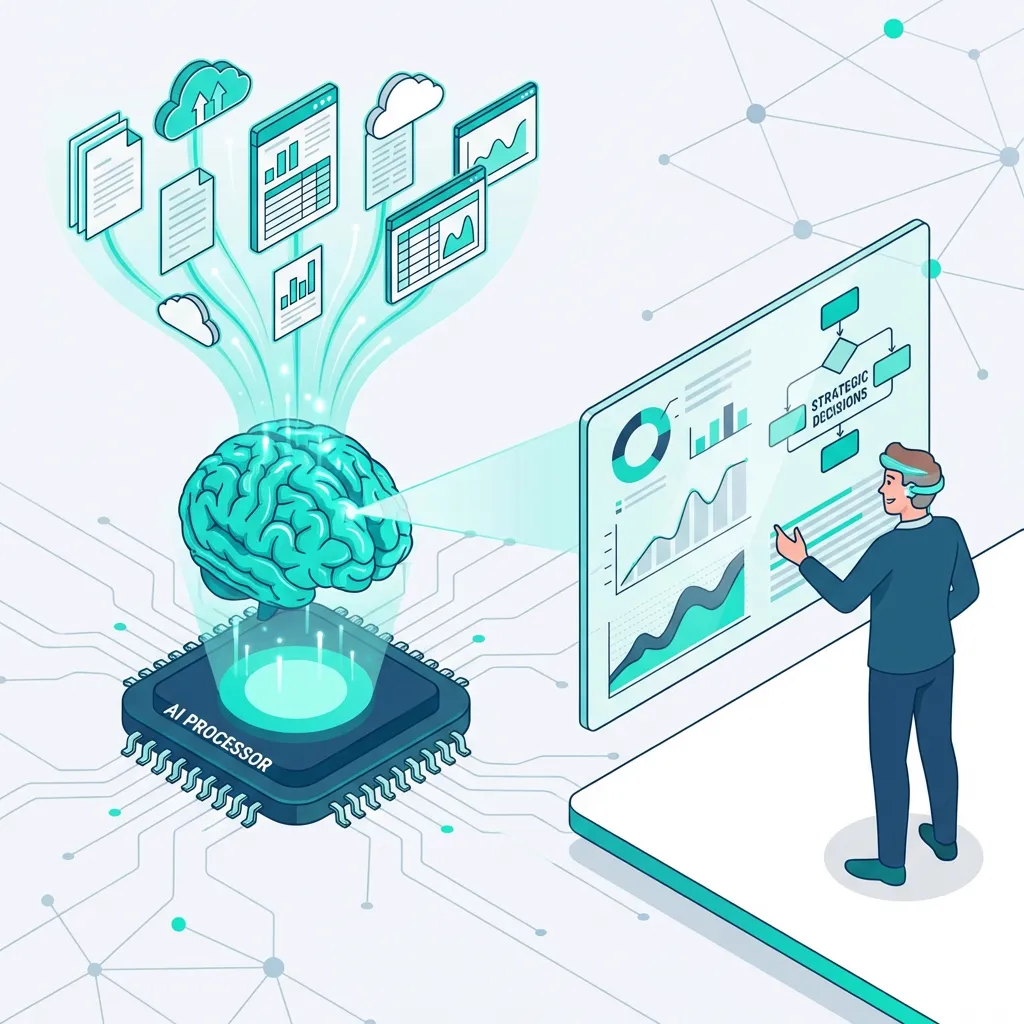
Scoring Algorithms
1. Weighted Criteria Scoring
| Criterion | Weight | Vendor A | Vendor B |
|---|---|---|---|
| Technical capability | 40% | 4.2 | 3.8 |
| Pricing competitiveness | 30% | 3.5 | 4.5 |
| Support quality | 20% | 4.0 | 3.0 |
| Financial stability | 10% | 4.5 | 3.5 |
| Weighted Score | 100% | 3.98 | 3.80 |
2. Gap-Based Scoring
- Full compliance = maximum points
- Partial compliance = partial points
- Gap = zero or negative points
3. Comparative Ranking
- Best in category = highest points
- Others ranked against best
- Normalized across dimensions
Normalization Methods
| Normalization Need | Method |
|---|---|
| Different units | Convert to common standard |
| Different scales | Rescale to 0-1 or 0-100 |
| Different terminology | Map to canonical terms |
| Missing data | Handle consistently (penalty, neutral, estimate) |
| Outliers | Cap or adjust extreme values |
Benefits of AI Scoring
Speed Comparison
| Task | Manual Time | AI Time |
|---|---|---|
| Extract specs from 5 vendors | 5+ hours | Minutes |
| Create comparison matrix | 2+ hours | Seconds |
| Calculate weighted scores | 30+ minutes | Instant |
| Generate ranking | 15+ minutes | Instant |
Consistency Comparison
| Aspect | Human Evaluation | AI Evaluation |
|---|---|---|
| Day-to-day variance | Common | None |
| Evaluator variance | Significant | None |
| Order effects | Present | None |
| Mood effects | Present | None |
Limitations to Understand
⚠️ AI Can't Evaluate:
- Relationship quality and fit: No data to analyze
- Vendor culture and values: Subjective, qualitative
- Strategic alignment: Requires future projection
- Negotiation dynamics: Outside data scope
- "Something feels off": Intuition from experience
AI scoring should inform human decisions, not replace them.
Gaming Potential
| Gaming Risk | Example |
|---|---|
| Keyword stuffing | Using specific terms to match criteria |
| Threshold gaming | Meeting minimums exactly |
| Emphasis manipulation | Highlighting scored factors |
| Presentation optimization | Formatting for extraction |
Best Practices for Implementation
AI + Human Hybrid Approach
| AI Does | Human Does |
|---|---|
| Data extraction | Strategic fit assessment |
| Objective scoring | Reference validation |
| Gap identification | Final selection decision |
| Ranking generation | Negotiation approach |
| Documentation | Exception handling |
Adjust Weights for Context
| Context | Suggested Emphasis |
|---|---|
| Cost-sensitive projects | Heavy price weighting (40%+) |
| Mission-critical systems | Heavy reliability/quality weighting (50%+) |
| Fast-track implementations | Heavy timeline/support weighting |
| Strategic partnerships | Heavy capability/fit weighting |
Implementation Steps
- Define criteria and weights: Establish evaluation framework before using AI
- Collect vendor data: Ensure comprehensive, comparable data from all vendors
- Run AI analysis: Upload documents, review extraction accuracy, generate outputs
- Human review: Validate results, factor in qualitative considerations
- Learn and improve: Compare predictions to outcomes, adjust weights
Ethics of AI Scoring
⚖️ Ethical Considerations
- Black Box Problem: "The AI said so" is not a legal or ethical defense. You must explain the basis of scores.
- Bias Amplification: AI trained on historical data may replicate historical biases.
- Data Privacy: Use enterprise-grade tools that isolate customer data.
Score Vendors Objectively
AI scoring transforms vendor evaluation from subjective to systematic. Use it for data-heavy comparison while applying human judgment for strategic decisions — feed the outputs into a Vendor Scorecard Template for ongoing relationship management.
See How SpecLens Works → | Vendor Scorecard Guide → | Vendor Risk Assessment →
Frequently Asked Questions
Related Articles
OCR vs AI Document Analysis
Understand OCR vs AI document analysis for procurement. Learn which technology works better for spec extraction and comparison.
AI in Procurement: The Complete 2026 Guide
Complete guide to AI in procurement. Learn how AI transforms sourcing, spec analysis, vendor evaluation, and automation.
ChatGPT vs Claude vs Copilot for Procurement
Compare ChatGPT, Claude, and Copilot for procurement. Learn which AI works best for document analysis and vendor evaluation.
GenAI for Vendor Comparison (2026)
Discover how Generative AI is revolutionizing vendor comparison. From automated extraction to hallucination-free analysis, learn the future of procurement.