

Vendor Scorecard Guide: KPIs & Templates
Stop guessing about supplier performance. Use our data-driven framework and 5 core KPI categories to build an effective vendor scorecard.
David Chen
Senior Procurement Analyst, SpecLens
- 850+companies trust SpecLens
- 99%extraction accuracy
- 8 hrssaved per comparison
- AES-256encrypted · GDPR compliant
In 2026, you can't manage what you don't measure. A vendor scorecard isn't just a report card for your suppliers; it's your primary tool for strategic alignment, proactive risk mitigation, and driving continuous improvement across your supply base.
Moving beyond simple "price" and "delivery time" metrics, modern scorecards integrate sustainability performance, innovation contribution, and financial stability. Organizations that implement structured vendor scorecards report stronger supplier relationships, 15-25% reduction in supply chain risks, and improved negotiation leverage.
This comprehensive guide provides a blueprint for creating effective vendor scorecards—including the essential KPIs, best practices for implementation, and common pitfalls to avoid. Pair it with our free Vendor Scorecard Template to skip the spreadsheet setup.
What You'll Learn:
- What a vendor scorecard is and why it matters
- The 5 core KPI categories to include (with specific metrics)
- Best practices for designing, implementing, and reviewing scorecards
- Common pitfalls and how to avoid them
- A framework for using scorecards to drive improvement
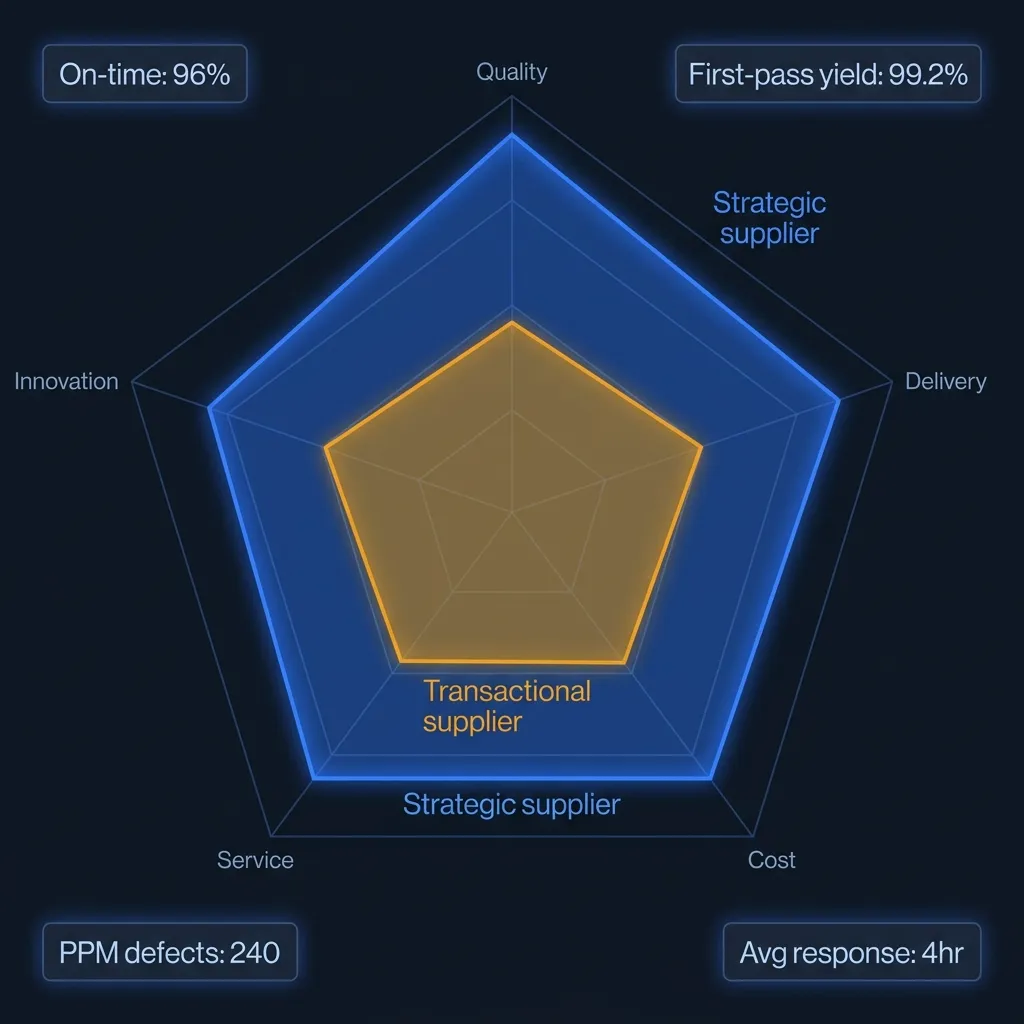
What Is a Vendor Scorecard?
A vendor scorecard (also known as a supplier scorecard or supplier performance scorecard) is a standardized document or tool used to evaluate and track the performance of your suppliers against pre-defined, measurable criteria. It provides an objective, data-driven basis for:
- Comparing supplier performance over time and against benchmarks.
- Identifying underperforming suppliers and areas for improvement.
- Making informed decisions about contract renewals, expansions, or terminations.
- Strengthening relationships through transparent, collaborative feedback.
A well-designed scorecard moves your vendor management from subjective "gut feelings" to objective, quantifiable assessments. For practical tips on evaluating vendors, see our guide on IT vendor selection.
The 5 Core KPI Categories for Your Vendor Scorecard
Don't overwhelm yourself or your suppliers with 50 metrics. Focus on 5-10 core KPIs spanning these five essential pillars to get a balanced, holistic view of supplier health. Customize the weighting based on what matters most to your organization.
1. Quality (Suggested Weight: 25-30%)
Quality metrics measure whether the supplier delivers products or services that meet your specifications and standards.
- Defect Rate / Error Rate: The percentage of delivered items or services that are defective, rejected, or require rework.
- Spec Compliance: Adherence to technical specifications, drawings, or statements of work.
- Service Quality: For service providers, this includes accuracy of deliverables, quality of documentation, and responsiveness to quality issues.
- Customer Complaints: Number of internal or end-customer complaints attributable to the supplier.
2. Delivery Performance (Suggested Weight: 20-25%)
Delivery metrics assess the supplier's reliability in getting the right goods to the right place at the right time.
- On-Time, In-Full (OTIF): The gold standard metric—percentage of orders delivered on time and in the correct quantity.
- Lead Time Accuracy: How closely actual lead times match quoted or promised lead times.
- Lead Time Variability: Consistency of delivery windows (low variability is better for planning).
- Order Accuracy Rate: Percentage of orders shipped without incorrect items, quantities, or documentation errors.
3. Cost Competitiveness (Suggested Weight: 15-20%)
Cost metrics go beyond just the initial purchase price to assess overall value for money.
- Price Competitiveness: How the supplier's pricing compares to market benchmarks and alternative sources.
- Total Cost of Ownership (TCO): Inclusive of purchase price, logistics, warehousing, quality costs, and any hidden expenses. See our TCO Calculator Guide for the complete framework and our analysis of the true cost of manual procurement.
- Price Stability: Frequency and magnitude of price hike requests or invoice disputes.
- Cost Reduction Initiatives: Proactive proposals from the supplier for cost savings or value engineering.
4. Responsiveness and Communication (Suggested Weight: 10-15%)
These metrics assess how easy the supplier is to work with on a day-to-day basis.
- Responsiveness to Inquiries: Average time to respond to questions, quote requests, or issue reports.
- Issue Resolution Time: How quickly are problems resolved once raised?
- Communication Clarity: Quality and proactiveness of communication (e.g., advance notice of delays).
- Point of Contact Availability: Ease of reaching a knowledgeable representative.
5. Risk, Compliance, and Sustainability (Suggested Weight: 15-20%)
These metrics are increasingly critical in 2026, covering supplier risk and alignment with your ESG goals — see our vendor risk assessment framework for the structured workup, the sustainable procurement guide for ESG context, and the ESG Vendor Scorecard Template for a ready-made format.
- Financial Stability: Supplier's financial health (e.g., Dun & Bradstreet score, credit rating).
- Regulatory Compliance: Adherence to relevant laws, certifications (ISO 9001, ISO 27001, SOC 2), and contractual terms.
- Sustainability / ESG Performance: Carbon footprint, ethical labor practices, environmental certifications.
- Business Continuity Planning: Robustness of the supplier's disaster recovery and continuity plans.
| KPI Category | Example Metrics | Suggested Weight |
|---|---|---|
| Quality | Defect Rate, Spec Compliance | 25-30% |
| Delivery | OTIF, Lead Time Accuracy | 20-25% |
| Cost | TCO, Price Stability | 15-20% |
| Responsiveness | Issue Resolution Time | 10-15% |
| Risk & ESG | Financial Stability, ESG Score | 15-20% |
Best Practices for Implementing Vendor Scorecards
1. Be Transparent with Your Suppliers
Share the scorecard criteria, weighting, and review cadence with your vendors before you start grading them. A scorecard should be a roadmap for success, not a trap. This fosters a collaborative relationship and encourages suppliers to proactively improve.
2. Use a Standardized Rating Scale
Implement a consistent rating scale (e.g., 1-5 or 1-10) with clear descriptions for each level. This reduces subjectivity and makes it easier to compare performance across different suppliers and categories.
Example: 5 = Exceeds Expectations, 4 = Meets Expectations, 3 = Partially Meets, 2 = Below Expectations, 1 = Unacceptable.
3. Automate Data Collection Where Possible
Manual scorecards often die in spreadsheets. Integrate your ERP, procurement software, or quality management systems to automatically pull data like "On-Time Delivery Rate" or "Invoice Accuracy." This removes bias, saves hours of work, and ensures the scorecard is always based on current data — the same pattern as AI vendor scoring systems, and the data-readiness prerequisite is in procurement AI data readiness.
4. Establish a Regular Review Cadence
Set clear review intervals:
- Strategic Suppliers: Quarterly Business Reviews (QBRs) with formal scorecard discussion.
- Tactical Suppliers: Annual or semi-annual reviews.
Use the scorecard as the primary agenda item for these meetings to keep discussions focused on data, not feelings.
5. Focus on Trends, Not One-Offs
Analyze supplier performance over time to identify patterns and systemic issues rather than reacting to isolated incidents. A single late delivery might be an anomaly; three months of declining OTIF is a trend that needs action. Strong scorecards also inform vendor negotiations.
Common Pitfalls to Avoid
- Too Many Metrics: Don't try to measure everything. 5-10 focused KPIs are more actionable than 30 diluted ones.
- No Action Plan: A scorecard is only useful if low scores trigger a defined action (e.g., improvement plan, probation, or offboarding).
- One-Way Communication: Don't just grade suppliers—get their feedback too. What barriers are they facing?
- Static Templates: Review and update your KPIs annually to reflect changing business priorities (e.g., adding ESG metrics).
The Goal: Collaboration, Not Just Grading
The ultimate goal of a vendor scorecard isn't to fire suppliers who score a "C". It's to use objective data to help them become "A" players. Use scorecard insights to build joint improvement plans and unlock mutual growth.
Conclusion: Start Measuring Today
A well-implemented vendor scorecard is one of the highest ROI activities in procurement. It provides clarity, enables better negotiations, de-risks your supply chain, and strengthens the partnerships that matter most.
Start by identifying your 5 most critical suppliers, defining your top 5 KPIs, and creating a simple template. From there, you can iterate, automate, and expand.
Validate Vendor Performance Instantly
Review vendor specs and proposals against your initial requirements in seconds. Ensure you get exactly what you paid for with SpecLens.
Start Analyzing VendorsReferences
- 1.CIPS — Chartered Institute of Procurement & Supply — Supplier performance measurement and vendor scorecard standards
- 2.ISM — Institute for Supply Management — Supplier evaluation frameworks and scoring methodology
Frequently Asked Questions
Related Articles
Vendor Risk Assessment Framework
Protect your organization with systematic vendor risk assessment. Frameworks and checklist for financial, operational, and compliance risk.
Compare Product Specifications (2026)
Master product specification comparison with proven strategies for vendor proposals and technical documents. Step-by-step guide for procurement teams.
How to Write an RFP: 2026 Guide
Complete RFP writing guide for 2026. Learn the 10 essential components, step-by-step process, and templates that get quality vendor responses.
Vendor Negotiation: 6 Strategies for 2026
Negotiate better deals with suppliers using these 6 proven strategies. Save costs, secure better terms, and build stronger vendor relationships.