

The True Cost of Manual Procurement
Manual processes are bleeding your budget. We analyze the hidden costs of human error, slow processing, and employee burnout.
Rhea Kapoor
Head of Procurement Research, SpecLens
- 850+companies trust SpecLens
- 99%extraction accuracy
- 8 hrssaved per comparison
- AES-256encrypted · GDPR compliant
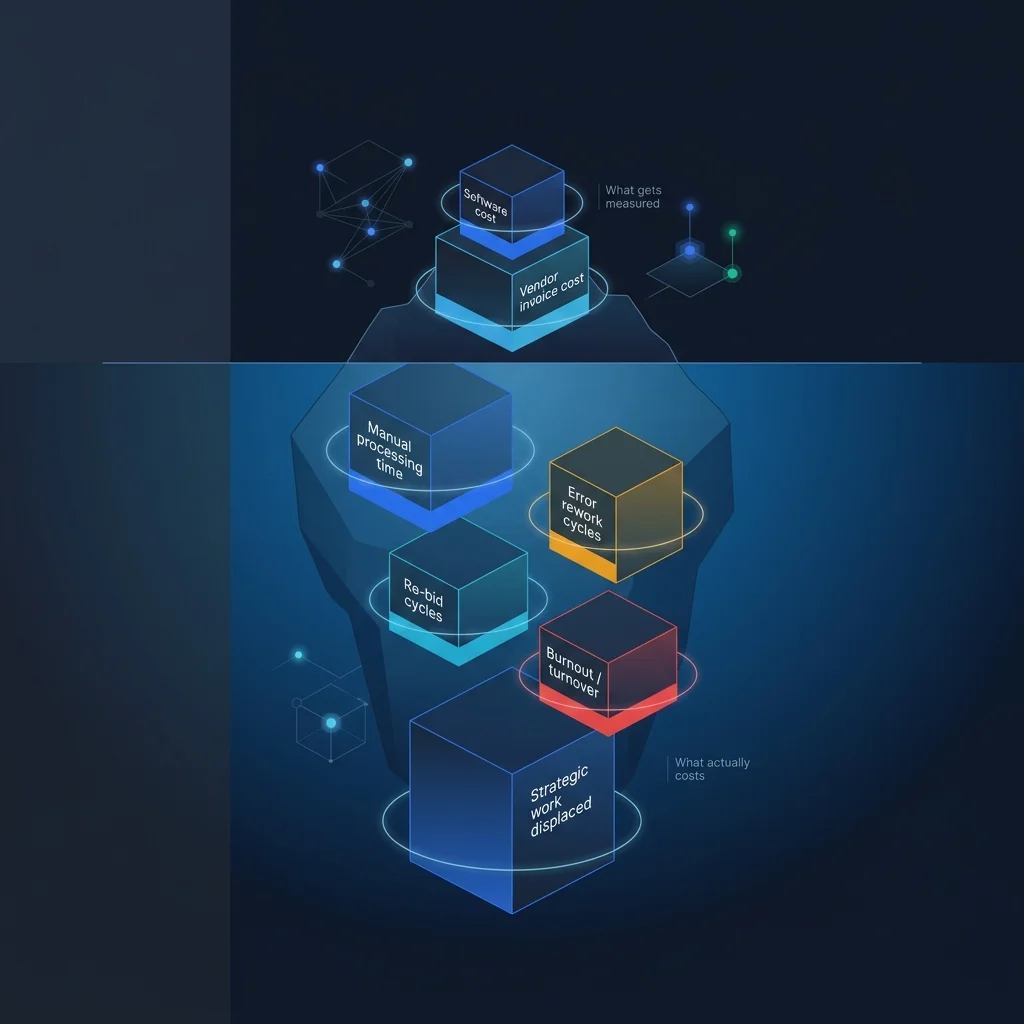
"We just use Excel, it works fine." This sentence is likely the single most expensive phrase in your procurement department. While software licenses have a clear price tag, the costs of sticking with manual processes are hidden, insidious, and far more massive than most leaders realize.
From human error leading to overpayments to employee burnout causing costly turnover, the inefficiencies of manual procurement are a silent tax on every dollar your organization spends. According to Gartner, manual procurement processes contribute to an average of 3-5% overspend annually due to errors and missed opportunities alone. Understanding the Total Cost of Ownership of your current tools reveals just how expensive "free" really is.
This guide exposes the real, quantified bill you're paying for "free" spreadsheets—and makes the business case for why automation pays for itself. (For a head-to-head against the spreadsheet alternative, see SpecLens vs Spreadsheets; for the team-side cost, procurement burnout.)
What You'll Learn:
- The high financial price of human error (with statistics)
- How manual processes slow you down vs. automation
- The hidden cost of employee burnout and talent loss
- Strategic blind spots created by lack of data visibility
- A simple ROI calculation for automation
The High Price of Human Error
Manual data entry has an inherent error rate of up to 4%. In a high-volume procurement environment, this statistic guarantees duplicated invoices, incorrect pricing, mismatched purchase orders, and missed contract terms. The downstream costs are staggering.
Gartner data shows manual processes cause 3-5% annual overspend due to errors and inefficiencies.
The average cost to identify and rectify a single invoice or PO error.
Nearly half of all procurement errors stem directly from manual data entry (2024 Global Report).
Example: If your business processes 10,000 transactions monthly, a 4% error rate means 400 transactions likely contain mistakes. If each error costs an average of $50 to identify and correct, this equates to $20,000 in monthly losses—or $240,000 annually—just in error correction costs.
A study by PayStream Advisors revealed that 3.6% of invoices processed manually contain errors, which can lead to duplicate payments, late fees, or missed early payment discounts. In one case, a global pharmaceutical company identified over $2 million in overpayments resulting from duplicated invoices and unobserved contract terms due to a lack of automation.
The Speed Penalty: Time is Money
Time directly translates to cost. Manual processes are shockingly slow compared to automated workflows, impacting not just efficiency but also your agility to respond to market opportunities.
| Metric | Manual | Automated |
|---|---|---|
| Invoice Processing Time | 8-10 days | 2-3 days |
| Invoice Approval Time | 8.2 days | 2.9 days (65% faster) |
| Purchase Order Processing | Baseline | 76% faster |
| Cost per Invoice Processed | $13 - $16 | $1.42 - $6 |
The Math: For a mid-sized company handling 1,000 invoices per month, switching from manual ($15/invoice) to automated ($3/invoice) processing could lead to savings of $12,000 per month or $144,000 per year—just in processing costs. Use our Procurement ROI Calculator to estimate your potential savings.
The Burnout Factor: Losing Your Best People
Perhaps the most overlooked cost of manual procurement is its impact on your talent. 68% of procurement professionals cite "outdated tools" as a major source of job dissatisfaction, according to a 2023 survey by Procurement Leaders.
When highly skilled buyers spend 20+ hours a week copy-pasting data from PDFs to Excel, chasing approvals via email, and manually reconciling invoices, they burn out. They become disengaged. And they leave.
A CPG (Consumer Packaged Goods) company observed a 34% attrition rate in its procurement function over 18 months, primarily attributed to frustration with redundant data entry and a lack of visibility into supplier performance. Replacing a single experienced procurement professional can cost 50-200% of their annual salary.
Automation isn't just about efficiency; it's about retention. It frees your team to do strategic, meaningful work that keeps them engaged and loyal. Modern AI tools like ChatGPT are transforming how procurement teams operate.
Strategic Blind Spots: The Cost of No Visibility
Manual processes lead to a chronic lack of real-time data and analytics, creating dangerous "strategic blind spots." A 2023 study by Ardent Partners found that:
- Only 27% of companies relying on manual procurement have full visibility into their spending.
- In contrast, 78% of digitally mature organizations report full spend visibility.
This lack of visibility leads to:
- Missed Early Payment Discounts: Discounts of 1-2% are left on the table because invoices aren't processed fast enough.
- Unoptimized Bulk Deals: Without consolidated data, buyers don't realize they can negotiate volume discounts across departments.
- Budget Misalignment: Spend leaks outside of contracted suppliers (maverick spending) and goes unnoticed.
- Poor Compliance: Inability to track vendor compliance and performance, with 62% of companies struggling to do this manually.
Calculate Your Own Savings
Simple ROI Estimator
Here's a quick way to estimate your potential savings from procurement automation:
Monthly Transactions × Error Rate (4%) × Cost per Error ($50) = Monthly Error Cost
Monthly Invoices × (Manual Cost $15 - Automated Cost $3) = Monthly Processing Savings
Annual Procurement Spend × 3% = Potential Annual Savings from Visibility
For an SME with $10M annual spend and 500 invoices/month, this could represent $300,000+ in annual savings.
Conclusion: Stop the Bleeding
The "savings" of sticking with manual processes are an illusion. The true cost—measured in errors, delays, talent loss, and missed opportunities—far exceeds the investment in modern procurement automation. The full ROI methodology is in our Procurement Automation ROI Guide.
The transition to automated procurement pays for itself in months, not years. Forward-thinking organizations recognize this, and they're pulling ahead while their competitors remain stuck in spreadsheets — see our SpecLens vs Manual Process head-to-head for the operational comparison.
The question isn't whether you can afford to automate. It's whether you can afford not to.
Eliminate Manual Data Entry
Stop copy-pasting from PDFs. Use SpecLens to automatically extract data from vendor documents and create instant, accurate comparison matrices. Explore all our free procurement tools.
Automate Your ComparisonsReferences
- 1.Ardent Partners — Procurement Research — Procurement process costs, manual processing benchmarks, and automation ROI
- 2.U.S. Bureau of Labor Statistics — Occupational Outlook Handbook — Purchasing managers and buyers: wages, employment, and job outlook
Frequently Asked Questions
Related Articles
Reduce Procurement Cycle Time
Learn proven strategies to reduce procurement cycle time without sacrificing quality. Identify bottlenecks and accelerate selection.
Procurement Automation ROI Guide
Learn how to calculate procurement automation ROI. Build a business case with metrics for time savings and error reduction.
5 Procurement Best Practices for 2026
Stay ahead of the curve with these essential procurement best practices. From digital transformation to sustainability, learn how to modernize your sourcing.
Procurement Burnout: Hidden Costs
Manual specification review is burning out your procurement team. Discover the numbers behind the silent epidemic and how AI can help reclaim your team's time.