
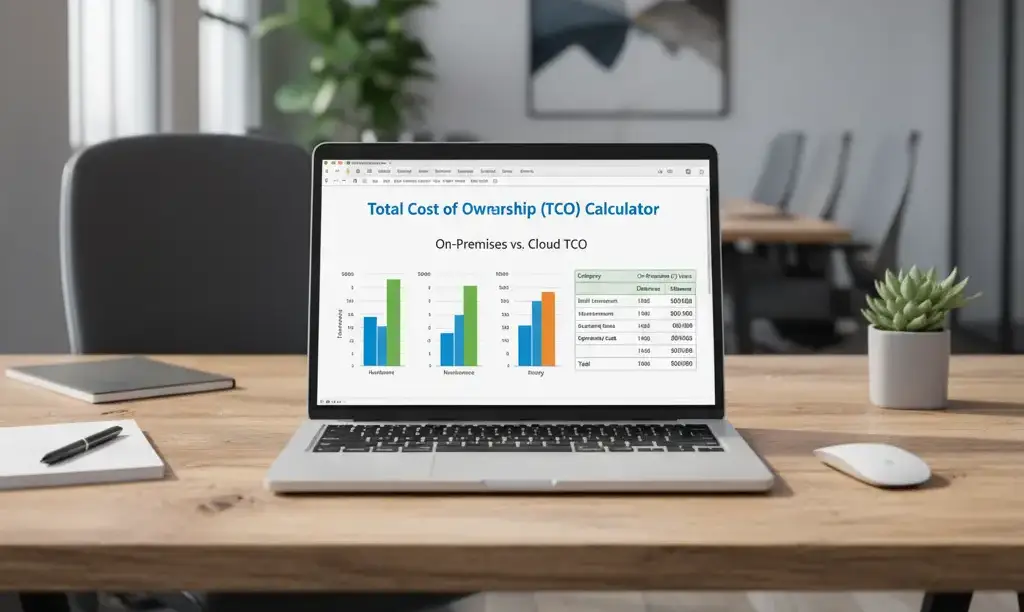
Free TCO Calculator + Complete Guide (2026)
Use our free TCO calculator to compare vendor costs. Includes the TCO formula, hidden cost checklist, and real industry examples.
Rhea Kapoor
Head of Procurement Research, SpecLens
- 850+companies trust SpecLens
- 99%extraction accuracy
- 8 hrssaved per comparison
- AES-256encrypted · GDPR compliant
Key takeaways
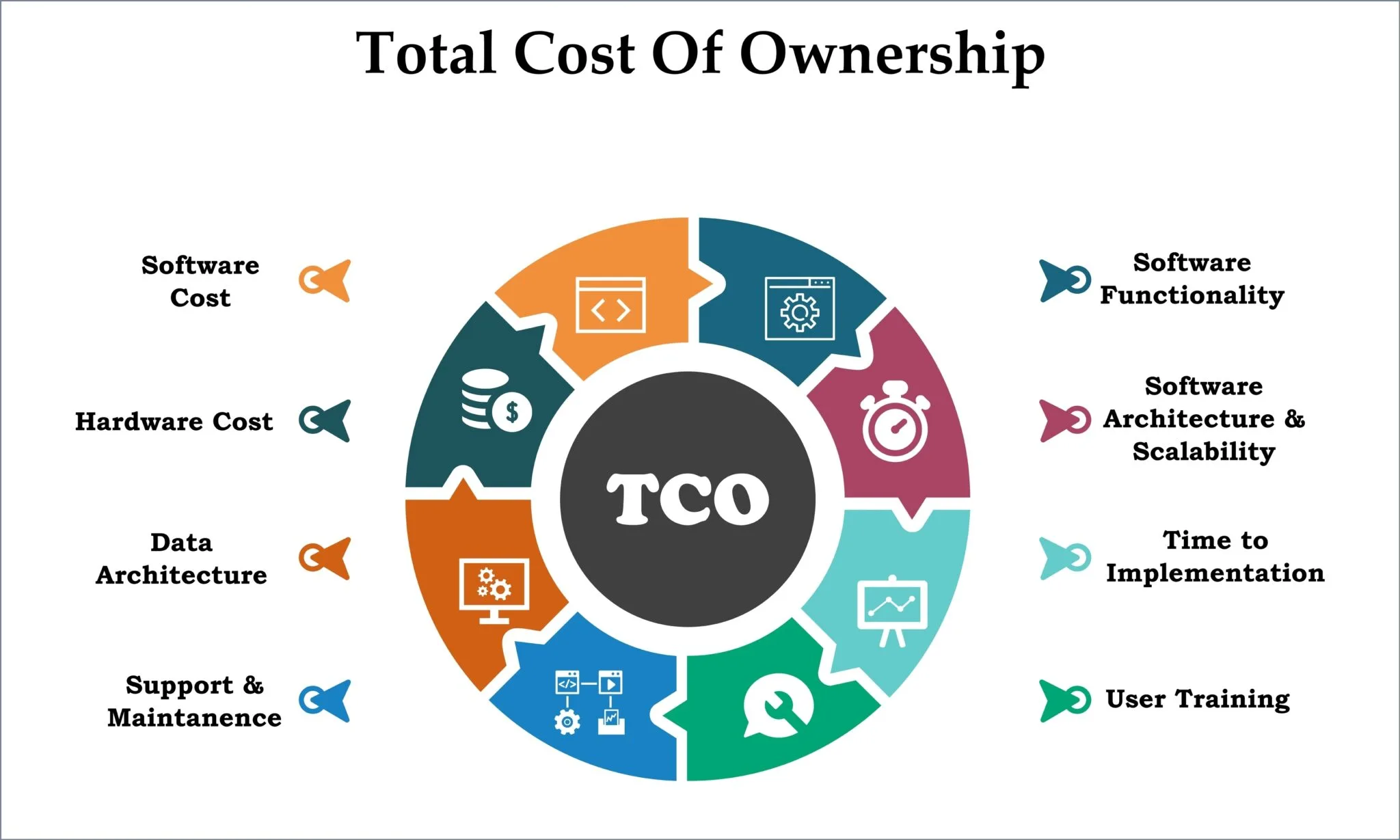
- Purchase price is typically only 20-40% of total lifecycle cost — the rest hides in operating, maintenance, training, and disposal.
- Use a consistent 3-5 year analysis period for IT equipment and 5-10 years for industrial equipment when comparing vendors.
- Always include the most-overlooked TCO costs: training, integration, downtime, energy, and end-of-life disposal.
- Compare vendors on TCO — not unit price — to avoid 40-60% lifetime overspend on cheaper-upfront options.
Why Total Cost of Ownership Matters in Procurement
When evaluating equipment purchases, the sticker price is just the beginning. Hidden costs—maintenance, training, energy consumption, downtime, and eventual disposal—can double or triple your initial investment. This is why understanding Total Cost of Ownership (TCO) is critical for making smart procurement decisions.
Studies show that in 2026, organizations focusing only on purchase price end up spending 40-60% more over the equipment's lifetime compared to those who calculate TCO — most of which traces back to the 15 hidden procurement costs that never make it into the original budget. Whether you're procuring IT infrastructure, manufacturing equipment, construction machinery, or healthcare devices, TCO analysis ensures you're making financially sound decisions. For IT infrastructure specifically, see our Cloud vs On-Premise Software guide.
What is Total Cost of Ownership (TCO)?
Total Cost of Ownership is a comprehensive financial analysis that calculates the complete lifecycle cost of acquiring, operating, maintaining, and disposing of equipment or services. Unlike simple price comparison, TCO considers:
- Acquisition costs: Purchase price, shipping, installation
- Operating costs: Energy, consumables, labor
- Maintenance costs: Repairs, spare parts, service contracts
- Indirect costs: Training, downtime, opportunity costs
- End-of-life costs: Disposal, recycling, decommissioning
The Hidden Costs Most Organizations Overlook
Many procurement teams underestimate or completely ignore these critical cost components:
1. Training and Learning Curve Costs
New equipment requires training. Factor in:
- Formal training programs (vendor-led or third-party)
- Staff time during training (lost productivity)
- Reduced efficiency during the learning period (typically 3-6 months)
- Ongoing training for new employees
Real Example: A manufacturing company purchased CNC equipment for $200,000 but spent an additional $35,000 on training and lost $50,000 in productivity during the ramp-up period. These costs weren't in their original budget — see our Manufacturing Equipment Buying Guide for the full ramp-up cost framework.
2. Integration and Compatibility Costs
Equipment rarely works standalone. Integration costs include:
- Custom software development or middleware
- System upgrades to ensure compatibility
- Consulting fees for complex integrations
- Testing and validation
3. Downtime and Opportunity Costs
When equipment fails, you lose more than repair costs:
- Direct downtime costs: Lost production or service capacity
- Indirect costs: Customer dissatisfaction, missed deadlines
- Emergency repair premiums: Rush shipping, overtime labor
- Reputation damage: Difficult to quantify but very real
Case Study: A hospital's MRI machine failure cost $15,000 in repairs but resulted in $120,000 in lost revenue from rescheduled appointments and patients going to competitors. (Read more on uptime-driven TCO in our Healthcare Equipment Procurement Guide.)
4. Energy and Environmental Costs
Operating costs vary dramatically between equipment:
- Electricity consumption
- Cooling requirements (especially for IT equipment)
- Consumables (toner, filters, lubricants)
- Environmental compliance and carbon taxes (increasingly common)
A server that costs $5,000 less upfront but consumes 30% more power will cost thousands more over its 5-year lifespan.
5. Upgrade and Scalability Costs
Future-proofing isn't free:
- Software upgrades and license renewals
- Hardware expansion (memory, storage, capacity)
- Technology refresh cycles
- Migration costs when eventually replacing equipment
The Complete TCO Calculation Framework
Use this comprehensive framework to calculate TCO for any equipment purchase:
Phase 1: Acquisition Costs (Year 0)
Purchase Price Components:
- Base equipment price
- Optional features and upgrades
- Volume discounts (if applicable)
- Sales tax and import duties
Initial Setup Costs:
- Shipping and freight
- Installation and commissioning
- Site preparation (electrical, ventilation, space modifications)
- Initial training
- Configuration and customization
- Testing and validation
Formula:
Acquisition Cost = Purchase Price + Setup Costs + Initial Training
Phase 2: Operating Costs (Annual)
Direct Operating Costs:
- Energy consumption: kWh × unit cost × hours operated
- Consumables: Supplies needed for operation
- Labor: Operator time and wages
- Insurance: Equipment-specific coverage
Indirect Operating Costs:
- Space costs (rent, climate control)
- Security and access control
- Monitoring and management systems
Formula:
Annual Operating Cost = Energy + Consumables + Labor + Insurance + Space
Phase 3: Maintenance Costs (Annual)
Preventive Maintenance:
- Scheduled service intervals
- Replacement parts (filters, belts, wear items)
- Service contracts or warranties
- Internal maintenance labor
Corrective Maintenance:
- Average annual repair costs (use vendor or industry data)
- Emergency service callouts
- Unplanned spare parts
- Downtime costs
Formula:
Annual Maintenance Cost = Preventive Maintenance + (Estimated Failures × Repair Cost)
Phase 4: Support and Management Costs (Annual)
Technical Support:
- Vendor support contracts
- Help desk or internal support costs
- Software updates and patches
- Documentation and knowledge base maintenance
Management and Administration:
- Asset tracking and inventory management
- Compliance reporting
- Performance monitoring
- Auditing and documentation
Phase 5: Disposal Costs (End of Life)
Decommissioning:
- Equipment removal and transportation
- Data sanitization (for IT equipment)
- Environmental remediation (if needed)
Disposal or Resale:
- Recycling fees
- Disposal costs (may be negative if resale value exists)
- Documentation and certificates of destruction
The TCO Calculation Formula
Put it all together with this comprehensive formula:
Total Cost of Ownership Formula:
TCO = Acquisition Costs + (Annual Operating Costs × Years) + (Annual Maintenance Costs × Years) + (Annual Support Costs × Years) + Disposal Costs - Residual Value
Where:
- Years = Expected equipment lifespan
- Residual Value = Estimated resale or salvage value at end of life
- All costs should be adjusted for inflation/discount rate if analyzing over 5+ years
TCO Calculator Template: Step-by-Step Guide
Here's how to build a practical TCO calculator spreadsheet:
Step 1: Define Your Analysis Parameters
- Analysis period: Typically 3-5 years for technology, 5-10 years for industrial equipment
- Discount rate: Your organization's cost of capital (typically 5-10%)
- Currency: Ensure all costs use the same currency
Step 2: Create Input Sections
Build a spreadsheet with these sections:
TCO Calculator Template Structure
Section A: Acquisition Costs
- Purchase price: $______
- Shipping/freight: $______
- Installation: $______
- Initial training: $______
- Configuration: $______
- Total Acquisition: $______
Section B: Annual Operating Costs
- Energy (kWh × rate × hours): $______/year
- Consumables: $______/year
- Labor: $______/year
- Insurance: $______/year
- Space costs: $______/year
- Total Annual Operating: $______/year
Section C: Annual Maintenance Costs
- Preventive maintenance: $______/year
- Service contracts: $______/year
- Estimated repairs: $______/year
- Downtime costs: $______/year
- Total Annual Maintenance: $______/year
Section D: Annual Support Costs
- Technical support: $______/year
- Software updates: $______/year
- Training (ongoing): $______/year
- Management overhead: $______/year
- Total Annual Support: $______/year
Section E: Disposal Costs
- Decommissioning: $______
- Recycling/disposal: $______
- Less: Estimated resale value: ($______)
- Net Disposal Cost: $______
Section F: TCO Summary
- Year 0 (Acquisition): $______
- Years 1-N (Operating): $______ × __ years = $______
- Years 1-N (Maintenance): $______ × __ years = $______
- Years 1-N (Support): $______ × __ years = $______
- Year N (Disposal): $______
- TOTAL COST OF OWNERSHIP: $______
Step 3: Add Comparison Features
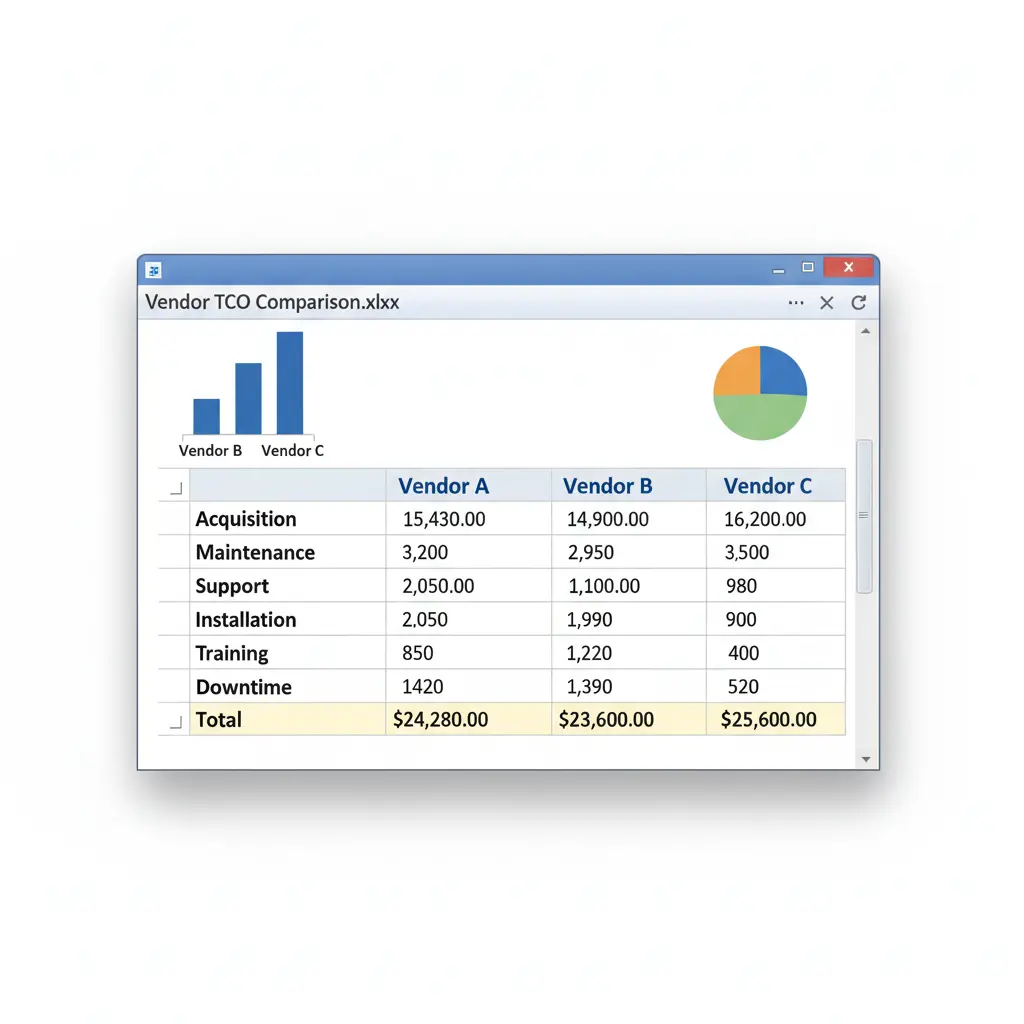
Create multiple columns to compare different vendors or equipment options side by side:
- Option A (Vendor 1)
- Option B (Vendor 2)
- Option C (Vendor 3)
Include summary metrics:
- Total TCO: Complete lifecycle cost
- Annual TCO: Total TCO ÷ years of service
- TCO per unit: If measuring productivity (e.g., TCO per server, per product manufactured)
Industry-Specific TCO Examples
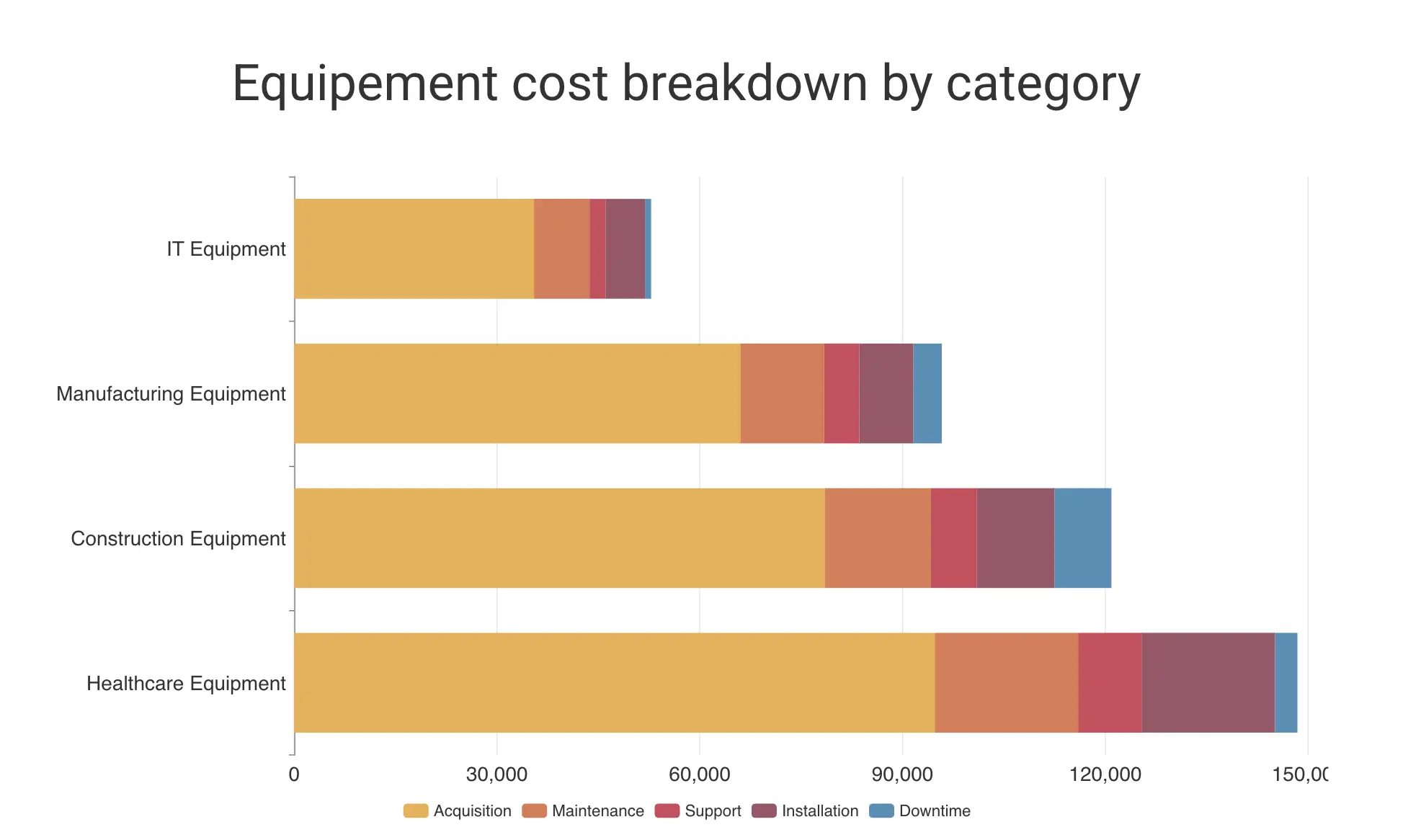
IT Equipment TCO Example: Server Procurement
Scenario: Comparing two server options for a 5-year lifecycle (for a deeper dive on server selection criteria, see our IT Hardware Procurement Guide).
| Cost Component | Vendor A (Low Price) | Vendor B (Premium) |
|---|---|---|
| Acquisition | ||
| Purchase price | $15,000 | $22,000 |
| Setup & installation | $2,000 | $1,500 |
| Annual Operating | ||
| Energy (higher power draw) | $3,200/year | $2,100/year |
| Cooling | $1,200/year | $800/year |
| Annual Maintenance | ||
| Service contract | $1,800/year | $2,400/year |
| Estimated repairs | $1,200/year | $400/year |
| Downtime costs | $2,000/year | $500/year |
| 5-Year TCO | $63,000 | $53,000 |
Result: Despite Vendor A's lower purchase price ($15K vs $22K), Vendor B's superior reliability and efficiency result in $10,000 lower TCO over 5 years—a 16% savings.
Manufacturing Equipment TCO Example: CNC Machine
Scenario: Two CNC machines with 10-year lifecycles.
- Option A: $180,000 purchase, high maintenance, lower productivity
- Option B: $240,000 purchase, low maintenance, 20% higher productivity
TCO Analysis Results:
- Option A TCO: $450,000 (10 years)
- Option B TCO: $420,000 (10 years)
- Option B also produces 20% more parts, increasing revenue by $150,000 over 10 years
Total Advantage: Option B provides $180,000 better value ($30K TCO savings + $150K additional revenue).
Construction Equipment TCO Example: Excavator Purchase vs Lease
Scenario: 5-year comparison of buying vs leasing an excavator (the buy-vs-rent decision is covered in detail in our Construction Equipment Buying Guide).
Purchase Option:
- Purchase price: $320,000
- Maintenance: $18,000/year
- Fuel: $22,000/year
- Insurance: $8,000/year
- Resale after 5 years: -$120,000
- 5-Year TCO: $440,000
Lease Option:
- Monthly lease: $6,500 × 60 months = $390,000
- Fuel: $22,000/year = $110,000
- Maintenance included in lease: $0
- Insurance included: $0
- 5-Year TCO: $500,000
Result: Purchasing saves $60,000 over 5 years, but leasing provides flexibility and predictable costs.
Advanced TCO Considerations
1. Time Value of Money (Net Present Value)
For multi-year analyses, account for the time value of money using Net Present Value (NPV) — the same discounting logic underpins formal should-cost analysis:
NPV = Cost ÷ (1 + discount rate)^year
Example: A $10,000 cost in year 5 with a 7% discount rate has a present value of $7,130.
2. Risk and Uncertainty Analysis
Add contingency factors for uncertain costs:
- Best case: Optimistic cost estimates (80% of expected)
- Most likely: Expected costs (100%)
- Worst case: Pessimistic estimates (130% of expected)
Use weighted averages: (Best × 0.25) + (Most Likely × 0.50) + (Worst × 0.25)
3. Sensitivity Analysis
Test how changes in key variables affect TCO:
- What if energy costs increase 20%?
- What if equipment lasts 7 years instead of 5?
- What if maintenance costs are 30% higher than estimated?
This identifies which cost factors have the biggest impact on your decision.
4. Productivity and Revenue Impact
Don't forget the revenue side:
- Throughput differences: Faster equipment produces more revenue
- Quality improvements: Fewer defects reduce waste costs
- Capacity: Higher capacity allows serving more customers
Formula:
Total Value = TCO + Revenue/Productivity Impact
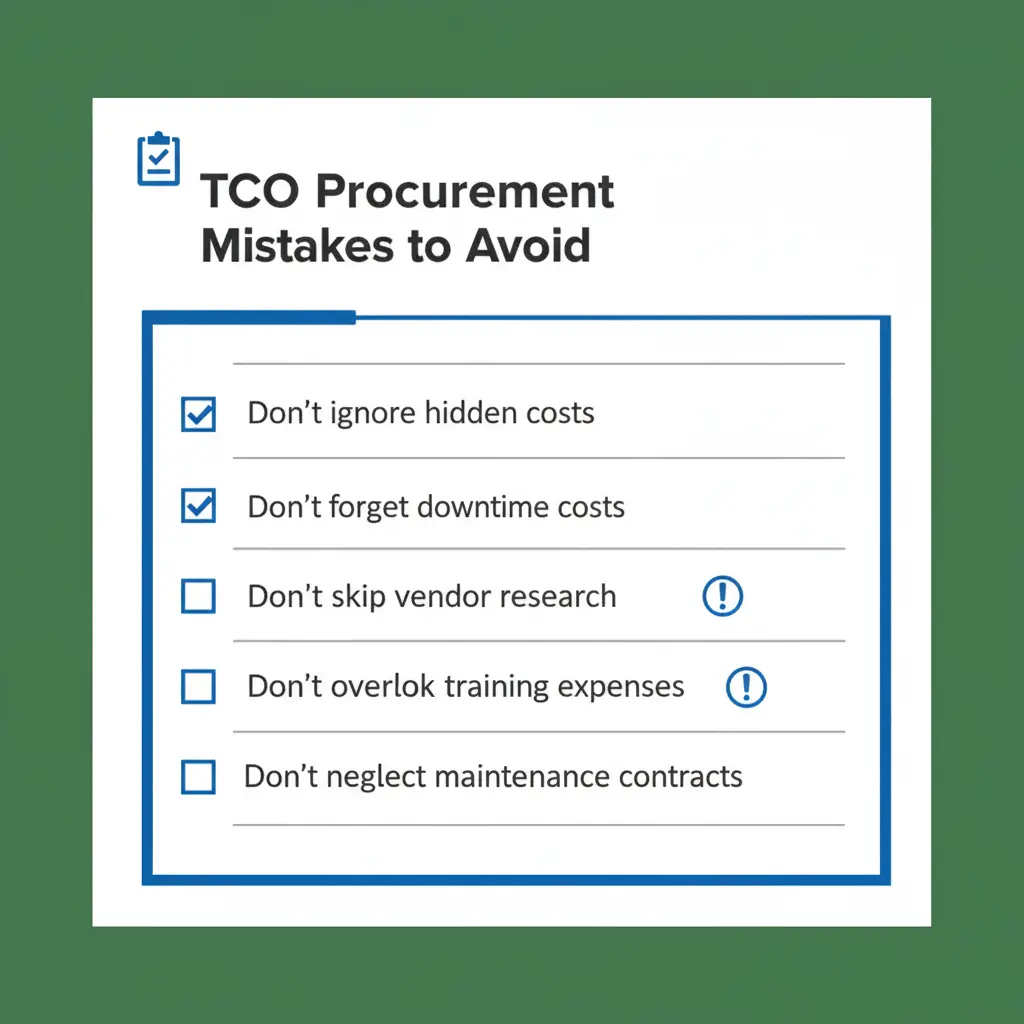
Common TCO Calculation Mistakes to Avoid
1. Focusing Only on Obvious Costs
Mistake: Including only purchase price and basic maintenance.
Fix: Use the comprehensive framework above—account for ALL cost categories.
2. Ignoring Vendor-Specific Factors
Mistake: Assuming all vendors have similar support quality.
Fix: Research vendor reliability, support responsiveness, and part availability. A vendor with poor support will cost more long-term.
3. Using Incorrect Time Horizons
Mistake: Comparing 3-year TCO for equipment that lasts 8 years.
Fix: Use realistic lifecycles based on industry standards and vendor specifications.
4. Not Adjusting for Inflation
Mistake: Using today's costs for expenses 5 years from now.
Fix: Apply inflation adjustments (typically 2-3% annually) to future costs.
5. Forgetting Opportunity Costs
Mistake: Not considering what else you could do with the capital.
Fix: Factor in your organization's cost of capital and alternative investment returns.
6. Overlooking Environmental and Regulatory Costs
Mistake: Ignoring carbon taxes, environmental compliance, and disposal regulations.
Fix: Research current and anticipated regulations—sustainability costs are increasing.
How AI and Automation Improve TCO Analysis
Modern procurement teams are using technology to make TCO calculations faster and more accurate:
Automated Data Extraction
- AI reads vendor proposals and extracts cost data automatically (see how SpecLens extracts specs in 3 steps)
- Eliminates manual data entry errors and saves hours — quantified in our SpecLens vs Spreadsheets comparison
- Normalizes units and formats across different vendors (more on this in our unit conversion in procurement guide)
Historical Cost Database
- Track actual costs from past procurements
- Improve estimates with real organizational data
- Identify cost trends and predict future expenses
Real-Time TCO Comparison
- Instant side-by-side TCO analysis of multiple vendors
- Visual dashboards showing cost breakdowns
- What-if scenarios to test different assumptions
Tools like SpecLens AI extraction can pull pricing and specification data from vendor proposals automatically, feeding directly into TCO calculators. This reduces calculation time from days to minutes while improving accuracy. You can also use our free Procurement ROI Calculator to estimate your savings from automation, or read the supporting case in Procurement Automation ROI Guide.
TCO Best Practices for Procurement Teams
1. Standardize Your TCO Template
Create organization-wide TCO templates for different equipment categories — start with our free TCO Worksheet Template. This ensures:
- Consistency across procurement decisions
- Nothing is overlooked
- Easy comparison of historical data
2. Involve Cross-Functional Teams
Get input from:
- Finance: Discount rates, capital budgeting rules
- Operations: Realistic operating cost estimates
- Maintenance: Expected repair and maintenance costs
- IT/Technical: Integration and compatibility considerations
- End users: Productivity and usability factors
3. Update TCO Assumptions Regularly
Review and update your TCO models:
- After each procurement to compare estimates vs actuals
- When energy or labor costs change significantly
- When new regulations or standards are introduced
4. Document Your Assumptions
Always record:
- Where cost estimates came from
- What assumptions were made
- Confidence level in each estimate
This allows future procurement teams to understand and improve the model.
5. Validate with Vendor References
Ask vendor references (a structured set of questions like these belongs in your vendor selection checklist):
- "What were your actual operating costs?"
- "How much did you spend on maintenance?"
- "What unexpected costs did you encounter?"
Real user data is more accurate than vendor estimates.
6. Track Post-Purchase Performance
Monitor actual costs after purchase:
- Compare to TCO estimates
- Identify where estimates were off
- Improve future TCO calculations
Free TCO Calculator Spreadsheet Template
To help you get started, here's a summary of what your TCO calculator spreadsheet should include:
Essential Excel Features to Include:
- ✓ Input section with clearly labeled cost categories
- ✓ Multiple vendor columns for side-by-side comparison
- ✓ Automatic calculations using formulas
- ✓ Year-by-year breakdown showing costs over time
- ✓ NPV calculations with adjustable discount rate
- ✓ Charts and graphs visualizing TCO comparison
- ✓ Sensitivity analysis section for what-if scenarios
- ✓ Summary dashboard with key metrics highlighted
Pro Tip: Use data validation and dropdown lists to ensure consistent data entry across your team.
Conclusion: Making Smarter Procurement Decisions with TCO
Try Our Free TCO Calculator
Calculate the true Total Cost of Ownership for your procurement decisions. Include hidden costs like maintenance, training, and disposal.
Calculate TCO Now →Total Cost of Ownership analysis transforms procurement from price-focused to value-focused. By considering the complete lifecycle costs—acquisition, operation, maintenance, support, and disposal—you'll make decisions that save your organization significant money long-term.
Key takeaways:
- Purchase price is just 20-40% of total lifecycle costs
- Hidden costs (training, downtime, energy, maintenance) often exceed the purchase price
- TCO analysis consistently reveals that the cheapest option isn't the best value
- Standardized TCO templates ensure consistent, thorough analysis
- Cross-functional input improves accuracy and buy-in
- Technology and AI can automate much of the TCO calculation process
Organizations that adopt TCO-based procurement report 20-35% cost savings compared to price-only decision-making. The upfront effort of building TCO models pays for itself many times over — the same logic underpins our wider procurement best practices for 2026.
Start with one equipment category, create a comprehensive TCO template, and refine it over time. Soon, TCO analysis will become second nature—and your procurement decisions will deliver significantly better value.
Ready to streamline your TCO analysis? SpecLens uses AI to compare product specifications and extract cost data from vendor proposals, feeding directly into your TCO calculations. What used to take days now takes minutes. Pair it with the Quote Comparison Template to keep pricing apples-to-apples across vendors.
References
- 1.ISM — Institute for Supply Management — Total cost of ownership methodology and procurement cost analysis standards
- 2.Aberdeen Strategy & Research — Capital asset cost analysis and equipment TCO research
- 3.Gartner — Procurement & Sourcing Operations — Procurement operations and lifecycle cost evaluation
Frequently Asked Questions
Related Articles
What Makes an RFP Complex? A Scoring Framework (2026)
Learn the 5-dimension RFP complexity scoring framework used by procurement teams to estimate review time, allocate resources, and decide when AI assistance is justified.
Compare Product Specifications (2026)
Master product specification comparison with proven strategies for vendor proposals and technical documents. Step-by-step guide for procurement teams.
How to Write an RFP: 2026 Guide
Complete RFP writing guide for 2026. Learn the 10 essential components, step-by-step process, and templates that get quality vendor responses.
Vendor Negotiation: 6 Strategies for 2026
Negotiate better deals with suppliers using these 6 proven strategies. Save costs, secure better terms, and build stronger vendor relationships.