

Cloud vs On-Premise Software: 2026 Guide
Should you own your infrastructure or rent it? We breakdown the Cost, Security, and Scalability of Cloud vs On-Premise solutions.
Priya Sharma
Procurement Technology Lead, SpecLens
- 850+companies trust SpecLens
- 99%extraction accuracy
- 8 hrssaved per comparison
- AES-256encrypted · GDPR compliant
The debate between cloud and on-premise software is far from settled. By 2026, 60% of enterprise work is happening in the cloud, yet for highly regulated industries and massive organizations with predictable workloads, on-premise solutions still hold significant ground.
The choice between cloud (SaaS) and on-premise procurement software isn't just a technical decision; it's a strategic financial and operational one that will impact your organization for years. This guide compares the two deployment models on the three metrics that matter most: Cost, Security, and Agility. (For the broader buyer's guide, see best procurement software 2026; sector context for IT/data-center buyers in IT & data center procurement.)
What You'll Learn:
- A head-to-head comparison of Cloud vs. On-Premise
- Total Cost of Ownership (TCO) analysis for both models
- The 2026 reality check on cloud security myths
- When to choose each option (with specific scenarios)
- The emerging hybrid cloud strategy
Head-to-Head: Cloud vs. On-Premise at a Glance
Cloud (SaaS)
- ✓Cost Model: OpEx (Subscription). Lower upfront cost, predictable monthly/annual fees.
- ✓Scalability: Virtually unlimited. Add users or features instantly with a click.
- ✓Maintenance: Automatic updates managed by the vendor. Always on the latest version.
- ✓Deployment: Fast implementation (weeks, not months).
- ✓Accessibility: Available anywhere with internet access.
On-Premise
- ✓Cost Model: CapEx (Capital Expenditure). Higher upfront cost, potentially lower long-term cost for stable workloads.
- ✓Control: Total control over data, software, and infrastructure.
- ✓Security: Data stays within your physical firewall (ideal for highly sensitive IP).
- ✓Customization: Unlimited ability to modify source code to fit unique processes.
- ✓Stability: No dependence on vendor's SaaS availability.
The Financial Verdict: Total Cost of Ownership (TCO) Analysis
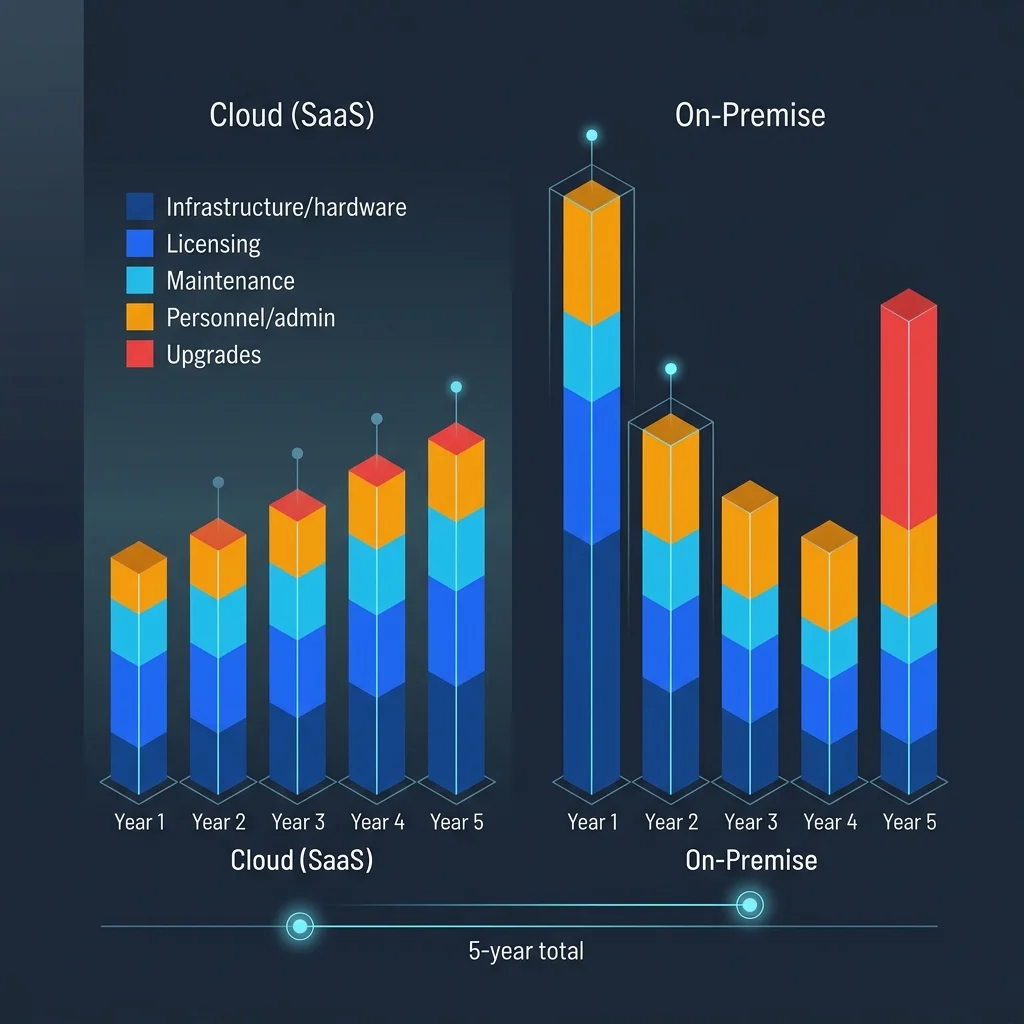
The "sticker price" never tells the whole story. The true cost of software includes implementation, maintenance, upgrades, staffing, and opportunity costs. Use our TCO Calculator to analyze specific scenarios, or read our comprehensive TCO Calculator Guide to understand the full framework. Here's how the two models typically compare:
Cloud (SaaS) TCO
- Upfront Costs: Minimal (implementation, configuration, data migration).
- Ongoing Costs: Subscription fees (per user or per module), data storage fees, integration costs, and potential data egress fees.
- Hidden Costs: Costs can accumulate over time, especially with growing user counts, increasing data volumes, and add-on features. Long-term, SaaS can become more expensive than on-premise for very large, stable deployments.
TCO Profile: Lower in Years 1-3. May become higher in Years 5+ if usage scales significantly.
On-Premise TCO
- Upfront Costs: Significant (server hardware, network infrastructure, software licenses, installation, and customization).
- Ongoing Costs: IT staff salaries for maintenance and support, hardware refresh cycles (every 3-5 years), software update implementation, and energy/hosting costs.
- Hidden Costs: Opportunity cost of IT resources, slower time-to-value, and potential for "technical debt" if updates are delayed. See our analysis of hidden procurement costs.
TCO Profile: Higher in Years 1-3 due to CapEx. "Flattens out" over Years 5-10 and can become more cost-effective for large, predictable workloads.
Decision Guidance:
- Choose Cloud if: You want to preserve cash flow, need to scale quickly, have a smaller IT team, or prioritize speed to value. The TCO is typically lower for the first 3-5 years.
- Choose On-Premise if: You have a massive, stable workload, a large internal IT team, stringent data sovereignty requirements, or a strong preference to capitalize expenses (CapEx) on your balance sheet.
Security: The 2026 Reality Check
The old myth that "Cloud is inherently insecure" is definitively dead in 2026. Top-tier cloud providers like AWS, Azure, and GCP spend more on security in a single month than most enterprises do in an entire decade. They offer:
- Multi-layer encryption (at rest and in transit).
- Continuous security patching and threat monitoring 24/7.
- Global compliance certifications (SOC 2, ISO 27001, GDPR, HIPAA, FedRAMP).
- Advanced access controls (MFA, zero-trust architecture).
However, on-premise offers something cloud cannot: absolute data sovereignty. If you are a defense contractor, government entity, or organization handling the most sensitive intellectual property where data must physically reside in a specific, controlled location, on-premise (or a private cloud) remains the only compliant option.
The Bottom Line: For 95% of organizations, cloud security is superior to what they could achieve in-house. For the 5% with extreme data control requirements, on-premise is essential.
Agility and Scalability
This is where cloud truly shines. Cloud-based procurement software offers:
- Rapid Deployment: Implementation in weeks, not months. Start generating value almost immediately.
- Instant Scalability: Add new users, modules, or geographic regions without procurement of new hardware.
- Access to Innovation: Cloud vendors continuously release new features (including AI capabilities) that are instantly available to all customers.
- Support for Remote Work: Accessible from anywhere, critical for modern distributed teams.
On-premise systems, by contrast, require planning and capital for any scaling initiative and often lag behind on feature updates.
The Rise of the Hybrid Cloud Strategy
The debate between cloud and on-premise is increasingly leading to a third answer: Hybrid Cloud. Many enterprises are now adopting a strategy that combines the best of both worlds.
- Keep the most sensitive core data, intellectual property, and legacy systems on-premise or in a private cloud.
- Move agile, user-facing applications like e-procurement, CRM, and HR to the public cloud to leverage AI, modern UX, and faster innovation cycles.
This approach balances the need for control and security with the demand for flexibility and modern capabilities.
Our Final Recommendation for 2026
For the vast majority of procurement teams, especially SMBs and organizations prioritizing agility, Cloud (SaaS) is the clear winner in 2026. The ability to access cutting-edge AI features (see AI in procurement: complete 2026 guide), integrate easily with suppliers, and support a remote or hybrid workforce far outweighs the traditional benefits of owning your own servers.
If you are a large enterprise with unique regulatory, security, or customization needs, an on-premise or hybrid approach may still be warranted. But the default starting point for any new evaluation should be cloud-first. For step-by-step guidance on evaluating vendors, see our IT vendor selection tips and the dedicated IT Hardware Procurement Guide for hybrid-deployment hardware decisions.
Experience Modern Cloud Procurement
SpecLens is a cloud-native platform requiring no installation. Process your vendor documents securely and leverage AI-powered analysis from anywhere.
Try SpecLens Cloud FreeFrequently Asked Questions
Related Articles
AI Equipment Procurement Guide 2026
How AI transforms equipment procurement in 2026. Automate spec extraction, smart vendor comparison, and data-driven purchasing decisions.
Best Procurement Software 2026: Top 6
Discover the best procurement software for 2026. Compare top tools like SpecLens, SAP Ariba, and Coupa to find the perfect match for your business.
ChatGPT for Procurement: Top 5 Use Cases
Learn how to use Generative AI safely in procurement. We explore 5 high-value use cases and 3 critical risks to watch out for.
Submittal Review Software Compared (2026)
Honest 2026 comparison of AI submittal-review tools — BuildSync, Part3, Remy, iFieldSmart, and SpecLens. Features, ICP fit, side-by-side capability matrix, and the 35% rejection-rate context.