

Fleet Vehicle Procurement Guide
Master fleet vehicle procurement. Learn vehicle specs, TCO analysis, EV considerations, and comparison strategies for fleet purchasing.
David Chen
Senior Procurement Analyst, SpecLens
- 850+companies trust SpecLens
- 99%extraction accuracy
- 8 hrssaved per comparison
- AES-256encrypted · GDPR compliant
Key takeaways
- Match vehicle specs to operational requirements: payload + 20% safety margin, duty cycle, and TCO over the replacement cycle.
- Lease for short-cycle replacements (3-4 years) and predictable monthly costs; buy for high-mileage applications and specialized vehicles.
- Switch to EVs when daily routes are under 150 miles, depot charging is feasible, and TCO favors lower fuel + maintenance.
- Standardize on 3-5 fleet configurations covering majority of needs; require business case for non-standard requests.
- Optimal fleet lifecycle: 5-7 years light-duty, 7-10 years medium-duty, 10-15 years heavy-duty — replace when annual maintenance exceeds 15-20% of replacement value.
Fleet vehicles are rolling capital investments that directly impact operational efficiency and total cost of ownership. Whether you're managing delivery vans, service trucks, or sales vehicles, procurement decisions today affect costs and capabilities for years (see also logistics & supply chain procurement for the broader context).
This comprehensive guide covers what fleet managers need to know when procuring commercial vehicles—from initial requirements through vendor selection, TCO analysis, and lifecycle management.
Why Fleet Procurement Decisions Matter
The Financial Scale
| Fleet Size | Typical Value | Annual Operating Cost |
|---|---|---|
| 10 vehicles | $300K - $600K | $80K - $200K |
| 50 vehicles | $1.5M - $3M | $400K - $1M |
| 100 vehicles | $3M - $6M | $800K - $2M |
| 500 vehicles | $15M - $30M | $4M - $10M |
Operational Impact
| Fleet Factor | Business Impact |
|---|---|
| Reliability | Service delivery consistency |
| Capability | What work can be performed |
| Capacity | How much can be transported |
| Cost | Operating expense and margins |
| Image | Customer perception |
Fleet Vehicle Categories
Commercial Vehicle Classes
| Class | GVWR (lbs) | Examples | Typical Use |
|---|---|---|---|
| 1 | Up to 6,000 | Passenger cars, small SUVs | Sales, executives |
| 2a | 6,001-8,500 | Large SUVs, small vans | Service, light delivery |
| 2b | 8,501-10,000 | Large pickups, cargo vans | Construction, trades |
| 3 | 10,001-14,000 | Medium vans, small box trucks | Delivery, service |
| 4 | 14,001-16,000 | Large step vans | Package delivery |
| 5-6 | 16,001-26,000 | Bucket trucks, box trucks | Utility, freight |
| 7-8 | 26,001+ | Semis, large trucks | Over-the-road |
Application Types
| Application | Typical Vehicles | Key Requirements |
|---|---|---|
| Sales/service | Sedans, small SUVs, vans | Comfort, reliability, professional appearance |
| Delivery (light) | Cargo vans, small trucks | Cargo capacity, maneuverability |
| Field service | Pickups, service bodies | Tool storage, towing, durability |
| Construction | Heavy-duty pickups | Payload, towing, ruggedness |
Critical Specifications
Performance Specifications
| Specification | What to Evaluate | Why It Matters |
|---|---|---|
| Engine/motor | Power, torque, fuel type | Work capability, operating cost |
| Transmission | Type, ratios, durability | Efficiency, driver experience |
| Towing capacity | Max trailer weight | Hauling capability |
| Payload | Max cargo weight | What you can carry |
| Cargo volume | Cubic feet available | What will fit |
| Range | Miles per tank/charge | Operational flexibility |
Safety Features
| Category | Features to Evaluate |
|---|---|
| Standard | Airbags, ABS, stability control |
| Advanced | Forward collision warning, automatic emergency braking |
| Driver assist | Lane keeping, adaptive cruise, blind spot monitoring |
| Fleet-specific | Telematics capability, driver monitoring readiness |
Total Cost of Ownership Analysis
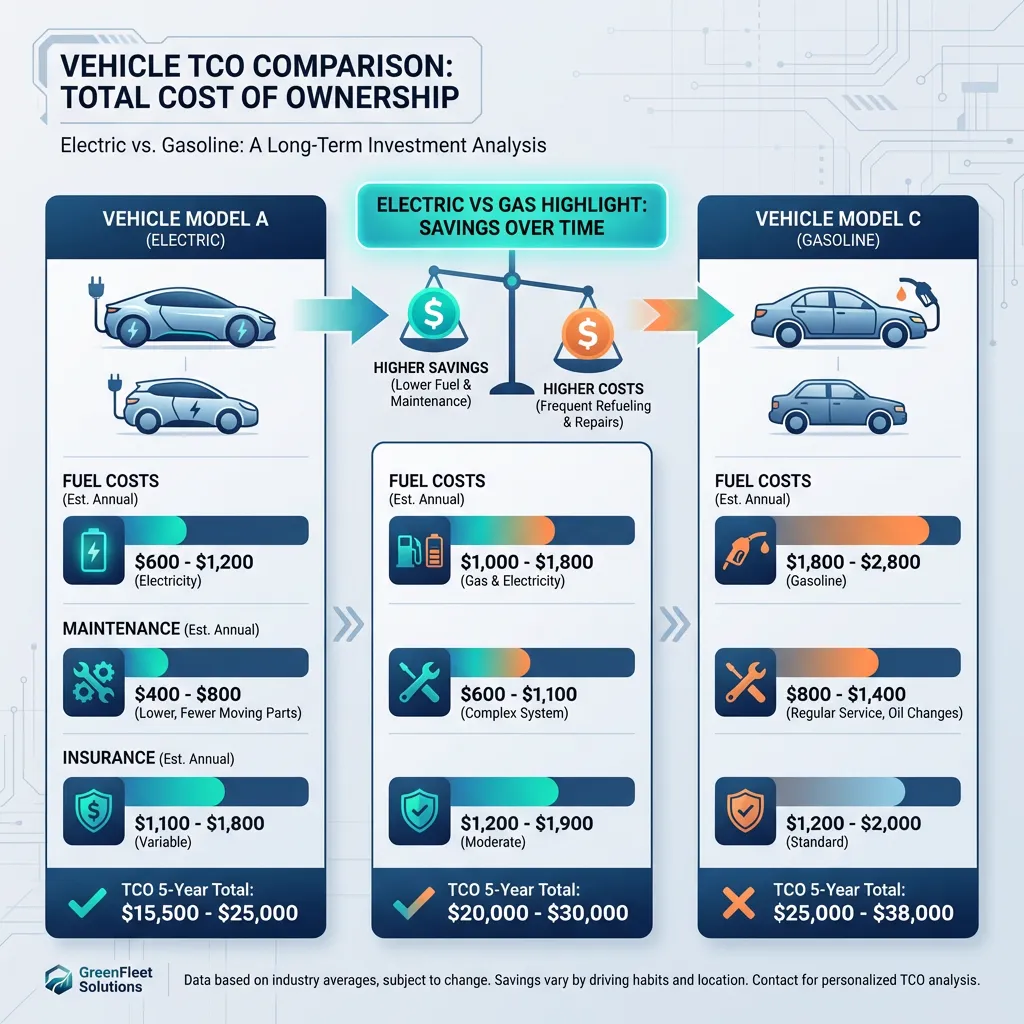
The component breakdown below maps directly to the framework in our TCO Calculator Guide; for the recurring expenses fleet managers most often miss, see 15 hidden procurement costs.
TCO Components
| Cost Component | Typical % of TCO | Key Drivers |
|---|---|---|
| Acquisition/depreciation | 30-45% | Purchase price, residual value |
| Fuel/energy | 20-30% | Efficiency, utilization, fuel prices |
| Maintenance/repair | 10-15% | Reliability, preventive maintenance |
| Insurance | 5-10% | Safety features, claims history |
| Administrative | 3-7% | Fleet management overhead |
Fuel Cost Comparison Example
| Vehicle | Annual Miles | MPG | Annual Fuel ($4/gal) | 5-Year Fuel |
|---|---|---|---|---|
| Vehicle A | 25,000 | 22 | $4,545 | $22,727 |
| Vehicle B | 25,000 | 26 | $3,846 | $19,231 |
| Savings | $699/year | $3,496 |
Key Insight: Higher-efficiency vehicles cost more upfront but often deliver better total economics.
EV Considerations
For a side-by-side EV vs ICE workup, see our Fleet EV Comparison guide; for the broader vehicle-class workup, see Compare Fleet Vehicles.
When EVs Make Sense
| Factor | Favorable for EV |
|---|---|
| Route profile | Predictable daily routes within range |
| Base operations | Return-to-base for charging access |
| Duty cycle | Low-speed urban/suburban operation |
| Sustainability | Corporate environmental commitments |
| Incentives | Available federal/state incentives |
Charging Infrastructure Costs
| Infrastructure Item | Typical Cost | Notes |
|---|---|---|
| Level 2 charger | $500-$2,500 | Overnight charging |
| Installation | $1,000-$5,000+ | Electrical capacity, permits |
| DCFC (fast charger) | $50,000-$150,000+ | En-route charging |
⚡ EV Range Planning
- EPA ratings are optimistic for commercial use
- Cold weather can reduce range 20-40%
- Payload and accessory use affect range
- Build in 20-30% buffer for real operations
Lease vs. Buy Decision
The same lifecycle-cost logic applies to other capital equipment categories — see Capital Equipment TCO Analysis for the broader framework, and construction equipment buy vs rent for an analogous decision worked end-to-end.
| Factor | Purchase | Lease |
|---|---|---|
| Cash impact | Large upfront or financed | Monthly payments only |
| Ownership | You own the asset | Lessor owns |
| Depreciation risk | Yours | Lessor's |
| Flexibility | You control disposition | Defined lease terms |
| Mileage | No limit | Typically capped |
Buy Case
- High Customization: Specialized upfits that make resale difficult
- High Mileage: Run vehicles 200k+ miles
- Rough Usage: Construction or off-road use
- Capital Available: Want depreciation tax shield
Lease Case
- Cash Preservation: Keep capital for core business
- Predictable Budgeting: Fixed monthly costs
- Newer Fleet: Rotate vehicles every 3-5 years
- Admin Outsourcing: Lease companies handle registration and maintenance
Optimal Vehicle Lifecycle
| Vehicle Type | Typical Optimal Life | Primary Drivers |
|---|---|---|
| Light-duty cars | 5-7 years / 80K-120K miles | Maintenance cost curve |
| Light-duty trucks/vans | 6-8 years / 100K-150K miles | Body condition, reliability |
| Medium-duty trucks | 7-10 years / 200K-300K miles | Major component life |
| Heavy-duty trucks | 5-8 years / 500K-1M miles | Engine/transmission rebuild |
Fleet Procurement Checklist
Requirements Definition
- ☐ Operational requirements documented
- ☐ Vehicle type and size requirements defined
- ☐ Utilization projections developed
- ☐ Upfit requirements identified
- ☐ Lease vs. buy analysis completed
Financial Analysis
- ☐ TCO calculated for top candidates (use our free TCO Calculator)
- ☐ Financing terms evaluated
- ☐ Incentives identified
- ☐ Insurance quotes obtained — pull bids with our Quote Comparison Template
- ☐ Budget approval secured (the case for automation savings is in our Procurement Automation ROI Guide)
Optimize Your Fleet Procurement
Fleet vehicle decisions compound over years of operation. Systematic specification comparison ensures you're optimizing for total cost of ownership, not just acquisition price. Standardize the request itself with our RFQ writing guide so quotes come back apples-to-apples.
Logistics Procurement → | Vendor Datasheet Comparison → | Supplier Technical Evaluation Template →
Frequently Asked Questions
Related Articles
EV Fleet Procurement: Compare Ford, Mercedes, Rivian, Ram (2026)
Commercial EV van procurement reset twice in late 2025 — BrightDrop discontinued and IRA Section 45W credit ended Sept 30, 2025 under OBBB. The 2026 comparison across Ford E-Transit, Mercedes eSprinter, Rivian RCV 500/700, and Ram ProMaster EV.
Construction Equipment Buying Guide
Navigate construction equipment procurement confidently. Learn heavy equipment specs, buy vs rent analysis, and vendor comparison.
Healthcare Equipment Procurement Guide
Master healthcare equipment procurement. Learn regulatory requirements, GPO considerations, and spec comparison for medical buyers.
IT Hardware Procurement Guide
Master IT hardware procurement. Learn server selection, storage evaluation, network specs, and vendor comparison strategies.