Construction equipment represents significant capital investment with direct impact on project productivity and profitability. The right equipment enables efficient operations. The wrong equipment undermines project economics and creates downstream problems. (See construction & engineering procurement for sector context, and our construction procurement software buyer's guide for the tooling landscape.)
This guide covers what construction buyers need to know when procuring heavy equipment—from RFP creation through acquisition and lifecycle management. The buy-vs-rent worked example is in our TCO Calculator Guide; for fleet-side equipment, see our Fleet Vehicle Procurement Guide.
Why Construction Equipment Decisions Matter
The Financial Impact
| Equipment Type | Typical Price Range |
|---|
| Compact excavators | $30,000 - $100,000 |
| Standard excavators | $100,000 - $500,000+ |
| Wheel loaders | $100,000 - $400,000+ |
| Dozers | $150,000 - $750,000+ |
| Mobile cranes | $200,000 - $2,000,000+ |
| Tower cranes | $300,000 - $1,500,000+ |
Project Productivity Impact
| Equipment Factor | Project Impact |
|---|
| Underpowered equipment | Slower cycle times, delayed completion |
| Oversized equipment | Wasted capital, higher operating costs |
| Poor reliability | Downtime, schedule disruption |
| Mismatched capability | Workarounds, reduced efficiency |
| Inadequate capacity | Bottlenecks, resource constraints |
Key Insight: The difference between optimal and suboptimal equipment can be 20-40% productivity variance.
Equipment Categories
Earthmoving Equipment
| Equipment | Primary Use | Key Specifications |
|---|
| Excavators | Digging, trenching, loading | Dig depth, reach, bucket capacity |
| Bulldozers | Grading, pushing, clearing | Blade width, horsepower |
| Wheel loaders | Loading, carrying | Bucket capacity, lift height |
| Graders | Fine grading, road building | Blade width, articulation |
| Compactors | Soil and asphalt compaction | Drum width, vibration force |
Lifting Equipment
| Equipment | Primary Use | Key Specifications |
|---|
| Tower cranes | High-rise vertical movement | Height, jib length, tip load |
| Mobile cranes | Flexible heavy lifting | Lift capacity, boom length |
| Crawler cranes | Heavy lifts, rough terrain | Capacity, ground pressure |
| Telehandlers | Rough terrain material handling | Lift capacity, reach, height |
Critical Specifications
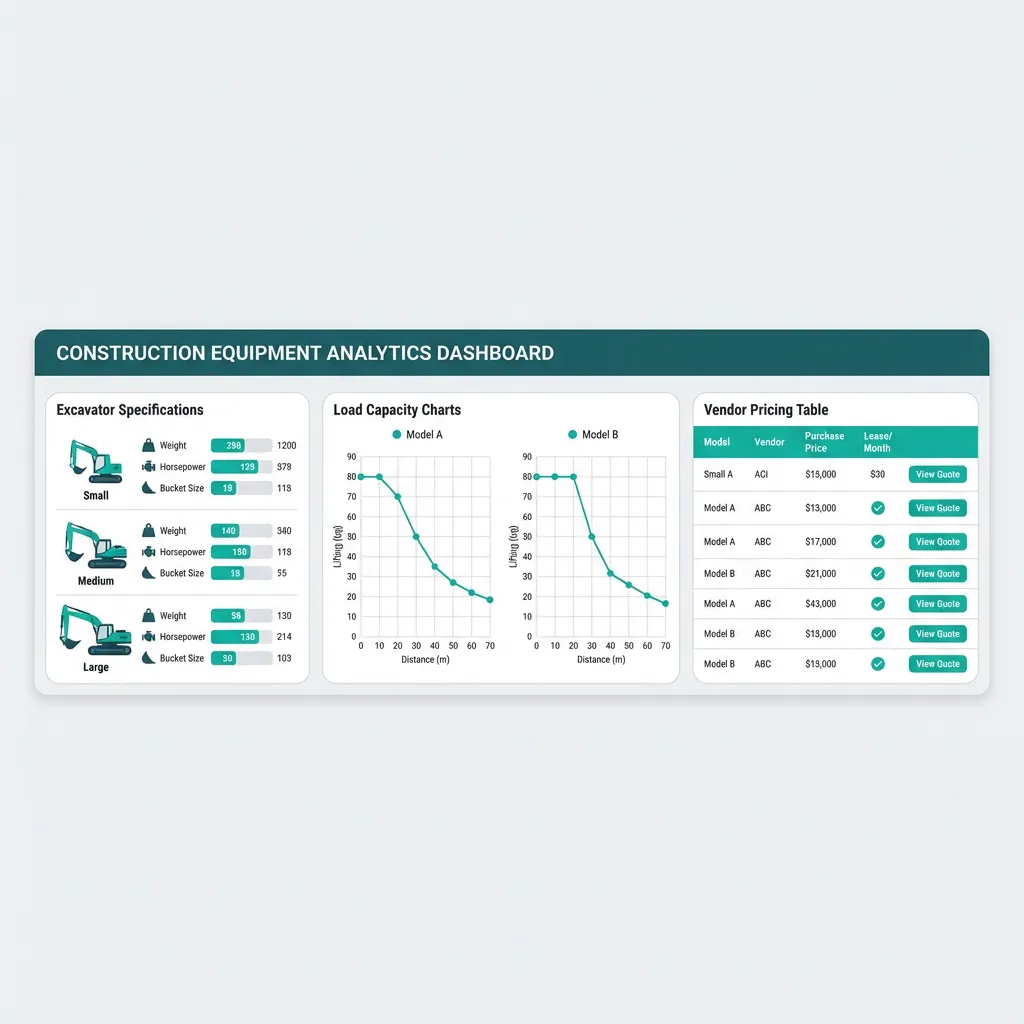
Excavator Specifications
| Specification | What It Means | Why It Matters |
|---|
| Operating weight | Total machine weight | Ground pressure, transport |
| Dig depth | Maximum excavation depth | Trench and foundation capability |
| Reach at ground | Horizontal reach | Working radius |
| Bucket capacity | Volume of bucket | Cycle productivity |
| Breakout force | Digging power | Material handling capability |
Crane Specifications
| Specification | What It Means | Why It Matters |
|---|
| Maximum capacity | Lift capacity at minimum radius | Heaviest pick possible |
| Capacity at radius | Lift at working distances | Actual job capability |
| Boom length | Maximum reach configuration | Working height and radius |
| Tip height | Maximum hook elevation | Building height capability |
Emissions & Compliance
| Regulation | Requirement | Impact |
|---|
| EPA Tier 4 Final | Current US emissions standard | Requires DEF, DPF, SCR |
| Stage V (EU) | European emissions standard | Similar to Tier 4 |
| CARB regulations | California-specific | More restrictive in some areas |
| Low-emission zones | Urban area restrictions | May limit equipment use |
Buy vs Rent Decision
When to Buy
| Factor | Buy Indicator |
|---|
| Utilization | High utilization expected (>60-70%) |
| Duration | Long-term need (years, not months) |
| Configuration | Specialized configuration required |
| Capability | Fleet management capability exists |
| Residual value | Strong expected resale |
When to Rent
| Factor | Rent Indicator |
|---|
| Utilization | Low or uncertain utilization |
| Duration | Short-term or project-specific need |
| Specialty | Equipment rarely needed |
| Cash | Cash preservation is priority |
| Flexibility | Need to scale fleet up/down |
Hybrid Arrangements
| Arrangement | Description | Best For |
|---|
| Rent-to-own | Rental payments apply toward purchase | Testing before committing |
| Operating lease | Set term, return equipment at end | Predictable cost |
| RPO | Rent with purchase option | Flexibility with potential ownership |
| Seasonal rental | Rent during peak, own core fleet | Variable demand |
Total Cost Analysis
| Category | Key Factors |
|---|
| Fuel | Consumption rate, hours, fuel prices |
| Maintenance | PM frequency, repair history, labor |
| Parts | Wear items, repair parts, filters |
| Insurance | Liability, physical damage |
| Operator | Labor cost, training |
Resale Value Factors
| Factor | Effect on Residual |
|---|
| Brand reputation | Premium brands hold value better |
| Condition | Maintenance history, appearance, wear |
| Hours | Primary depreciation driver |
| Configuration | Popular configurations sell faster |
Used vs. New Equipment
🔧 Buy NEW When:
- Reliability is paramount (primary crane, critical machine)
- Utilization is high (2,000+ hours/year)
- Technology matters (GPS grade control, telematics)
- You cannot risk undefined repair bills
⚙️ Buy USED When:
- It's a backup or support machine
- Going into harsh environment (demolition, rock crushing)
- Want to avoid 20-30% first-year depreciation
- Need equipment immediately (new lead times are 6 months)
Equipment Lifecycle
| Equipment Type | Typical Economic Life |
|---|
| Excavators | 10,000-15,000 hours |
| Loaders | 12,000-18,000 hours |
| Dozers | 12,000-18,000 hours |
| Trucks | 10,000-15,000 hours |
| Cranes | 15,000-25,000 hours |
Procurement Checklist
Requirements Definition
- ☐ Project requirements identified
- ☐ Equipment type and size determined
- ☐ Utilization estimate developed
- ☐ Buy vs rent analysis completed
- ☐ Budget established
Vendor Evaluation
- ☐ Potential sources identified
- ☐ Specifications collected
- ☐ Demonstrations/inspections completed
- ☐ References checked
- ☐ Dealer capabilities evaluated
Equip Your Projects Right
Construction equipment decisions affect project economics for years. Compare systematically and choose based on real project requirements, not marketing claims — see our specification comparison guide for the systematic side-by-side workflow, plus scope gap detection and OR-equal substitutions for construction-specific issues.
Construction Procurement → | Vendor Risk Assessment → | Bluebeam Alternatives →
Ready to Transform Your Procurement Process?
Try SpecLens today and experience AI-powered specification comparison. Save time, reduce errors, and make better purchasing decisions.
