IT hardware procurement sits at the intersection of technical complexity and business value. Get it right, and your infrastructure enables growth, performance, and competitive advantage. Get it wrong, and you're managing limitations for years. (See IT & data center procurement for the wider sector view, and 10 IT vendor selection tips for tactical guidance.)
This comprehensive guide covers what IT buyers need to know when evaluating and purchasing enterprise hardware—from servers to storage to network equipment. For the cloud vs on-prem dimension, see our Cloud vs On-Premise Software guide; for full lifecycle cost, the TCO Calculator Guide walks through a 5-year server example end-to-end.
Why IT Hardware Decisions Matter
The Strategic Impact
| Impact Area | Consequence |
|---|
| Application performance | User experience, productivity |
| Data capacity | What you can store and analyze |
| Business continuity | Uptime, disaster recovery |
| Scalability | Ability to grow |
| Security posture | Protection capability |
| Operating costs | Power, cooling, maintenance |
The Financial Commitment
| Equipment Type | Typical Price Range |
|---|
| Rack servers | $5,000 - $50,000+ per unit |
| Blade systems | $20,000 - $200,000+ per chassis |
| Enterprise storage | $50,000 - $2,000,000+ |
| Core network switches | $10,000 - $100,000+ |
| HCI platforms | $50,000 - $500,000+ |
Enterprise Hardware Categories
| Category | Key Components | Primary Considerations |
|---|
| Compute | Servers, HCI, blades | Performance, density, management |
| Storage | SAN, NAS, object, all-flash | Capacity, performance, data services |
| Network | Switches, routers, wireless | Throughput, latency, manageability |
| End User | Desktops, laptops, monitors | Standardization, productivity |
Procurement Model Options
| Model | Characteristics | Best For |
|---|
| Capital purchase | Own the asset, depreciate | Stable workloads, long-term |
| Lease | Operating lease, return at end | Preserve capital, refresh regularly |
| HWaaS | Subscription model, vendor managed | Predictable costs, less management |
| Hybrid cloud | Mix on-premises with cloud | Variable workloads, flexibility |
Server Procurement
Server Architecture Choices
| Architecture | Characteristics | Best For |
|---|
| Rack mount | Discrete units, maximum flexibility | Traditional data centers |
| Blade | Shared infrastructure, high density | Compute-heavy, standardized |
| Converged/HCI | Integrated compute+storage+network | Simplified management |
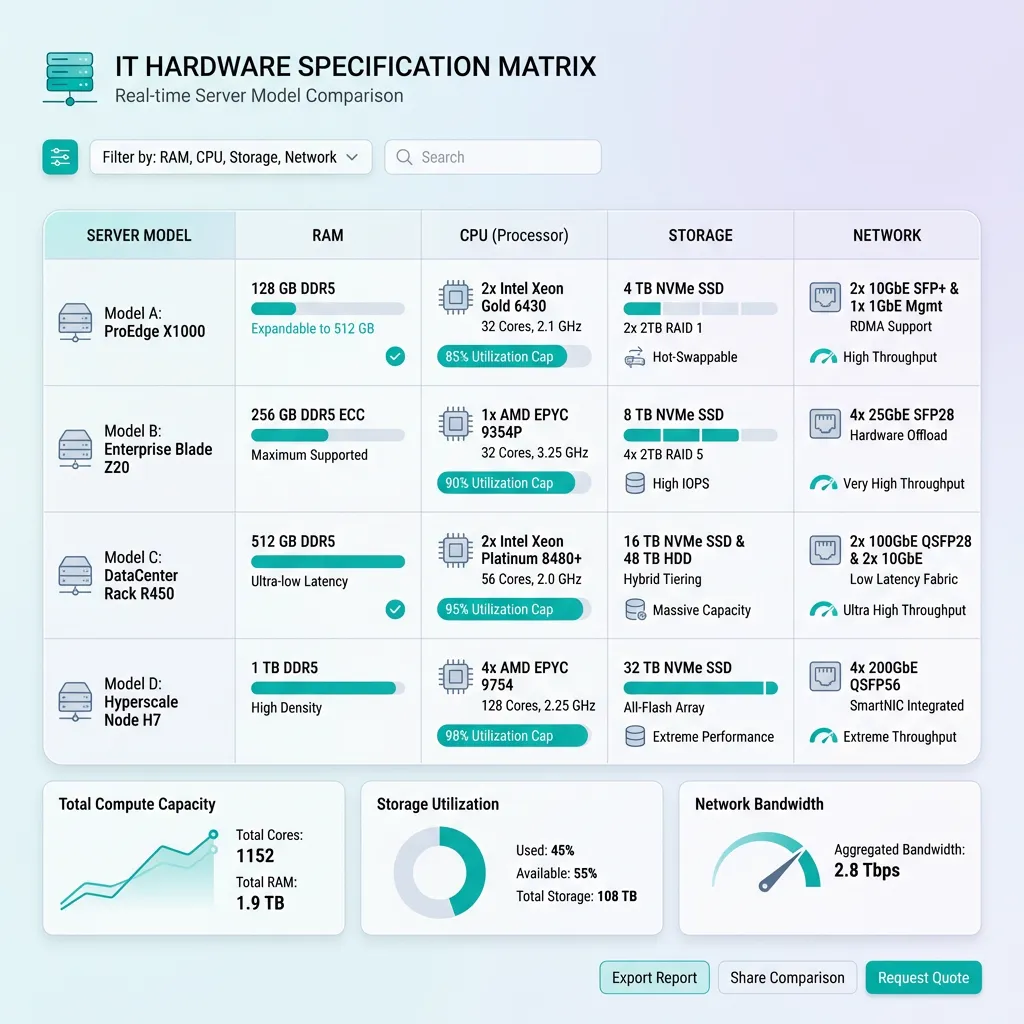
Critical Server Specifications
| Specification | What to Evaluate | Why It Matters |
|---|
| Processor | Model, cores, frequency, cache, TDP | Compute capability, power consumption |
| Memory | Capacity, slots, max expansion, speed | Application requirements, growth |
| Storage | Drive bays, interfaces, NVMe support | Local vs. SAN, performance tier |
| Network | NIC ports, speed, offload capabilities | Connectivity, throughput |
| Power | Wattage, redundancy, efficiency rating | Operating cost, reliability |
| Management | Remote access, monitoring, automation | Operational efficiency |
Memory Configuration
| Workload Type | Memory Consideration |
|---|
| Database | Large memory for caching, ECC critical |
| Virtualization | Memory per VM × density |
| Analytics | In-memory processing needs |
| Web/app servers | Typically moderate requirements |
| Container/K8s | Pod density and limits |
Storage Procurement
Storage Architectures
| Type | Characteristics | Best For |
|---|
| SAN (Fibre Channel) | Block storage, high performance | Enterprise databases, mission-critical |
| SAN (iSCSI) | Block storage over Ethernet, lower cost | Moderate performance |
| NAS | File-based, shared access | Unstructured data, collaboration |
| Object | Massive scale, cloud-native APIs | Backups, archives, media |
| All-Flash | Lowest latency, highest IOPs | Transaction processing, real-time |
Key Storage Specifications
| Specification | What to Evaluate | Why It Matters |
|---|
| Capacity | Raw vs. usable, expansion options | Current and future needs |
| Performance | IOPs, throughput, latency | Application requirements |
| Data protection | RAID, replication, snapshots | RPO, RTO requirements |
| Efficiency | Deduplication, compression ratios | Effective vs. raw capacity |
| Scalability | Max capacity, performance scaling | Growth accommodation |
Network Equipment Procurement
Switch Specifications
| Specification | What to Evaluate | Typical Ranges |
|---|
| Port count | Data + uplink ports | 12 to 96+ |
| Speed | 1G/10G/25G/40G/100G | Match infrastructure |
| Throughput | Aggregate bandwidth | Non-blocking preferred |
| Latency | Port-to-port latency | Microseconds for modern |
| PoE capability | Wattage per port, total budget | 15W to 90W+ per port |
Wireless Access Points
| Specification | What to Evaluate |
|---|
| WiFi standards | WiFi 6/6E/7 support |
| Spatial streams | MU-MIMO capabilities |
| Client density | Max simultaneous clients |
| Management | Controller options (cloud vs. on-prem) |
Total Cost of Ownership
| Cost Component | Typical % of TCO | Examples |
|---|
| Hardware purchase | 25-40% | Equipment, options |
| Software/licensing | 10-20% | OS, management, features |
| Implementation | 5-15% | Setup, migration, integration |
| Power and cooling | 15-25% | Electricity, HVAC |
| Maintenance/support | 15-25% | Vendor support, parts |
| Personnel | 10-20% | Administration, management |
💡 Power Cost Example
A 500W server running 24/7 at $0.10/kWh = $438/year in power alone. Over 5 years, that's $2,190—potentially more than the server cost.
Support and Maintenance
| Support Level | Typical Coverage | Cost Range |
|---|
| Basic | Business hours, next business day | 10-15% of hardware/year |
| Standard | 24/7, 4-hour response | 15-20% of hardware/year |
| Premium | 24/7, 2-hour response, proactive | 20-30% of hardware/year |
Pro Tip: Negotiate multi-year support during purchase when you have maximum leverage.
Security Considerations
⚠️ Hardware Supply Chain Security
- Supply Chain Attacks: Buy exclusively from authorized channels. Avoid "gray market" hardware.
- Firmware Integrity: Require digitally signed firmware updates.
- Country of Origin: For sensitive industries, TAA compliance is mandatory.
IT Hardware Procurement Checklist
Requirements Definition
- ☐ Workload requirements documented
- ☐ Performance baselines established
- ☐ Capacity projections completed
- ☐ Integration requirements identified
- ☐ Budget established
Vendor Evaluation
- ☐ Qualified vendors identified
- ☐ Specifications collected
- ☐ Demos/PoC completed (if applicable)
- ☐ References checked
- ☐ Support capabilities evaluated
Make Smarter IT Hardware Decisions
IT hardware decisions impact your organization for years. Systematic specification comparison ensures you're making decisions based on requirements and data, not vendor marketing — pair it with the storage procurement solution overview if your stack runs SAN/NAS-heavy.
IT & Data Center Procurement → | Spec Sheet Analysis → | Vendor Datasheet Comparison →
Ready to Transform Your Procurement Process?
Try SpecLens today and experience AI-powered specification comparison. Save time, reduce errors, and make better purchasing decisions.
