
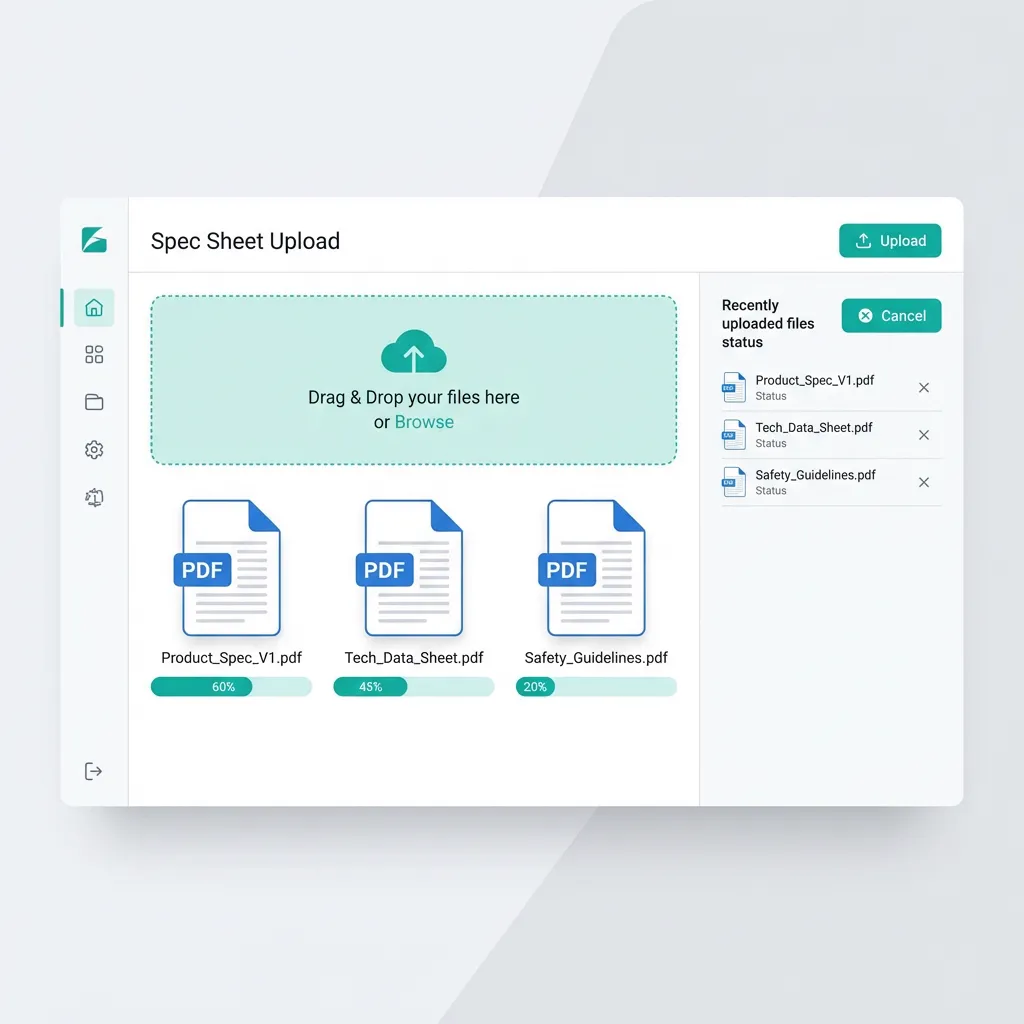
Technical Spec Sheet Analysis
Master technical spec sheet analysis for procurement. Extract critical specs, spot gaps, and compare vendor datasheets.
Priya Sharma
Procurement Technology Lead, SpecLens
- 850+companies trust SpecLens
- 99%extraction accuracy
- 8 hrssaved per comparison
- AES-256encrypted · GDPR compliant
A technical spec sheet contains the truth about what equipment can and can't do—but only if you know how to read it. Marketing claims disappear when you examine the actual specifications. The best vendor becomes obvious when you compare what matters. (For the cross-vendor side-by-side workflow, see vendor datasheet comparison methods; for the broader spec-comparison process, how to compare product specifications.)
This comprehensive guide teaches you how to analyze technical spec sheets for effective procurement decisions — pair it with our spec compliance verification guide for award-time verification, and unit conversion in procurement when datasheets mix units.
Why Spec Sheet Analysis Matters
Beyond Marketing Claims
Spec sheets provide objective data:
| Marketing Says | Spec Sheet Shows |
|---|---|
| "High performance" | Actual throughput numbers |
| "Energy efficient" | Power consumption in watts |
| "Compact design" | Exact dimensions |
| "Industry-leading" | Measurable specifications |
| "Easy integration" | Interface specifications |
The Decision Foundation
| Capability | Result |
|---|---|
| Objective comparison | Data-driven vendor selection |
| Requirements verification | Confirm fit to needs |
| Gap identification | Know what's missing |
| Future planning | Assess scalability |
| Risk reduction | Avoid capability surprises |
Common Spec Sheet Challenges
| Challenge | Impact |
|---|---|
| Different formats | Hard to compare directly |
| Varying terminology | Same spec, different names |
| Unit inconsistencies | Conversions required |
| Missing specifications | Gaps not obvious |
| Conditional claims | Footnotes limit applicability |
| Marketing mixed in | Separating substance from spin |
Understanding Spec Sheet Structure
Common Sections
| Section | Contains |
|---|---|
| Overview | Product summary, key features |
| Performance | Speed, capacity, throughput |
| Physical | Dimensions, weight, mounting |
| Electrical | Power, voltage, current |
| Environmental | Temperature, humidity, rating |
| Interface | Connectivity, protocols, compatibility |
| Compliance | Certifications, standards |
Reading Priority
| Priority | Focus |
|---|---|
| Critical | Specifications that determine fit-for-purpose |
| Important | Specifications affecting value and efficiency |
| Reference | Specifications unlikely to differentiate |
| Ignore | Marketing claims without technical substance |
Understanding Values and Conditions
Specifications often come with conditions:
| Specification Statement | What It Actually Means |
|---|---|
| "Up to 1000 units/hour" | Maximum under ideal conditions |
| "Operating temp: 0-40°C" | Won't work outside this range |
| "99.9% uptime (typical)" | Not guaranteed |
| "*See footnote" | Limitations apply |
Pro Tip: Always read the conditions attached to specifications. The headline number is often the best-case scenario, not the typical performance.
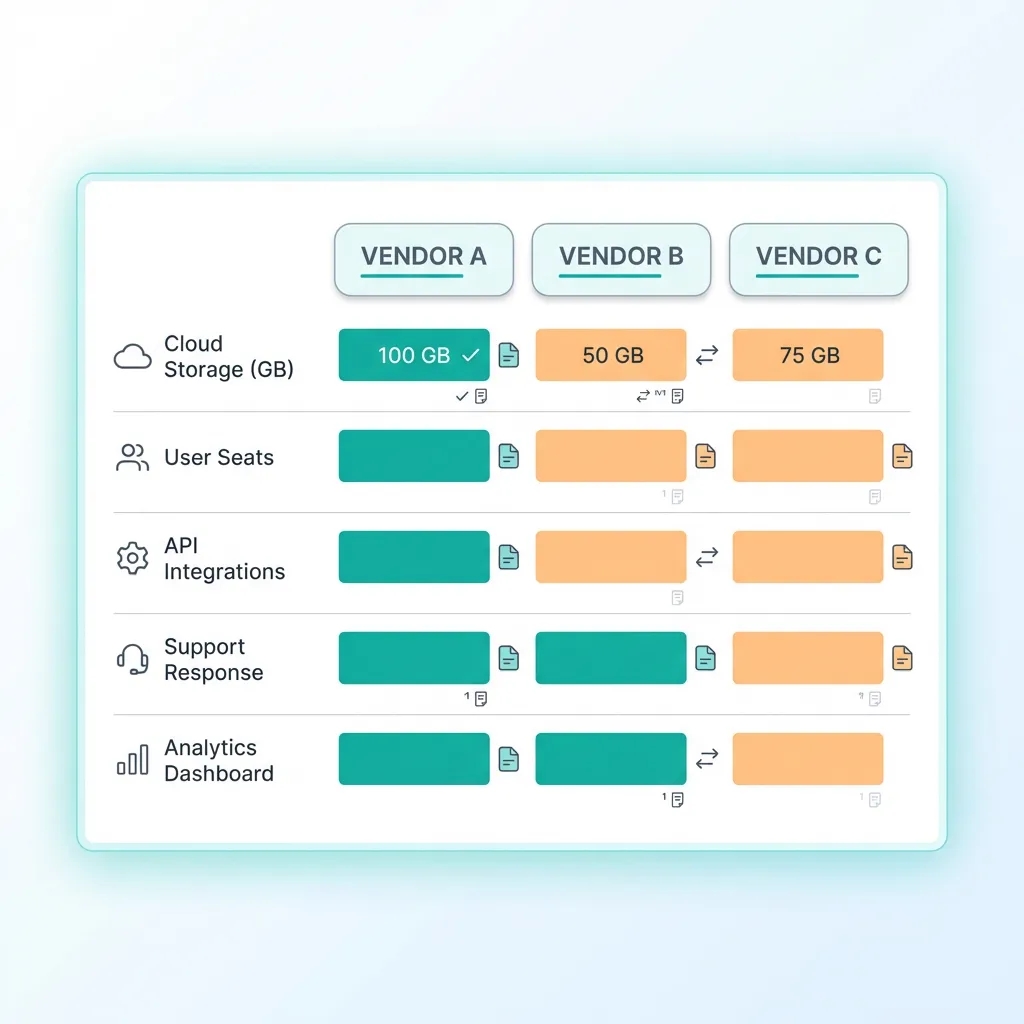
Critical Specification Categories
Performance Specifications
These determine if equipment can do the job:
| Specification Type | Examples | Why It Matters |
|---|---|---|
| Capacity | Volume, units, throughput | Can it handle your needs? |
| Speed | Cycle time, processing rate | Fast enough for requirements? |
| Accuracy | Precision, tolerance, error rate | Quality level acceptable? |
| Power | Horsepower, wattage, torque | Sufficient for application? |
| Range | Operating range, coverage | Works in your conditions? |
Physical Specifications
Determine if equipment fits your environment:
| Specification Type | Examples | Why It Matters |
|---|---|---|
| Dimensions | Length, width, height | Fits in allocated space? |
| Weight | Operating weight, shipping weight | Floor load, handling capacity? |
| Mounting | Floor, rack, wall, etc. | Compatible with installation? |
| Footprint | Floor space required | Space efficient? |
| Clearance | Service access requirements | Room for maintenance? |
Common oversights:
- Forgetting service clearance requirements
- Not checking floor load capacity
- Ignoring door/elevator size for installation
- Missing utility connection locations
Electrical Specifications
| Specification Type | Examples | Why It Matters |
|---|---|---|
| Voltage | 120V, 208V, 240V, 480V | Match available power? |
| Phase | Single-phase, 3-phase | Electrical infrastructure? |
| Current | Amps, full-load amps | Circuit capacity? |
| Power | Watts, kW | Operating cost, capacity? |
| Efficiency | 80 PLUS rating, efficiency % | Energy cost? |
Environmental Specifications
| Specification Type | Examples | Why It Matters |
|---|---|---|
| Temperature | Operating range, storage range | Works in your environment? |
| Humidity | RH range, condensing limits | Climate appropriate? |
| Altitude | Maximum operating altitude | High-altitude locations? |
| IP rating | Ingress protection (dust/water) | Environmental exposure? |
| Vibration | Tolerance levels | Installation environment? |
⚠️ Temperature Example
- Equipment operating range: 0°C to 40°C
- Your environment: Warehouse with summer peaks of 45°C
- Problem: Equipment may not perform or survive
Interface Specifications
| Specification Type | Examples | Why It Matters |
|---|---|---|
| Physical ports | USB, Ethernet, serial, etc. | Connection capability? |
| Protocols | MODBUS, OPC-UA, REST API | System integration? |
| Data formats | JSON, XML, CSV | Data exchange? |
| Standards compliance | Industry protocols | Interoperability? |
| Expansion | Slots, ports, capacity | Future growth? |
Compliance Specifications
| Specification Type | Examples | Why It Matters |
|---|---|---|
| Safety certifications | UL, CE, CSA | Legal requirements? |
| Industry standards | ISO, ASME, ASTM | Quality assurance? |
| Regulatory approval | FDA, FCC, EPA | Permitted use? |
| Environmental | RoHS, WEEE | Sustainability compliance? |
Extraction Methodology
Step 1: Prepare Your Requirements List
| Requirement ID | Specification | Required Value | Priority |
|---|---|---|---|
| REQ-001 | Processing speed | ≥ 500 units/hour | Critical |
| REQ-002 | Power supply | 208V single-phase | Critical |
| REQ-003 | Operating temp | -10°C to 45°C | Important |
| REQ-004 | Network interface | Ethernet, REST API | Important |
Step 2: Extract Systematically
- Find the corresponding specification
- Note the exact value
- Note the units
- Note any conditions
- Record page/section reference
Step 3: Normalize Data
| Vendor | Raw Value | Normalized |
|---|---|---|
| A | 500 units/hr | 500 units/hr |
| B | 9 units/min | 540 units/hr |
| C | 0.15 units/sec | 540 units/hr |
Step 4: Compare to Requirements
| Requirement | Required | Vendor A | Vendor B | Vendor C |
|---|---|---|---|---|
| Speed | ≥ 500 u/hr | 500 ✓ | 540 ✓ | 540 ✓ |
| Voltage | 208V | 208V ✓ | 480V ✗ | 208V ✓ |
| Temp range | -10 to 45°C | 0-40°C ✗ | -20 to 50°C ✓ | -10 to 45°C ✓ |
Common Analysis Pitfalls
Assuming Unmarked = Adequate
Mistake: If a specification isn't listed, assuming it's acceptable.
Reality: Missing specifications may mean not applicable, vendor doesn't know, deliberately omitting unfavorable data, or different terminology.
Solution: Ask directly when critical specifications are missing.
Ignoring Conditions and Footnotes
Mistake: Reading headline numbers, skipping fine print.
Example:
Headline: "1000 units/hour capacity"
Footnote: "*At 50% of rated load"
Solution: Always read conditions. Understand what's really being specified.
Comparing Incomparable Values
Mistake: Comparing values measured differently.
Example:
- Vendor A: "Efficiency: 95%" (at full load)
- Vendor B: "Efficiency: 92%" (across operating range)
Solution: Understand measurement conditions. Request comparable data.
Standardizing Units: The Metric Headache
Nothing kills a comparison faster than mixed units.
📐 The "Bar vs PSI" Problem
- Vendor A: 10 Bar
- Vendor B: 150 PSI
Quick check: 10 Bar = 145 PSI. Vendor B wins.
Without converting, Vendor A looks smaller ("10" < "150").
Best Practice: Create a "Normalized" column in your analysis spreadsheet. Convert EVERYTHING to your standard unit.
Handling "Proprietary" Values
Vendors love to invent metrics that only they can win.
- Apple: "Retina Display" (Instead of PPI)
- Dyson: "Air Watts" (Instead of CFM/Suction)
The Procurement Counter-Move: Reject the proprietary unit. Ask for the underlying scientific metric. If they refuse, penalize the score for "Lack of Transparency."
AI-Powered Spec Sheet Analysis
| Task | Manual | AI-Powered |
|---|---|---|
| Extract specifications | Hours per vendor | Minutes total |
| Normalize units | Manual calculation | Automatic |
| Terminology mapping | Experience required | AI handles |
| Gap detection | Visual inspection | Automatic highlighting |
| Comparison matrix | Build spreadsheet | Auto-generated |
Spec Sheet Analysis Checklist
Before Analysis
- ☐ Requirements list prepared
- ☐ Priority specifications identified
- ☐ Unit preferences established
- ☐ Comparison framework ready
During Analysis
- ☐ All required specifications extracted
- ☐ Units recorded with values
- ☐ Conditions and footnotes noted
- ☐ Source locations documented
- ☐ Missing specifications flagged
After Analysis
- ☐ Values normalized for comparison
- ☐ Requirements compliance checked
- ☐ Gaps identified and documented
- ☐ Questions for vendors listed
- ☐ Summary prepared for decision-makers
Master Specification Analysis
Effective spec sheet analysis separates the best vendors from the rest. Whether analyzing manually or using AI tools, a structured approach ensures complete, accurate, comparable data for procurement decisions — see our OCR vs AI document analysis comparison for the technology side.
Specification Compliance Matrix → | Vendor Datasheet Comparison → | Free Specification Checklist Generator →
Frequently Asked Questions
Related Articles
Vendor Datasheet Comparison Methods
Learn effective vendor datasheet comparison methods. Transform PDF datasheets into structured side-by-side comparisons.
Spec Compliance Verification Guide
Learn how to verify vendor specs actually meet your requirements. Systematic compliance verification for accurate procurement.
Specification Gap Analysis Guide
Learn specification gap analysis to identify missing vendor information. Catch incomplete proposals before they become costly.
Unit Conversion in Procurement
Master unit conversion in procurement to avoid spec mismatches and costly errors. Includes conversion tables and formulas.