When one vendor quotes in inches and another in millimeters, a single conversion error can mean ordering equipment that doesn't fit, specifying materials that don't work, or selecting the wrong vendor entirely. (For the broader cross-vendor workflow, see vendor datasheet comparison methods and how to compare product specifications.)
Unit conversion seems simple—until it causes a $100,000 mistake. This comprehensive guide covers unit conversion in procurement: common errors, conversion tables, and systematic approaches to prevent mistakes — and is one of the patterns we trace in specification gap analysis and why <25% of custom manufacturing quotes are accurate.

Why Unit Conversion Matters in Procurement
Real-World Errors
| Error Type | Example | Consequence |
|---|
| Dimension mismatch | Equipment 2 inches too wide for space | Expensive redesign or return |
| Weight error | Structural support inadequate | Safety issue, remediation cost |
| Power miscalculation | Electrical capacity insufficient | Additional infrastructure cost |
| Temperature range | Operating limits misunderstood | Equipment failure |
| Pressure specification | Rating inadequate for application | Safety risk, equipment damage |
| Flow rate error | Pump undersized for requirements | System performance issues |
Where Errors Occur
| Scenario | Risk |
|---|
| International vendors | Different unit systems default |
| Legacy specifications | Old documents, inconsistent units |
| Multiple vendor comparison | Each using different units |
| Manual data entry | Transcription errors |
| Mental conversion | Approximation errors |
| Calculator misuse | Decimal point errors |
⚠️ Error Compounding Example
- Spec says "1 inch wall thickness"
- Converted incorrectly to "25 mm" instead of "25.4 mm"
- Error of 0.4mm per inch
- 100-inch length = 40mm short
- Equipment doesn't fit application
Small percentage errors create large absolute problems at scale.
The Financial Impact
| Error Magnitude | Typical Consequences |
|---|
| 1-2% | May be within tolerance |
| 2-5% | Fit and function issues |
| 5-10% | Significant incompatibility |
| 10%+ | Complete mismatch, replacement |
Common Procurement Unit Categories
Length/Dimension
| Unit | Symbol | Equal To |
|---|
| Inch | in | 25.4 mm |
| Foot | ft | 304.8 mm = 0.3048 m |
| Yard | yd | 0.9144 m |
| Mile | mi | 1.609 km |
| Millimeter | mm | 0.03937 in |
| Meter | m | 3.281 ft |
Common Error: Using 25mm for 1 inch (actual is 25.4mm).
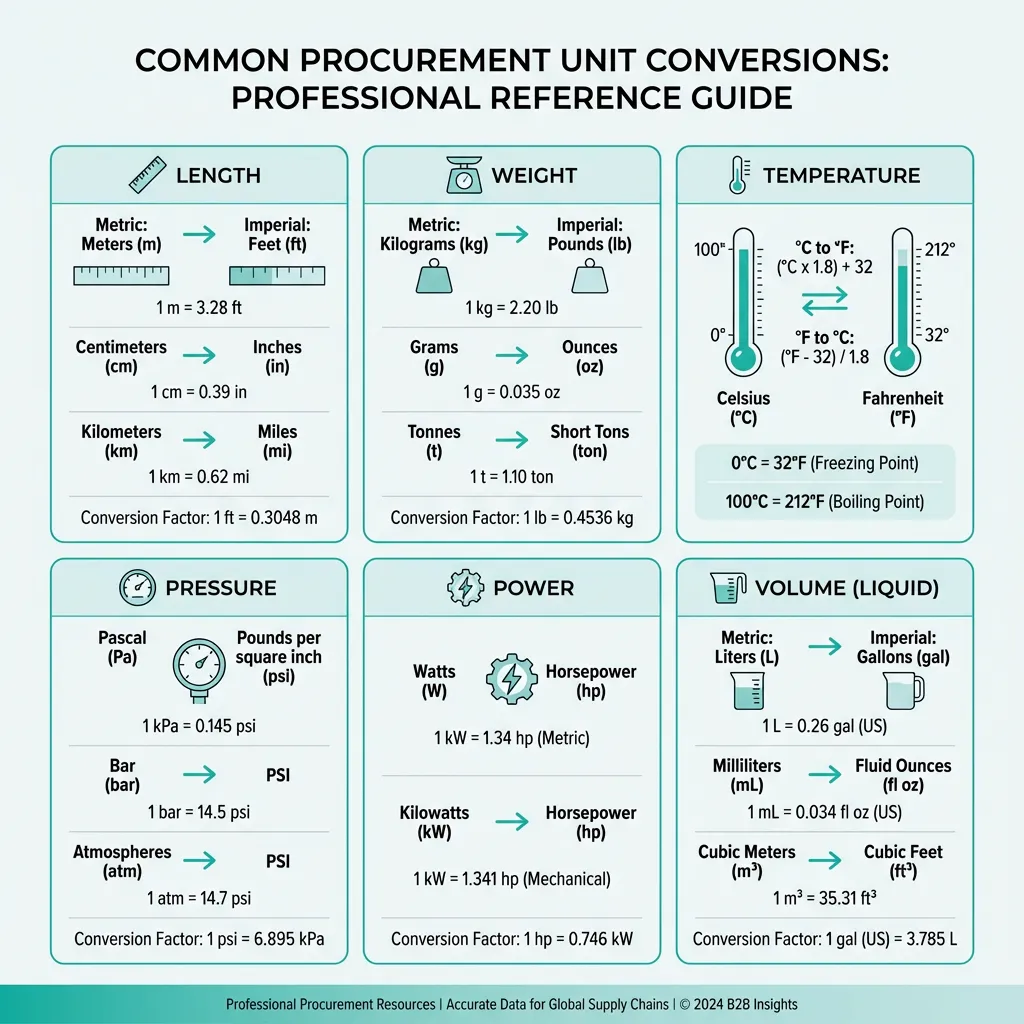
Weight/Mass
| Unit | Symbol | Equal To |
|---|
| Ounce | oz | 28.35 g |
| Pound | lb | 0.4536 kg = 453.6 g |
| Short ton (US) | ton | 907.2 kg = 2,000 lb |
| Long ton (UK) | long ton | 1,016 kg = 2,240 lb |
| Metric ton (tonne) | t | 1,000 kg = 2,205 lb |
| Kilogram | kg | 2.205 lb |
Critical Distinction: Ton vs. tonne vs. long ton are NOT interchangeable. Always verify which ton system is being used.
Volume/Capacity
| Unit | Symbol | Equal To |
|---|
| Fluid ounce (US) | fl oz | 29.57 mL |
| Gallon (US) | gal | 3.785 L |
| Gallon (UK/Imperial) | gal | 4.546 L |
| Cubic foot | ft³ | 28.32 L |
| Liter | L | 0.2642 gal (US) |
| Barrel (oil) | bbl | 159 L = 42 gal (US) |
Common error: US gallon vs. Imperial gallon (20% difference).
Temperature
| Conversion | Formula |
|---|
| °F to °C | (°F - 32) × 5/9 |
| °C to °F | (°C × 9/5) + 32 |
| °C to K | °C + 273.15 |
Key Reference Points
| Celsius | Fahrenheit | Context |
|---|
| -40°C | -40°F | Extreme cold |
| 0°C | 32°F | Freezing |
| 20°C | 68°F | Room temperature |
| 100°C | 212°F | Boiling |
Pressure
| Unit | Symbol | Equal To |
|---|
| Pounds per sq inch | PSI | 6.895 kPa = 0.06895 bar |
| Bar | bar | 14.50 PSI = 100 kPa |
| Kilopascal | kPa | 0.1450 PSI |
| Atmosphere | atm | 14.70 PSI = 101.3 kPa |
Power/Energy
| Unit | Symbol | Equal To |
|---|
| Watt | W | Base unit |
| Kilowatt | kW | 1,000 W |
| Horsepower (mechanical) | HP | 745.7 W |
| Horsepower (metric) | PS | 735.5 W |
| BTU/hour | BTU/h | 0.2931 W |
Common confusion: kW (power) vs. kWh (energy) - completely different concepts.
Data/Information
| Unit | Symbol | Equal To |
|---|
| Megabit | Mb | 1,000,000 bits |
| Megabyte | MB | 1,024 KB (or 1,000 KB SI) |
| Megabit per second | Mbps | Network speed |
| Megabyte per second | MB/s | Storage speed |
Common Error: Mbps vs. MB/s (8× difference: 8 Mbps = 1 MB/s).
Systematic Conversion Process
Step-by-Step Approach
- Identify source unit: What unit is the vendor using? Which variation (US/UK)?
- Identify target unit: What unit is your specification in?
- Find conversion factor: Use reliable source, verify with second source for critical conversions
- Perform conversion: Write out calculation, use calculator (not mental math)
- Validate: Does result seem reasonable? Sanity check against expectations
Documentation
For every conversion, document:
| Document | Include |
|---|
| Original value | Vendor's stated specification |
| Original unit | Exactly as stated |
| Conversion factor | Factor used |
| Converted value | Calculated result |
| Target unit | Result unit |
| Source | Where conversion factor came from |
Normalize to Standard
| Category | Suggested Standard | Rationale |
|---|
| Length | Millimeters (mm) | SI, precision |
| Weight | Kilograms (kg) | SI, universal |
| Volume | Liters (L) | SI, clear |
| Temperature | Celsius (°C) | SI, international |
| Pressure | kPa or bar | SI, clear meaning |
| Power | Watts (W) or kW | SI, standard |
Common Error Prevention
Errors to Avoid
| Error | Prevention |
|---|
| Using approximate factors | Use exact factors for precision |
| Wrong unit direction | Verify multiplication vs. division |
| Decimal point errors | Double-check decimal placement |
| Confusing similar units | Clearly distinguish US/UK/metric |
| Mental math | Use calculator |
| Copy without verification | Confirm pasted values |
Cross-Check Methods
- Reference comparison: Does converted dimension confirm fit in allocated space?
- Round number check: Did round numbers stay round? (100 inches = 2,540mm)
- Magnitude check: Is result in right order of magnitude?
- Inverse verification: Convert result back to original unit
Spreadsheet Formula Examples
| Conversion | Formula |
|---|
| Inches to mm | =A1*25.4 |
| mm to inches | =A1/25.4 |
| lb to kg | =A1*0.45359237 |
| kg to lb | =A1*2.20462262 |
| °F to °C | =(A1-32)*5/9 |
| °C to °F | =A1*9/5+32 |
| PSI to bar | =A1*0.0689476 |
| HP to kW | =A1*0.7457 |
Quick Reference Tables
Length Quick Reference
| Convert | Multiply By |
|---|
| Inches → mm | 25.4 |
| mm → inches | 0.03937 |
| Feet → meters | 0.3048 |
| Meters → feet | 3.281 |
Weight Quick Reference
| Convert | Multiply By |
|---|
| Pounds → kg | 0.4536 |
| kg → pounds | 2.205 |
| Short tons → metric tons | 0.9072 |
Pressure Quick Reference
| Convert | Multiply By |
|---|
| PSI → bar | 0.06895 |
| bar → PSI | 14.504 |
| PSI → kPa | 6.895 |
Convert with Confidence
Unit conversion errors are preventable with systematic approach. Use verified conversion factors, document your process, and validate results. Or let AI tools handle normalization automatically — see OCR vs AI document analysis for the technology comparison and how SpecLens works for a worked walk-through.
Procurement Resources → | Vendor Datasheet Comparison → | Technical Spec Sheet Analysis →
Ready to Transform Your Procurement Process?
Try SpecLens today and experience AI-powered specification comparison. Save time, reduce errors, and make better purchasing decisions.
