

Custom Manufacturing Procurement: Why <25% of Quotes Are Accurate
Discover why fewer than 25% of rapid quotes in custom manufacturing are accurate — and the root causes behind ambiguous specs, BOM-procurement disconnect, and PDF-locked data. Includes a spec quality audit checklist.
Priya Sharma
Procurement Technology Lead, SpecLens
- 850+companies trust SpecLens
- 99%extraction accuracy
- 8 hrssaved per comparison
- AES-256encrypted · GDPR compliant
If you procure custom manufactured parts — CNC machined components, sheet metal fabrications, PCBAs, injection-molded plastics, or additive manufactured assemblies — you already know the frustration: you send out an RFQ, wait a week, and the quotes come back all over the map. Some are wildly overpriced. Some look suspiciously cheap. A few are missing lead times entirely. And almost none of them are quoting exactly what you asked for.
This isn't bad luck. It's a structural problem, and the data confirms it: research from Smart Industry found that fewer than 25% of rapid quotes received in custom manufacturing procurement were accurate — with inaccurate quoting ranked as the single top pain point in the entire custom manufacturing sourcing process.
That means three out of four quotes you receive are not fit for decision-making. You're either overpaying, under-specifying your risk, or wasting weeks in clarification loops. This guide explains exactly why this happens and — more importantly — how to fix it at the source. (For the broader RFQ playbook, see our how to write an RFQ guide and free RFQ template.)
What You'll Learn:
- Why custom manufacturing procurement has a quote accuracy crisis
- The 5 root causes behind inaccurate quotes
- The engineer-buyer translation gap and what it costs
- What machine-readable specifications actually look like
- How BOM-aware AI platforms are changing the game
- A spec quality audit checklist before your next RFQ cycle
- 10 signs your spec documentation is sabotaging your quotes
The Quote Accuracy Crisis in Custom Manufacturing
Custom manufacturing procurement is fundamentally different from commodity procurement. When you buy standard fasteners or generic cables, the specification is largely self-defining — the part number says what it is. But when you're sourcing a machined aluminum housing, a custom sheet metal chassis, or a multi-layer PCB assembly, the specification is the product. There is no standard. The quote is only as good as the information that went into requesting it.
The cascade effect is severe. An inaccurate quote typically means one of three things:
- The supplier quoted the wrong material grade because your spec said "stainless steel" without specifying 304 vs. 316L.
- The supplier assumed a different tolerance class because your drawing said "±0.1mm" but your quality engineer meant ±0.01mm.
- The supplier missed a critical process step because the surface treatment requirement was buried in a footnote on page 7 of a PDF.
Each of these errors has a compounding cost. If caught at quote stage, it costs a few days of back-and-forth. If caught at inspection, it costs a rejected batch. If caught at assembly, it can ground an entire production line. If caught in the field, the consequences can be catastrophic. The rework dollars compound into the patterns we trace in 15 hidden procurement costs.
The Real Cost of Quote Inaccuracy
A 2024 analysis of mid-market manufacturers found that specification-related rework and supplier disputes consumed an average of 12-18% of total procurement labor hours. When you add in the cost of delayed production starts and emergency re-sourcing, the total cost of spec-driven procurement failures often exceeds 3-5% of annual cost of goods sold.
The 5 Root Causes of Inaccurate Custom Manufacturing Quotes
1. Ambiguous or Incomplete Specification Documents
The most common cause — and the most fixable. Specification documents for custom parts often have gaps that are invisible to the engineering team (who already know the answer in their heads) but critical to the supplier (who doesn't). The full diagnostic for this pattern is in specification gap analysis; for unit ambiguity specifically, see unit conversion in procurement.
Common gaps include:
- Material specifications without grade or temper (e.g., "aluminum" instead of "6061-T6")
- Surface finish requirements without method or standard (e.g., "smooth finish" instead of "Ra 1.6μm, ground")
- Tolerance callouts without reference standard (e.g., "±0.005" without specifying inches or millimeters)
- Missing thread specifications (UNC vs. UNF vs. metric, class of fit)
- Undocumented heat treatment or coating requirements
- Missing quantity vs. tolerance tradeoff guidance (prototypes vs. production tooling expectations)
2. BOM-Procurement Disconnect
In most manufacturing companies, the Bill of Materials lives in the engineering or PLM system (SolidWorks PDM, Windchill, Arena, Teamcenter) while procurement operates out of an ERP or standalone procurement platform. These systems rarely talk to each other in real time.
The result: buyers are frequently working from exported spreadsheets or emailed PDFs that are one or two revisions behind the current engineering BOM. They're sourcing against specs that engineering has already updated — but never told procurement about.
In companies without a formal ECO (Engineering Change Order) process tied to procurement notifications, this disconnect is endemic. According to a survey of contract manufacturers, over 60% reported receiving RFQs that referenced superseded drawings at least monthly.
3. PDF-Locked Technical Data
Most manufacturing specifications are delivered as PDFs — scanned drawings, exported CAD-generated PDFs, or Word documents converted to PDF. While PDFs look authoritative, they are procurement dead-ends. A supplier receiving a 15-page PDF drawing package must manually extract every dimension, material, process, and tolerance to build a cost model.
Manual extraction is slow, error-prone, and inconsistent. Different estimators at the same supplier will extract different data from the same PDF. This is a primary driver of quote variance across suppliers bidding on identical work.
With Gartner predicting that 90% of B2B buying will be AI agent-intermediated by 2028, the incompatibility of PDF-locked specifications with automated procurement workflows is quickly becoming a strategic liability — explored in depth in our agentic AI in procurement guide and procurement AI data readiness guide.
4. Format Incompatibility Across the Supply Chain
Even when specifications are electronically structured (e.g., in a PLM system), they rarely translate cleanly into supplier quoting systems. A STEP file from CATIA may not import cleanly into a small job shop's Mastercam. A BOM exported from SAP may use internal part number schemas that mean nothing to a supplier.
The absence of a universal specification exchange format for custom manufactured goods is a structural market failure that the industry has never solved — and that newer platforms are only now beginning to address.
5. The Missing Context Problem
Technical drawings rarely capture the full context of what a part needs to do. A supplier quoting a bracket doesn't know whether it's a structural load-bearing member or a cosmetic cover panel. A supplier quoting a PCB doesn't know whether it will be used in a medical device (where IPC Class 3 is mandatory) or a consumer product (where Class 2 is acceptable). Without this context, suppliers make assumptions — and those assumptions become the hidden source of cost variance and quality failures.
The Engineer-Buyer Translation Gap
At the heart of the custom manufacturing procurement problem is an organizational disconnect that predates digital tools by decades. Engineers speak in GD&T, material standards, process codes, and revision histories. Buyers speak in lead times, unit costs, payment terms, and supplier scorecards. These two vocabularies overlap very little — and the handoff between them is where most specification failures originate.
| What Engineering Produces | What Procurement Needs | The Gap |
|---|---|---|
| Drawing with GD&T callouts | Clear, quotable specification | Buyer can't interpret GD&T; supplier assumes tolerances |
| BOM with internal part numbers | Supplier-readable material/part specs | Internal part numbers are meaningless externally |
| Revision-controlled drawings | Current, confirmed spec at time of RFQ | Buyer often sources from outdated revision |
| Process notes and quality standards | Explicit requirements in RFQ document | Process notes get lost in PDF conversion |
| Assembly context in design intent | Application context for supplier decisions | Supplier has no context for smart tradeoffs |
This translation gap has real costs. When procurement professionals in a 2025 survey were asked to estimate the time spent resolving specification clarifications with suppliers, the average answer was 4.2 hours per RFQ. For a team managing 200 active RFQs per year across a complex product portfolio, that's over 800 hours annually — the equivalent of roughly 20 weeks of a full-time employee's work — spent clarifying information that should have been in the specification to begin with.
What Machine-Readable Specifications Actually Look Like
"Machine-readable specification" sounds technical and intimidating, but it's simpler than it sounds. A machine-readable spec is one where the critical procurement data — material, process, dimensions, tolerances, quantity, surface finish, delivery requirements — exists in structured, queryable fields rather than buried in free-form text or locked in a PDF.
In practice, this means moving from this:
"See attached drawing REV C. Material: SS. Machine per drawing. 50 pcs. Need ASAP."
To this:
The structured version takes perhaps 5 more minutes to write — but it eliminates every common clarification question, enables accurate automated quoting, and is directly usable by AI procurement agents. It also compresses quote cycle times dramatically: suppliers with full information quote in hours, not days.
How BOM-Aware AI Is Changing Custom Manufacturing Procurement
The most significant recent development in this space is the emergence of procurement platforms that are BOM-aware — meaning they can ingest a bill of materials, read the underlying engineering data, and either auto-populate RFQ fields or flag specification gaps before the RFQ goes out.
Several platforms are making meaningful progress here:
CADDi
CADDi's platform ingests manufacturing drawings and BOMs and applies AI to detect missing attributes, flag tolerance inconsistencies, and compare supplier quotes in the context of the full part specification. Their AI assistant answers context-specific questions — "why did this supplier quote 3x the market rate?" — without requiring the buyer to re-read the entire drawing package. CADDi has found particular traction in automotive and industrial equipment manufacturing.
Jiga
Jiga is a custom parts sourcing platform purpose-built for CNC machining, sheet metal fabrication, additive manufacturing, and PCBs. Buyers upload CAD files and specifications; Jiga's platform routes the RFQ to a vetted supplier network, normalizes the specification data for quoting, and provides side-by-side quote comparison with engineering context. The platform's structured intake process ensures that material, process, and tolerance data are captured before any quote requests are sent.
LightSource AI
LightSource AI targets direct materials procurement for manufacturers, automating the RFQ process with supplier intelligence layered on top. Their AI can identify which suppliers in your network have the process capabilities to match your specification — before you send the RFQ — reducing the rate of "can't quote" responses that plague most custom manufacturing sourcing cycles.
Fictiv
Fictiv's digital manufacturing platform focuses on speed-to-quote for complex custom parts. By requiring structured CAD upload and specification entry at intake, they achieve near-instant quoting for a large range of standard manufacturing processes — and flag non-standard requirements for manual review rather than letting them quietly corrupt the quote.
The common thread across all of these platforms: they solve the specification problem at intake, not at clarification stage. They front-load the specification work so that the quote-to-order conversion rate is dramatically higher and the post-award surprises are dramatically lower.
The Specification-to-Sourcing Journey: What Best-in-Class Looks Like
In organizations with mature custom manufacturing procurement, the specification-to-sourcing journey looks very different from the typical "email a PDF and wait" process:
| Stage | Best-in-Class Practice | Common Failure Mode |
|---|---|---|
| Spec Creation | Structured templates with mandatory fields; engineering and procurement co-own | Engineering produces drawings; procurement is handed a PDF |
| Spec Review | Pre-RFQ spec completeness check against a defined checklist | Spec goes straight to RFQ without review |
| Supplier Matching | AI matches spec requirements to supplier capabilities before outreach | RFQ sent to the usual 3 suppliers regardless of process fit |
| Quote Intake | Structured quote response form; deviation reporting required | Freeform email responses compared manually |
| Quote Analysis | Normalized comparison; spec compliance check before price comparison — see spec compliance verification | Price-only comparison; spec deviations discovered post-award |
| Award | Spec-confirmed award; supplier acknowledges all critical requirements (use the Specification Compliance Matrix) | Award on price; spec confirmation deferred to PO terms |
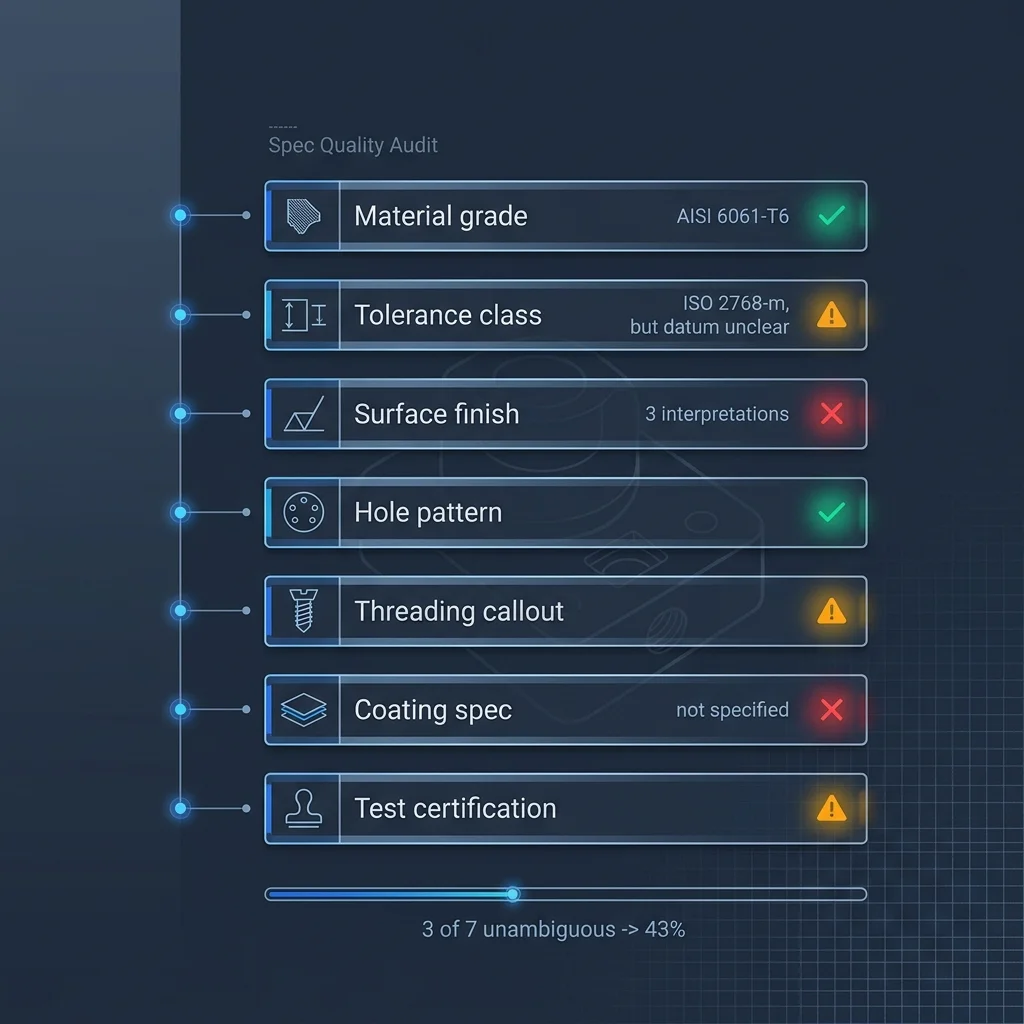
How to Run a Spec Quality Audit Before Your Next RFQ Cycle
Before you send out your next batch of custom manufacturing RFQs, run each specification through this audit. It takes 15-20 minutes per part family and will save you days of clarification time downstream.
Step 1: Check Material Specificity
Replace any generic material callouts with full ASTM/ISO/AMS-specified grades. "Aluminum" → "Aluminum 6061-T6, AMS 2770." "Stainless" → "316L SS, ASTM A276, Condition A." "Plastic" → "Nylon 6/6, 30% glass-filled, UL94 V-0 rated."
Step 2: Validate Tolerance Completeness
Every dimension that drives form, fit, or function needs a tolerance callout. If you're using GD&T, confirm that a procurement-readable summary table exists alongside the drawing — not every buyer can read Feature Control Frames fluently.
Step 3: Confirm Units Are Unambiguous
Mixed unit documents (some dimensions in mm, some in inches) are a leading cause of misquotes. Pick one unit system per drawing and enforce it. If you receive supplier quotes back in different units, that's a signal your spec was ambiguous.
Step 4: Check Process Requirements Are Explicit
Surface treatments, heat treatments, coatings, testing requirements, inspection standards — all must appear explicitly in the RFQ package, not only on the drawing. Many suppliers quote based on the RFQ text and never open the attached drawing.
Step 5: Add Application Context
One paragraph describing the application, environment, and critical use case will save you hours of back-and-forth. Suppliers make better engineering tradeoff decisions when they understand what the part does — and they flag potential issues they'd otherwise miss.
Step 6: Confirm Drawing Revision Currency
Before any RFQ release, confirm with engineering that the drawing revision in the package matches the current controlled release. This takes 2 minutes and prevents the most common specification failure mode in custom manufacturing.
10 Signs Your Spec Documentation Is Sabotaging Your Quotes
Suppliers regularly ask the same clarifying questions on repeat orders
Quote prices vary by more than 30% across suppliers on identical RFQs
Post-award spec clarifications are a normal part of your process
Engineering changes are communicated to suppliers verbally or by email rather than via updated documents
Your RFQ package is primarily a PDF with no structured data fields
Tolerance callouts use general notes ("machined surfaces ±0.005") rather than feature-specific tolerances
Material callouts use generic names without grade, standard, or condition
Surface finish requirements are described in words rather than Ra/Rz values
Your RFQ doesn't include application context or critical function requirements
Quote-to-order conversion rate is below 40% (industry benchmark for well-specified RFQs: 60-70%)
If 3 or more of these apply to your procurement process, specification quality is your highest-leverage improvement opportunity — ahead of supplier consolidation, price negotiation, or any technology investment. (For the should-cost discipline that closes the loop on quote variance, see should-cost analysis guide; for the wider sector view, manufacturing & industrial procurement and Manufacturing Equipment Buying Guide.)
The Bigger Picture: Why Spec Quality Matters for AI-Enabled Procurement
The urgency of spec quality improvement goes beyond the immediate efficiency gains. As AI-mediated procurement becomes the norm — Gartner projects that AI agents will handle the majority of B2B procurement interactions by 2028 — machine-readable, structured specifications become the entry ticket to the new procurement ecosystem.
AI procurement agents can't interpret ambiguous natural language specs. They can't read between the lines of a 15-page PDF the way an experienced buyer can. They need clean, structured data. Organizations that still rely on PDF-locked, loosely specified RFQ packages will find themselves progressively locked out of the efficiency gains that their competitors with mature spec management practices are already capturing.
The good news: fixing this doesn't require a massive technology investment. It starts with a specification template, a pre-RFQ checklist, and a 30-minute conversation between engineering and procurement to agree on what "complete" means. The 25% quote accuracy statistic is a solvable problem — and solving it is one of the highest-ROI procurement improvements available to any manufacturing organization right now.
Ready to Improve Your Quote Accuracy?
SpecLens helps procurement teams analyze technical specifications, compare vendor datasheets, and identify gaps before RFQs go out — so your suppliers can quote what you actually need. Standardize the response format with our Quote Comparison Template.
Try SpecLens →Tags:
References
- 1.Smart Industry — Custom Manufacturing Research — Pain points in custom manufacturing procurement and quoting accuracy (2025)
- 2.LightSource AI — Procurement Insights — RFQ process in direct materials procurement and specification management (2025)
- 3.Gartner — Supply Chain & Procurement Research — AI agents and B2B procurement automation forecast (2025)
- 4.Jiga — Custom Parts Platform — Custom parts sourcing platform and digital RFQ for manufacturers (2025)
Frequently Asked Questions
Related Articles
What Makes an RFP Complex? A Scoring Framework (2026)
Learn the 5-dimension RFP complexity scoring framework used by procurement teams to estimate review time, allocate resources, and decide when AI assistance is justified.
Compare Product Specifications (2026)
Master product specification comparison with proven strategies for vendor proposals and technical documents. Step-by-step guide for procurement teams.
How to Write an RFP: 2026 Guide
Complete RFP writing guide for 2026. Learn the 10 essential components, step-by-step process, and templates that get quality vendor responses.
Free TCO Calculator + Complete Guide (2026)
Use our free TCO calculator to compare vendor costs. Includes the TCO formula, hidden cost checklist, and real industry examples.