
RFI vs RFQ vs RFP Explained
Learn the differences between RFI, RFQ, and RFP documents. Understand when to use each procurement request type for effective vendor engagement and selection.
Rhea Kapoor
Head of Procurement Research, SpecLens
- 850+companies trust SpecLens
- 99%extraction accuracy
- 8 hrssaved per comparison
- AES-256encrypted · GDPR compliant
Key takeaways
- RFI gathers market intelligence, RFQ collects binding pricing on fixed specs, RFP solicits proposed solutions for complex purchases.
- Use RFP for purchases above $50-100K with multiple evaluation criteria; use RFQ for well-specified commodities where price wins.
- RFQ timelines run 3-5 weeks total; RFP timelines run 8-12 weeks — compressing them produces lower-quality responses.
- Skip the RFI when your team has recent category experience and a stable supplier market; conduct one when entering a new category.
Using the wrong procurement document wastes time—yours and vendors'. An RFP when you needed an RFQ bogs everyone down. An RFQ when you didn't know your requirements gets useless responses. An RFI that should have been research creates false vendor expectations.
This comprehensive guide clarifies when to use each document type for effective, efficient procurement. Once you've picked the right format, jump to the format-specific deep-dives: How to Write an RFP and How to Write an RFQ.
Quick Answer: RFI vs RFQ vs RFP
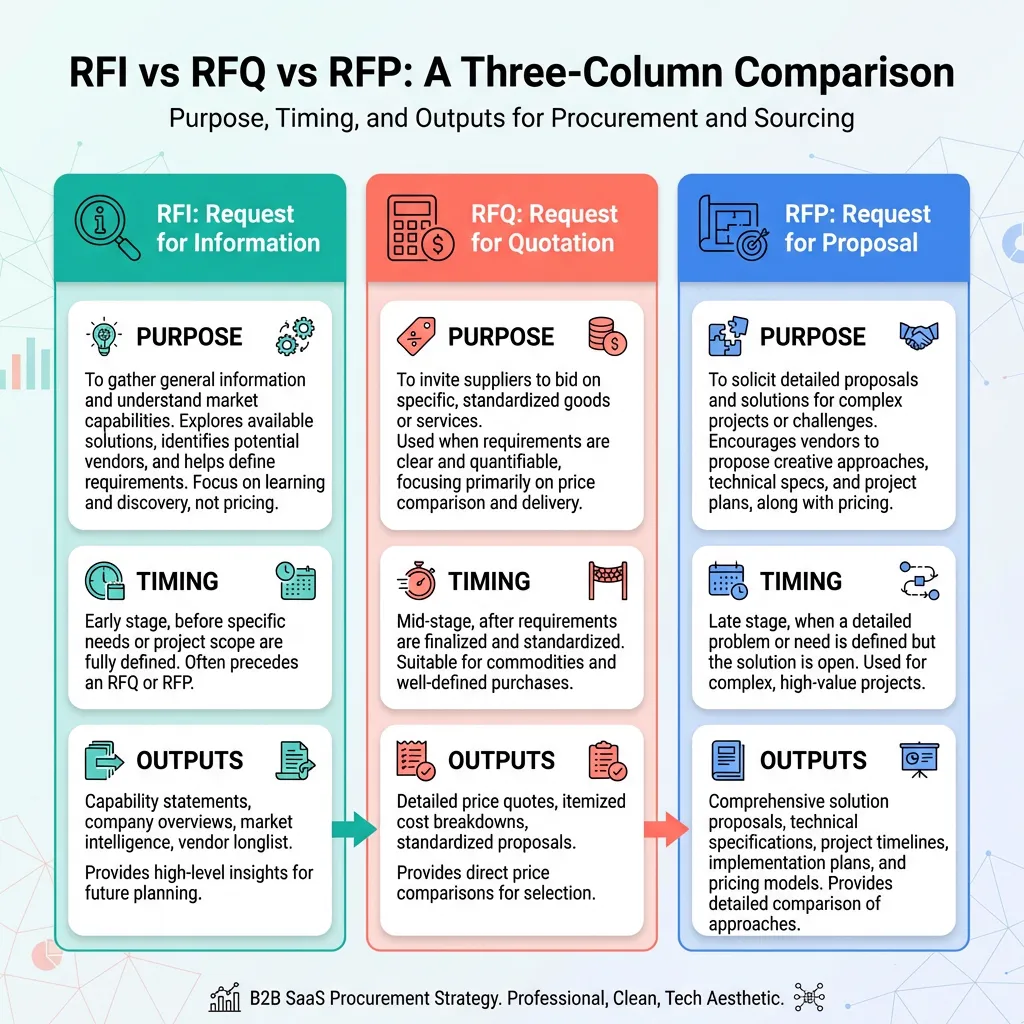
An RFI (Request for Information) is for early market research before you know what you need; vendor responses are non-binding. An RFQ (Request for Quotation) is for competitive pricing on tightly defined specifications; the decision is mostly price-driven. An RFP (Request for Proposal) is for complex purchases where vendor approach, methodology, and total value matter alongside price. Use them in sequence — RFI to learn the market, RFQ for commodities with fixed specs, RFP for solution-led evaluations.
The Three Documents Explained
RFI: Request for Information
Purpose: Gather market information before defining requirements (a useful precursor to vendor selection).
When you use it:
- Early procurement stages
- Exploring market capabilities
- Before you know exactly what's available
- Comparing alternative approaches
What you're asking:
- "What can you do?"
- "How do you approach this?"
- "What's possible?"
- "What should we consider?"
Vendor response is: Informational, not binding. General capability description for market education and often used for vendor qualification.
RFQ: Request for Quotation
Purpose: Get competitive pricing for defined specifications. Use our free RFQ template to standardize the request.
When you use it:
- Specifications are clear and detailed
- Price is the primary decision factor
- Multiple vendors can supply
- Comparison is straightforward
What you're asking:
- "What's your price for exactly these specifications?"
- "When can you deliver?"
- "What are your terms?"
Vendor response is: Pricing for specified items, delivery and terms, enabling direct comparison.
RFP: Request for Proposal
Purpose: Evaluate solutions and vendors for complex requirements. Start from our free RFP template, and score the resulting draft with the free RFP Complexity Analyzer before sending.
When you use it:
- Complex needs requiring vendor input on approach
- Technology/methodology matters
- Multiple factors beyond price
- Vendor expertise is relevant
What you're asking:
- "How would you solve this problem?"
- "What solution do you propose?"
- "Why is your approach best?"
Vendor response is: Complete solution proposal, methodology and approach, pricing and terms, qualifications and references.
Comparison Table
| Aspect | RFI | RFQ | RFP |
|---|---|---|---|
| Purpose | Information gathering | Pricing comparison | Solution evaluation |
| Stage | Early/research | Defined requirements | Complex evaluation |
| Binding | No | Usually | Yes |
| Selection? | No | Maybe | Yes |
| Typical length | Short (2-5 pages) | Medium (5-20 pages) | Long (20-100+ pages) |
| Response effort | Low | Medium | High |
| Evaluation criteria | Capability review | Price-focused | Multi-factor |
| Contract result | None | Possible | Expected |
Decision Framework: Which One Do I Need?
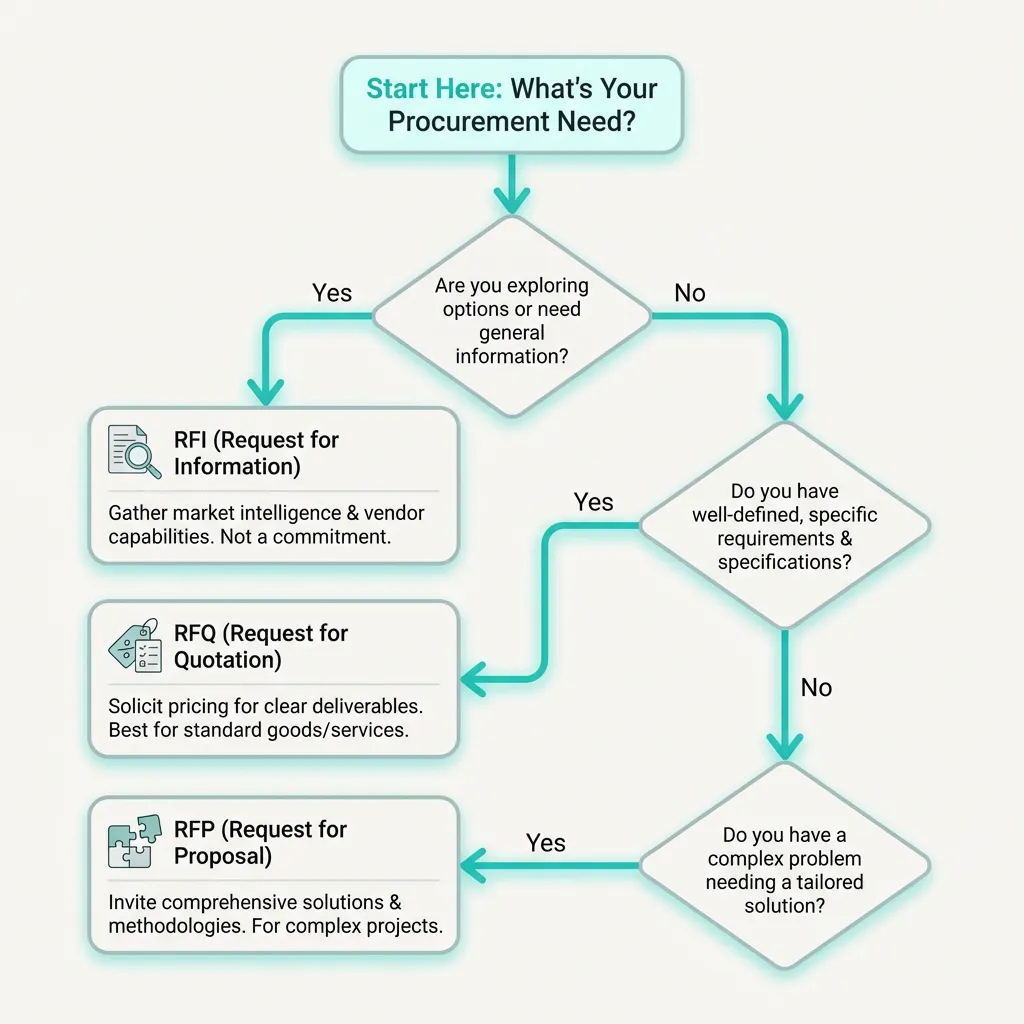
Use this decision logic to choose correctly every time:
Question 1: Do you know exactly what you want to buy?
NO: You need help defining the solution. Use RFI to learn, or RFP to ask for solutions.
YES: Go to Question 2.
Question 2: Is the item/service standard or commodity?
YES: Competitive pricing is the main goal. Use RFQ.
NO: It's complex or customized. Go to Question 3.
Question 3: Does the vendor's methodology matter?
YES: Use RFP to evaluate their approach.
NO: If you can specify the outcome perfectly and method doesn't matter, use RFQ.
Question 4: Are you ready to buy right now?
NO: You are just budgeting or researching. Use RFI.
YES: Use RFP or RFQ.
When to Use RFI
Appropriate Situations
| Scenario | Why RFI |
|---|---|
| New category | Don't know market well |
| Technology exploration | Multiple approaches exist |
| Requirements definition | Need vendor input |
| Vendor prequalification | Building qualified list |
| Market research | Understanding options |
| Budget planning | Early cost estimates |
RFI Best Practices
Typical RFI sections:
- Introduction and purpose
- Company background
- Current situation / problem statement
- Questions for vendors
- Evaluation approach
- Response instructions
- Confidentiality provisions
RFI Limitations
| Don't Expect | Because |
|---|---|
| Detailed pricing | You haven't given detailed specs |
| Binding commitments | RFI is informational |
| Immediate selection | RFI feeds next phase |
| Comprehensive proposals | Response should be proportional |
When to Use RFQ
Appropriate Situations
| Scenario | Why RFQ |
|---|---|
| Clear specifications | You know exactly what you want |
| Commodity purchase | Standard products/services |
| Price is primary | Other factors equal or minor |
| Quick turnaround | Faster than RFP |
| Multiple sources | Competition is possible |
| Repeat purchase | Familiar category |
Specification Clarity
| Good Specification | Poor Specification |
|---|---|
| "316 Stainless Steel, 2" diameter, Ra 1.6 μm surface finish" | "High-quality stainless steel pipe" |
| "ISO 9001:2015 certified supplier" | "Quality manufacturer" |
| "Delivery within 4 weeks to [address]" | "Fast shipping" |
Pro Tip: Provide a standardized pricing format table — our Quote Comparison Template works as the response format. When all vendors answer in the same format, comparison becomes dramatically easier.
RFQ Limitations
| Don't Expect | Because |
|---|---|
| Vendor creativity | You're specifying the solution |
| Alternative approaches | RFQ means "quote this specific thing" |
| Detailed methodology | Focus is on price and specs |
| Extensive evaluation | Decision is price-driven |
When to Use RFP
Appropriate Situations
| Scenario | Why RFP |
|---|---|
| Complex requirements | Multiple components, integration |
| Solution matters | How vendor solves matters |
| Services-heavy | Not just products |
| Multiple factors | Price isn't everything |
| Vendor expertise needed | Approach affects outcome |
| Significant value | Worth the evaluation investment |
| Long-term relationship | Vendor fit matters |
Evaluation Criteria Example
| Category | Weight |
|---|---|
| Technical solution | 40% |
| Pricing / cost | 30% |
| Vendor qualifications | 20% |
| Implementation approach | 10% |
For more on RFP evaluation, see our RFP Evaluation Matrix Scoring Guide, the RFP Compliance Checklist, and warning signs to flag in RFP response red flags.
Using Documents in Sequence
Often the documents work together:
Research → Price Sequence
RFI → (Define specs) → RFQ → Selection
Use when: You need to understand market first, then specifications become clear, finally price comparison decides.
Research → Full Evaluation Sequence
RFI → (Shortlist) → RFP → Selection
Use when: Market research needed first, qualifying vendors early, full solution evaluation follows.
Pre-Qualified Vendor Sequence
RFI → (Qualify vendors) → RFP (to shortlist) → Selection
Use when: Need to screen vendor capability. Only want qualified vendors to invest in RFP response.
Hybrid Approaches
Sometimes a pure RFQ or pure RFP isn't quite right.
The "RFQ with Proposal Elements"
Used when you are buying a commodity but want some service assurance.
- Base: RFQ structure (Detailed specs, pricing table)
- Addition: "Please attach a 1-page summary of your quality control process for this material."
- Why: Keeps it simple but filters out "garage shops."
The "RFP Light"
Used for smaller projects where solution matters but a 50-page document is overkill.
- Structure: Problem statement + 5 key questions + Pricing
- Why: Reduces vendor fatigue for smaller contracts ($20k-$50k)
Industry-Specific Nuances
Construction
- RFI: Heavily used to clarify architectural drawings during the project, not just before
- RFQ: Used for materials (lumber, steel)
- RFP: Used for hiring the General Contractor or Architect — see construction procurement
Software / IT
- RFI: Critical because technology changes fast
- RFP: The standard for most software buys
- RFQ: Only used for hardware or commodity licenses (e.g., "quote 500 Microsoft Office licenses") — see IT & data center procurement
Manufacturing
- RFQ: The dominant document. Drawings are exact; price is king — and quote accuracy matters: see why <25% of custom manufacturing quotes are accurate
- RFP: Used for capital equipment (robots, new lines) or logistics partnerships — see manufacturing procurement
Stakeholder Management
Your internal stakeholders usually just say "We need to send an RFP." Part of your job is guiding them to the right tool.
How to explain it: "If we send an RFP for office chairs, vendors will send us 50 pages of marketing about ergonomic philosophy. We don't want to read that. We want to know who has the chairs we picked out in stock at the best price. Let's use an RFQ."
"If we send an RFQ for 'Marketing Agency Services', we'll get a price list for hourly rates, but we won't know if they have any creative ideas. We need to see their portfolio and strategy. Let's use an RFP."
Common Mistakes
Using RFP When RFQ Is Appropriate
Mistake: Full RFP process for commodity purchase with clear specs.
Consequences: Wasted vendor effort, excessive evaluation time, no benefit from solution creativity, frustrated vendors for future needs.
Solution: If specifications are clear and price is the main differentiator, use RFQ.
Using RFQ When RFP Is Needed
Mistake: Trying to get pricing comparison for complex, undefined needs.
Consequences: Incomparable responses, missed requirements, poor vendor selection, implementation problems.
Solution: If the solution approach matters, use RFP.
Skipping RFI When Exploration Is Needed
Mistake: Jumping to RFP without understanding the market.
Consequences: Poorly written requirements, missing capable vendors, wrong approach in RFP, expensive re-work.
Solution: When you don't know the market well, start with RFI.
RFI That Creates Vendor Expectations
Mistake: RFI so detailed it seems like RFP, creating expectation of imminent sale.
Consequences: Vendor frustration, relationship damage, reduced future participation.
Solution: Make RFI purpose clear. Be explicit it's information-gathering.
Document Comparison Checklist
Use RFI If:
- ☐ You don't fully understand the market
- ☐ You need to learn about available solutions
- ☐ You want to pre-qualify vendors
- ☐ Requirements aren't yet defined
- ☐ You're exploring alternative approaches
Use RFQ If:
- ☐ Specifications are completely defined
- ☐ Price is the primary differentiator
- ☐ Multiple vendors can provide identical items
- ☐ You need quick turnaround
- ☐ Minimal vendor input on approach is needed
Use RFP If:
- ☐ Solution approach matters
- ☐ Multiple evaluation factors apply
- ☐ Vendor expertise affects outcome
- ☐ Complex or custom needs exist
- ☐ Long-term relationship is being established
Quick Reference Summary
| Know Market? | Know Specs? | Solution Matters? | Document |
|---|---|---|---|
| No | No | — | RFI first |
| Yes | Yes | No | RFQ |
| Yes | Define | Yes | RFP |
| No | — | Yes | RFI → RFP |
Choose the Right Document
Selecting the appropriate document type is the first step to effective procurement. Match the document to your knowledge level, requirement clarity, and evaluation needs. Once responses come in, you'll want a way to compare product specifications across them quickly.
Free RFP Template → | Free RFQ Template → | How to Write an RFQ →
Frequently Asked Questions
Related Articles
How to Write an RFQ (Template)
Learn how to write an effective RFQ that gets accurate, comparable pricing. Includes RFQ template and best practices.
RFP Compliance Checklist
Use this RFP compliance checklist to verify vendor proposals meet your requirements. Systematic verification for fair evaluation.
RFP Evaluation Matrix Template
Learn how to build an RFP evaluation matrix for objective vendor proposal scoring. Includes weighting guide, scoring scales, and downloadable template.
RFP Response Red Flags to Watch
Learn to spot RFP response red flags that indicate vendor problems. Identify warning signs to avoid bad vendor selections.