
Specification Gap Analysis Guide
Learn specification gap analysis to identify missing vendor information. Catch incomplete proposals before they become costly.
Priya Sharma
Procurement Technology Lead, SpecLens
- 850+companies trust SpecLens
- 99%extraction accuracy
- 8 hrssaved per comparison
- AES-256encrypted · GDPR compliant
Key takeaways
- A specification gap is any requirement your RFP includes that a vendor's response or datasheet doesn't address — never assume compliance for unanswered specs.
- Build a requirements traceability matrix: every spec as a row, every vendor as a column, mark each cell as fully/partially/not addressed.
- Manual gap analysis of a 10-vendor response to a 50-spec RFP takes 20-40 hours; AI tools complete the same analysis in minutes.
- Issue clarification requests for every gap with a clear deadline — undocumented assumptions create legal and operational risk post-award.
- Gap patterns are a vendor risk indicator: consistent gaps across straightforward specs predict poor delivery quality, not just incomplete proposals.
The most dangerous specifications aren't the ones that fail to meet your requirements. They're the ones that aren't there at all.
Specification gap analysis is the systematic process of identifying what's missing from vendor proposals—the omitted data, unstated capabilities, and absent details that can derail a procurement decision. When vendors leave gaps in their responses, it's rarely accidental. (For the upstream verification step, see our spec compliance verification guide.)
This guide shows you how to find those gaps before they find you. For a deeper construction-specific take, see scope gap detection and OR-equal substitutions.
The Problem with Incomplete Vendor Information
Vendor documentation is a marketing exercise as much as a technical one. Companies lead with strengths and stay silent on weaknesses. That strategic omission creates gaps—gaps that procurement teams often don't discover until after contracts are signed.
Why Vendors Leave Gaps
Understanding vendor motivations helps you spot gaps more effectively:
- Competitive disadvantage: If a specification would reveal poor performance relative to competitors, vendors may simply not mention it.
- Not tested or unknown: Some vendors haven't tested every specification. Rather than admit uncertainty, they omit the data.
- Assumed irrelevant: The vendor may not realize a specification matters to you because their typical customers don't ask for it.
- Oversight: Sometimes gaps are genuine mistakes—specs listed on one datasheet but not carried to proposal documents.
- Strategic ambiguity: Leaving specifications vague or absent preserves negotiating room and avoids firm commitments.
The Cost of Missing Specs
When specification gaps go undetected (these are a primary driver of the 15 hidden procurement costs and why fewer than 25% of custom manufacturing quotes are accurate):
| Gap Type | Potential Consequence |
|---|---|
| Missing performance spec | Equipment doesn't meet throughput needs |
| Absent compliance cert | Regulatory issues post-installation |
| Unlisted compatibility spec | Integration failures with existing systems |
| Omitted environmental rating | Equipment failure in operating conditions |
| Missing warranty detail | Unexpected maintenance costs |
Key Insight: Procurement teams often report that problems discovered after purchase could have been predicted from gaps in vendor specifications—if those gaps had been systematically identified.
Types of Specification Gaps
Not all gaps are equal. Understanding the different types helps you prioritize which ones require immediate clarification and which can be addressed later.
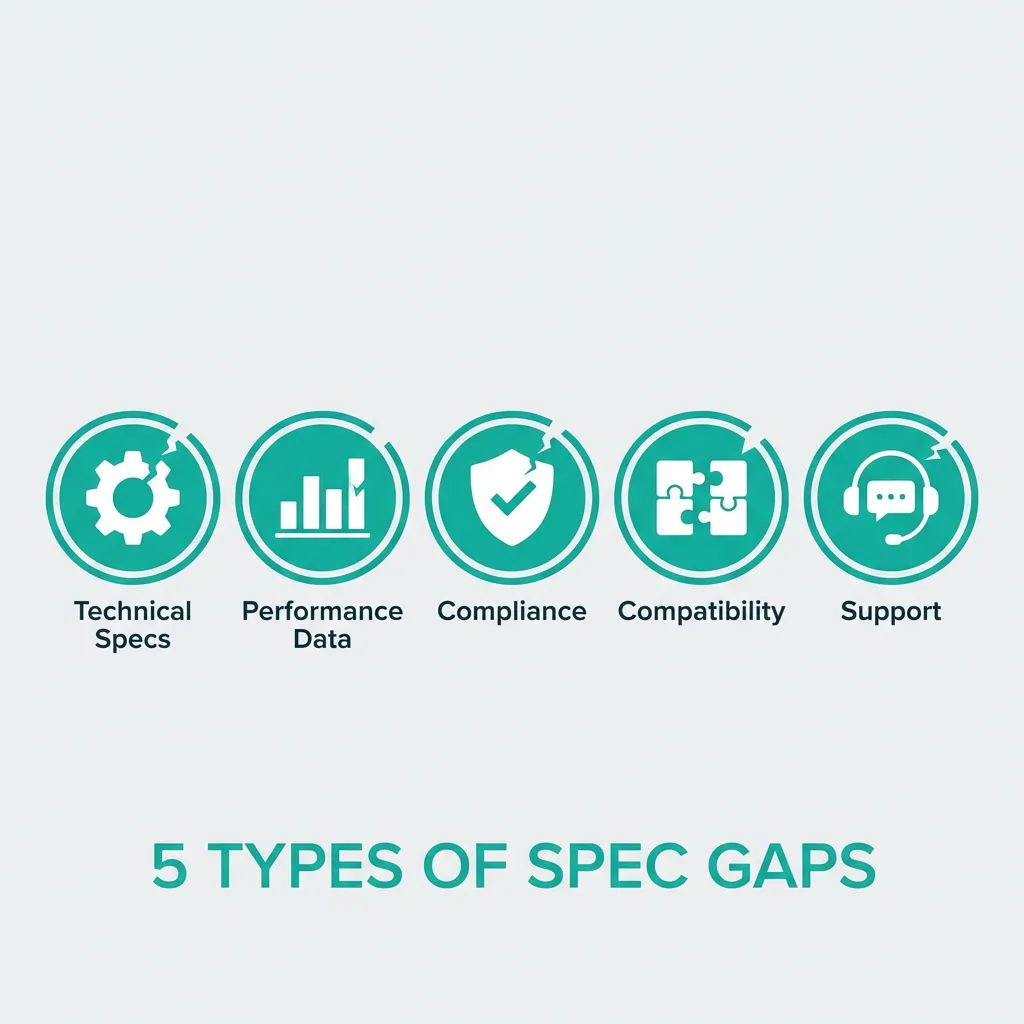
Missing Technical Specifications
The most straightforward gap: a specification you need isn't listed.
Examples:
- Physical dimensions not stated
- Power requirements absent
- Weight not specified
- Operating voltage unlisted
Why it matters: Without technical specs, you cannot verify fit, compatibility, or operational requirements.
Detection method: Compare each vendor's response against your RFP specification requirements. Any requirement that lacks a corresponding vendor response is a gap.
Omitted Performance Data
The vendor lists the feature but doesn't quantify performance.
Examples:
- "High-speed processing" without throughput numbers
- "Efficient operation" without efficiency ratings
- "Large capacity" without actual capacity specifications
Why it matters: Qualitative claims are meaningless for comparison. "Fast" compared to what?
Detection method: Flag any response that uses qualitative language where you specified quantitative requirements.
Absent Compliance Information
Certifications and regulatory compliance are either present or they're not—but vendors sometimes list compliance vaguely.
Examples:
- No CE marking documentation
- Safety certifications not referenced
- Industry standards claimed but not verified
- "Meets requirements" without certification evidence
Why it matters: Compliance gaps can result in regulatory violations, deployment delays, or liability issues.
Detection method: Create a compliance checklist and verify each certification is explicitly documented with evidence.
Hidden Compatibility Issues
Integration and compatibility specifications are frequently incomplete.
Examples:
- Software version compatibility unstated
- API specifications absent
- Protocol support unclear
- Interface details missing
Why it matters: Compatibility gaps lead to integration failures, requiring expensive workarounds or additional purchases.
Detection method: Map exact integration requirements and verify each touchpoint has a corresponding vendor specification.
Warranty & Support Gaps
Support terms are often buried in fine print—or omitted entirely from technical proposals.
Examples:
- Warranty duration not specified
- Service level agreements absent
- Support hours unstated
- Parts availability not addressed
- End-of-life policy missing
Why it matters: Support gaps affect total cost of ownership and operational continuity planning.
Detection method: Include explicit support requirements in your RFP and verify each receives a vendor response.
Manual Gap Detection Process
Before automation, here's how to systematically identify specification gaps manually.
Step 1: Creating Your Baseline Requirements
Gap analysis requires a baseline. You can't identify what's missing without first defining what's required — start with our free Specification Checklist Generator if you don't already have a category-specific list.
Build your specification matrix using the Specification Compliance Matrix template:
- List every specification requirement from your RFP
- Categorize by type (technical, performance, compliance, compatibility, support)
- Mark each as mandatory or desirable
- Define acceptable values or ranges for each specification
Step 2: Cross-Referencing Every Vendor
With baseline in hand, systematically review each vendor response:
- Work through your baseline specification by specification
- Locate the vendor's response to each spec
- Document the vendor's stated value
- Note the source page number
- Mark any specification without a clear vendor response
Create your gap tracking matrix:
| Specification | Vendor A | Vendor B | Vendor C |
|---|---|---|---|
| Operating temp | -10°C to 50°C | ❌ Missing | 0°C to 40°C |
| Throughput | 1000 units/hr | 1200 units/hr | ❌ Missing |
| CE certified | Yes, cert #12345 | Yes, cert #54321 | ❌ Not stated |
Step 3: Documenting Gaps Systematically
For each gap, record:
- Specification name and category
- Vendor(s) missing this specification
- Whether the specification is mandatory or desirable
- Impact level if the gap remains unresolved
- Action required (clarification request, vendor query, etc.)
Time Required: The Reality
| Scope | Typical Time |
|---|---|
| 3 vendors, 30 specs | 2-3 hours |
| 5 vendors, 50 specs | 5-7 hours |
| 7+ vendors, 100+ specs | 10+ hours |
This doesn't include time waiting for vendor clarifications or re-reviewing updated documents.
Interpreting Silence: Reading Between the Lines
Sometimes what is missing tells you exactly what the answer is.
The "Standard" Trap: If a vendor says "Standard Support Included" but omits the hours, it usually means "9-to-5, Mon-Fri." If they had 24/7 support, they would shout it from the rooftops. Silence usually implies the minimum viable definition.
The "Current" Trap: If a compliance certificate is missing an expiration date, assume it is expired. If they had a valid one, they would have sent it.
The "Proprietary" Trap: If an integration method isn't detailed because it's "Proprietary," assume it's hard to use, undocumented, and expensive to maintain. Good APIs are celebrated; bad ones are hidden behind "proprietary" labels.
How AI Automates Gap Detection
Modern procurement tools use AI to accelerate gap detection—identifying missing specifications in seconds rather than hours (see how SpecLens extracts specs in 3 steps and the broader AI in procurement guide for context).
Automatic Cross-Vendor Comparison
AI extraction tools process all vendor documents simultaneously, building a unified comparison matrix — the same workflow we cover in vendor datasheet comparison methods. When a specification appears in some vendor documents but not others, the gap is flagged automatically.
How it works:
- Upload vendor documents (PDFs, Word, Excel)
- AI extracts specifications from each document
- System normalizes terminology across vendors
- Missing specifications are highlighted instantly
Visual Gap Highlighting
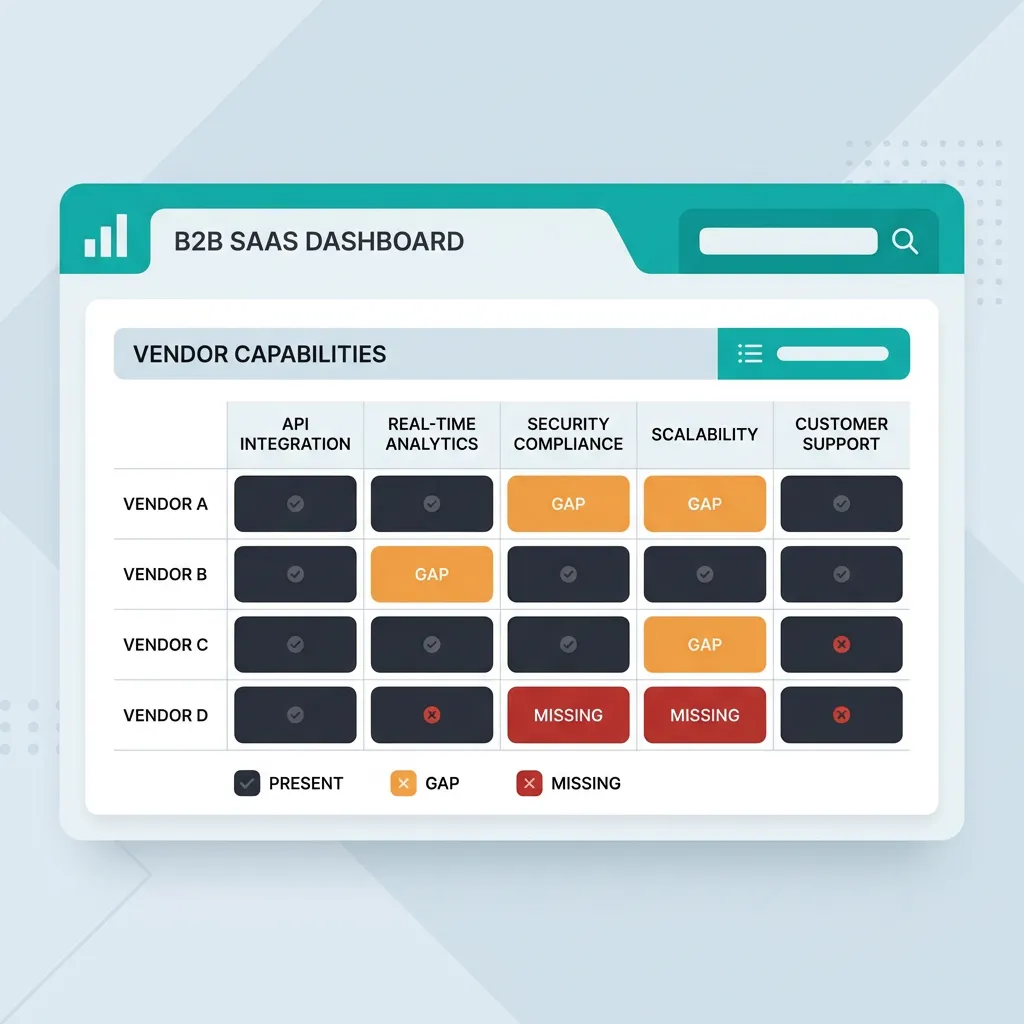
Rather than hunting for gaps in spreadsheets, AI-powered comparison matrices visually highlight missing data:
- Green cells: Specification present
- Orange cells: Specification missing (gap)
- Yellow cells: Specification ambiguous or incomplete
Missing Spec Alerts
Advanced tools don't just show gaps—they quantify them:
- Gap count per vendor: Which vendor has the most incomplete response?
- Critical gap flagging: Which missing specs are mandatory requirements?
- Gap pattern analysis: Are specific specification categories consistently missing?
Case Study: The Hidden API Limit
📋 Real-World Example
The Scenario: A high-growth e-commerce company needed an inventory management system.
The RFP: Specified support for "high volume API calls."
The Vendor Response: "Our API is enterprise-grade and supports high-volume transactions."
The Gap: They did not specify the daily rate limit.
The Impact: On Black Friday, the system crashed. It turned out the vendor had a hard limit of 10,000 calls per hour. The company hit 50,000. Because the specific number was a "Gap" in the proposal, the vendor claimed they met the "standard industry definition" of high volume.
The Lesson: "High volume" is an opinion. "50,000 calls/hour" is a specification. Never accept an adjective where a number belongs.
What to Do When You Find Gaps
Identifying gaps is only half the work. Here's how to handle the gaps you discover.
Clarification Request Templates
When you find specification gaps, request clarification formally:
For missing technical specifications:
We note that your proposal does not include specifications for [SPECIFICATION NAME]. Please provide the following within [TIMEFRAME]:
• Specific value for [SPECIFICATION]
• Test conditions under which this value was measured
• Any documentation supporting this specification
For missing compliance certifications:
Your proposal references [COMPLIANCE STANDARD] but does not include certification documentation. Please provide:
• Certificate number and issuing body
• Certification scope and expiration date
• Any conditions or limitations on the certification
Scoring Implications
Specification gaps should affect vendor scoring (build them into your RFP evaluation matrix):
- Option 1: Penalty scoring - Deduct points for each missing mandatory specification
- Option 2: Assumption-based scoring - Assume worst-case values for missing specifications
- Option 3: Incompleteness disqualification - Require all mandatory specifications to proceed (start with our RFP compliance checklist)
Contract Protection Clauses
When gaps remain even after clarification, protect yourself contractually:
- Warranty provisions: Require vendors to warrant that specifications meet your stated requirements, even where specific values weren't provided.
- Performance guarantees: Include measurable performance criteria with remedies if equipment fails to meet expectations.
- Specification verification period: Build in an acceptance testing phase where you can verify specifications before final payment.
- Change provisions: Reserve rights to revisit terms if actual specifications, once known, differ materially from what was assumed.
Gap Prioritization Matrix
Not all gaps are equal. Map them:
| Quadrant | Criticality | Ease | Action |
|---|---|---|---|
| 1 | Critical | Easy | Fix immediately. "Must-Haves" that the vendor forgot. |
| 2 | Critical | Hard | Deal breakers. If vendor can't fix, they are out. |
| 3 | Non-Critical | Easy | "Nice to haves." Use as negotiation leverage. |
| 4 | Non-Critical | Hard | Ignore. Don't waste budget fixing these. |
Gap Analysis Checklist
Use this checklist to ensure comprehensive gap analysis on every procurement:
Before Analysis
- ☐ Complete specification baseline defined
- ☐ Requirements prioritized (mandatory vs. desirable)
- ☐ Acceptable ranges established for each spec
- ☐ Gap tracking matrix prepared
During Analysis
- ☐ Each vendor response cross-referenced against baseline
- ☐ Every missing specification documented
- ☐ Gap severity assessed (critical, major, minor)
- ☐ Source pages noted for all present specifications
After Initial Analysis
- ☐ Clarification requests issued for critical gaps
- ☐ Response deadline communicated to vendors
- ☐ Gap impact on scoring documented
- ☐ Stakeholders updated on gap findings
Post-Clarification
- ☐ Vendor responses reviewed and incorporated
- ☐ Remaining gaps documented
- ☐ Scoring adjustments applied
- ☐ Contract protections drafted for unresolved gaps
Start Catching Gaps Before They Become Problems
Specification gap analysis protects your organization from the hidden risks in incomplete vendor proposals. Whether you conduct analysis manually or leverage AI-powered detection, systematic gap identification is essential for informed procurement decisions — and it's the foundation of a real vendor risk assessment.
Vendor Datasheet Comparison → | Technical Spec Sheet Analysis → | RFP Response Red Flags →
Frequently Asked Questions
Related Articles
Spec Compliance Verification Guide
Learn how to verify vendor specs actually meet your requirements. Systematic compliance verification for accurate procurement.
Technical Spec Sheet Analysis
Master technical spec sheet analysis for procurement. Extract critical specs, spot gaps, and compare vendor datasheets.
Unit Conversion in Procurement
Master unit conversion in procurement to avoid spec mismatches and costly errors. Includes conversion tables and formulas.
Vendor Datasheet Comparison Methods
Learn effective vendor datasheet comparison methods. Transform PDF datasheets into structured side-by-side comparisons.