
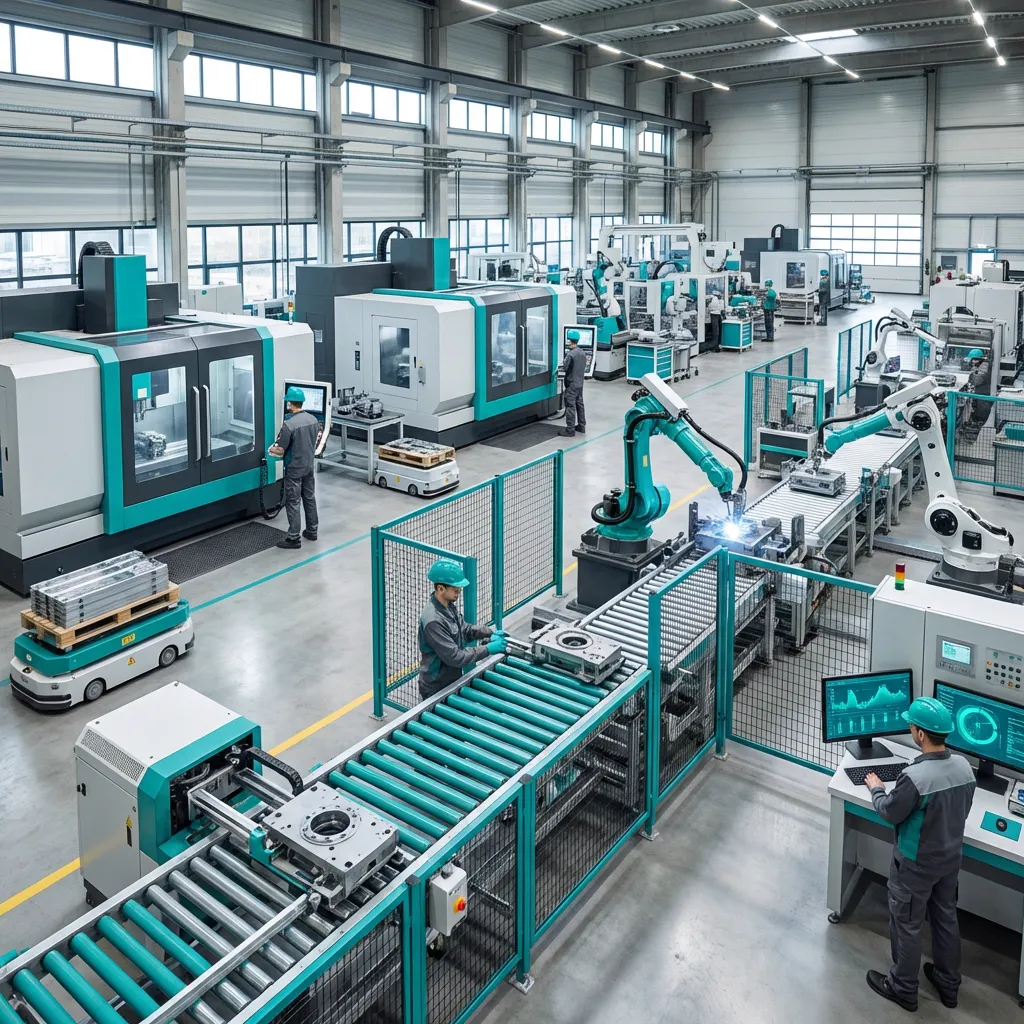
Manufacturing Equipment Buying Guide
Navigate manufacturing equipment procurement. Learn machinery specs, automation considerations, and vendor comparison strategies.
David Chen
Senior Procurement Analyst, SpecLens
- 850+companies trust SpecLens
- 99%extraction accuracy
- 8 hrssaved per comparison
- AES-256encrypted · GDPR compliant
Manufacturing equipment purchases define your production capability for years to come. The right equipment enables efficient operations, quality output, and competitive advantage. The wrong choice creates bottlenecks, quality problems, and expensive replacement cycles. (See manufacturing & industrial procurement for sector context, and industrial equipment procurement for the cross-category solution view.)
This guide covers what manufacturing buyers need to know when evaluating and purchasing production equipment—from writing the RFQ through vendor selection and lifecycle management. The quote-accuracy problem worth solving up front is in why <25% of custom manufacturing quotes are accurate; full lifecycle cost in our TCO Calculator Guide.
Why Manufacturing Equipment Procurement Matters
The Stakes Are High
| Impact Area | Consequence |
|---|---|
| Production capacity | Ability to meet demand |
| Product quality | Consistency and precision |
| Operating costs | Efficiency and waste |
| Flexibility | Ability to adapt to changes |
| Competitive position | Cost and capability vs. competitors |
Capital Commitment
- CNC machining centers: $50,000 to $500,000+
- Industrial robots: $25,000 to $400,000+
- Fabrication equipment: $100,000 to $2,000,000+
- Automation cells: $200,000 to $5,000,000+
Key Insight: Equipment typically operates for 10-20+ years. Consider the full lifecycle, not just initial performance.
Manufacturing Equipment Categories
Production Machinery
| Category | Examples | Key Considerations |
|---|---|---|
| CNC machines | Lathes, mills, machining centers | Precision, throughput, axis config |
| Fabrication | Laser cutters, press brakes, punches | Material thickness, precision, speed |
| Forming | Injection molding, stamping, forging | Cycle time, tonnage, part size |
| Assembly | Robotic cells, conveyors | Flexibility, changeover, integration |
| Testing | CMM, inspection systems | Accuracy, speed, data integration |
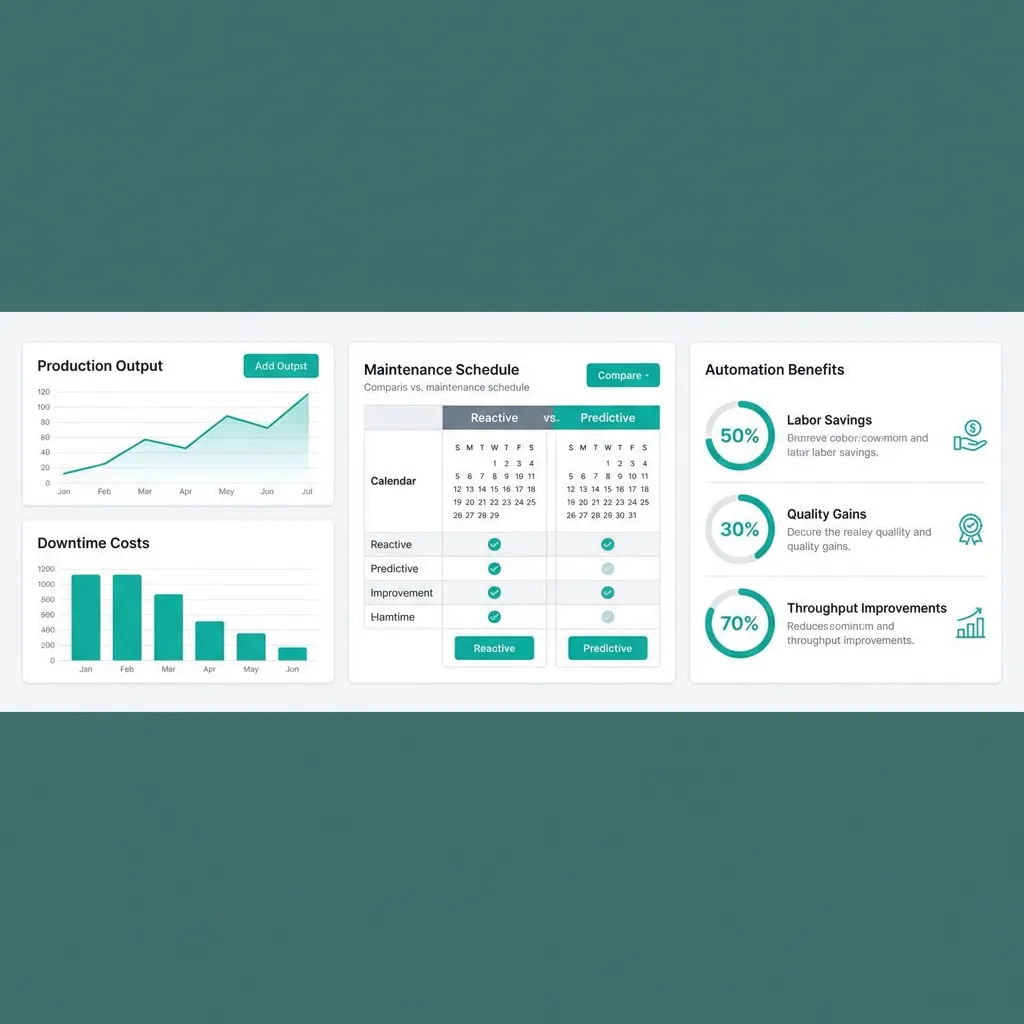
Automation & Robotics
| Robot Type | Characteristics | Best For |
|---|---|---|
| Articulated (6+ axes) | Maximum flexibility | Welding, complex assembly |
| SCARA | Fast, precise, limited motion | Pick and place, light assembly |
| Cartesian/gantry | Large work areas | Palletizing, machine loading |
| Collaborative (cobots) | Work alongside humans | Light assembly, tending tasks |
Critical Machinery Specifications
Performance Specifications
| Specification | What to Evaluate | Why It Matters |
|---|---|---|
| Capacity/size | Work envelope, max part size, weight | Must accommodate your parts |
| Speed | Cycle time, rapid traverse, spindle speed | Affects throughput |
| Power | Motor ratings, spindle power | Cutting/forming capability |
| Rigidity | Frame construction, damping | Affects precision and tool life |
| Axis configuration | Number of axes, travel | Part complexity possible |
Accuracy & Repeatability
📏 Understanding the Difference
- Accuracy: How close to the target position the machine achieves
- Repeatability: How consistently the machine returns to the same position
For manufacturing, repeatability often matters MORE than accuracy. Consistent parts are predictable and quality-controllable.
Duty Cycle & Throughput
| Specification | Meaning |
|---|---|
| Rated cycle time | Achievable under ideal conditions |
| Actual cycle time | Realistic with your parts and processes |
| Sustainable throughput | Maintained over weeks, not minutes |
| Peak throughput | Short-term maximum |
Robot Specifications
| Specification | What to Evaluate | Typical Ranges |
|---|---|---|
| Reach | Working envelope coverage | 0.5m to 4m+ |
| Payload | Maximum weight at wrist | 1kg to 2000kg+ |
| Repeatability | Positioning consistency | ±0.02mm to ±0.5mm |
| Axes | Degrees of freedom | 4 to 7+ axes |
| IP rating | Environmental protection | IP40 to IP67 |
When to Automate
| Factor | Favors Automation | Favors Manual |
|---|---|---|
| Labor cost | High or rising | Low and stable |
| Consistency | Critical for quality | Acceptable variation |
| Volume | High and predictable | Low or variable |
| Task nature | Repetitive, predictable | Variable, judgment-intensive |
| Safety | Hazardous for workers | Safe environment |
Budget Reality: Integration often costs 50-100% of robot hardware cost. Factor this into ROI calculations.
Vendor Evaluation
OEM vs. Integrator vs. Distributor
| Source | Advantages | Disadvantages |
|---|---|---|
| OEM direct | Single contact, full knowledge | May not understand your application |
| System integrator | Turnkey solutions, application expertise | Higher cost |
| Distributor | Regional support, inventory access | Limited technical depth |
Technical Evaluation
- Demonstration with your parts: Test realistic production conditions
- Reference visits: Visit facilities with similar applications
- Runoff testing: Formal acceptance testing before shipment
- Technical review: Understand measurement conditions
Total Cost of Ownership
| Cost Element | Considerations | Typical % of TCO |
|---|---|---|
| Equipment purchase | Base machine, options, tooling | 30-50% |
| Installation | Rigging, foundation, utilities | 5-15% |
| Integration | Controls, conveyors, safety | 10-25% |
| Consumables | Tooling, coolant, filters | 10-20% |
| Maintenance | PM, repairs, spare parts | 15-30% |
TCO Comparison Example
| Cost Component | Equipment A | Equipment B |
|---|---|---|
| Purchase | $350,000 | $400,000 |
| Energy/year | $25,000 | $18,000 |
| Maintenance/year | $15,000 | $12,000 |
| 10-year TCO | $750,000 | $700,000 |
Lower purchase price doesn't always mean lower total cost.
Industry 4.0 Considerations
🏭 Smart Manufacturing Readiness
- OEE Tracking: Equipment should report availability, performance, and quality metrics
- Predictive Maintenance: Sensors can predict bearing failure weeks before it stops production
- Integration: Can this machine talk to your ERP? Receive work orders digitally?
Key Question: "What data does this machine output, and is the protocol open or proprietary?"
Manufacturing Procurement Checklist
Requirements Definition
- ☐ Production requirements documented
- ☐ Part geometries and materials defined
- ☐ Quality specifications established
- ☐ Volume and throughput needs calculated
- ☐ Integration requirements identified
Safety Compliance
- ☐ All pinch points and rotating parts guarded per OSHA/ISO
- ☐ Emergency stops accessible from all operator positions
- ☐ Energy isolation point accessible and labeled
- ☐ Noise levels below 85dB or hearing protection required
Make Better Equipment Decisions
Manufacturing equipment purchases shape your operational capability for years to come. Systematic specification comparison ensures you're choosing based on production requirements, not marketing claims — start the comparison from our Specification Compliance Matrix.
Manufacturing Procurement → | Vendor Datasheet Comparison → | Should-Cost Analysis →
Frequently Asked Questions
Related Articles
Construction Equipment Buying Guide
Navigate construction equipment procurement confidently. Learn heavy equipment specs, buy vs rent analysis, and vendor comparison.
Fleet Vehicle Procurement Guide
Master fleet vehicle procurement. Learn vehicle specs, TCO analysis, EV considerations, and comparison strategies for fleet purchasing.
Healthcare Equipment Procurement Guide
Master healthcare equipment procurement. Learn regulatory requirements, GPO considerations, and spec comparison for medical buyers.
IT Hardware Procurement Guide
Master IT hardware procurement. Learn server selection, storage evaluation, network specs, and vendor comparison strategies.