

ChatGPT for Procurement: Top 5 Use Cases
Learn how to use Generative AI safely in procurement. We explore 5 high-value use cases and 3 critical risks to watch out for.
Priya Sharma
Procurement Technology Lead, SpecLens
- 850+companies trust SpecLens
- 99%extraction accuracy
- 8 hrssaved per comparison
- AES-256encrypted · GDPR compliant
By 2026, ChatGPT and other generative AI tools won't just be assistants; they will be essential team members. From drafting complex contracts to autonomously negotiating with suppliers, the use cases are exploding across the enterprise.
Procurement leaders are already reporting massive efficiency gains: 76% faster purchase order processing, up to 92% reduction in manual data capture, and significant double-digit cuts in administrative costs. But with this great power comes the need for rigorous governance, clear guidelines, and an understanding of the real risks involved.
This guide will walk you through the high-impact use cases where generative AI delivers the most value in procurement, provide real-world examples from leading companies, and outline the critical risks you must address before adoption.
What You'll Learn:
- 7 high-value use cases for ChatGPT in procurement
- Real-world case studies from Walmart, eBay, and Unilever
- 4 critical risks to manage before deployment
- Best practices for safe and effective implementation
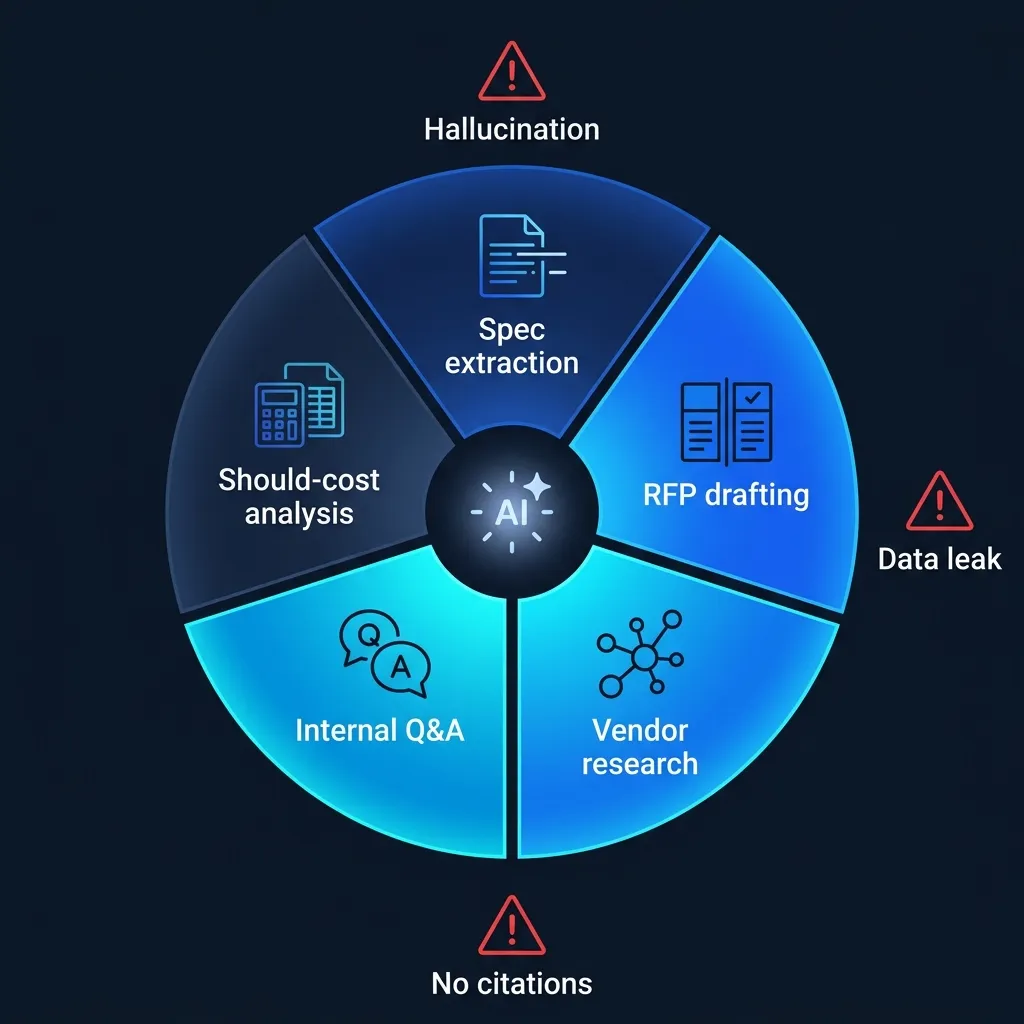
7 High-Value Use Cases for Generative AI in Procurement
Where exactly should you apply this technology for maximum return on investment? Here are the seven most impactful use cases based on current enterprise deployments.
1. Automating RFQ and RFP Creation
Stop starting from scratch. ChatGPT can draft detailed Requests for Quotation (RFQs) and Requests for Proposal (RFPs) by analyzing broad requirements. It can suggest technical specifications, evaluation criteria, and even questions to ask vendors based on industry best practices and historical data from your organization. For more guidance, see our comprehensive guide on how to write an RFP.
Impact: Reduces document drafting time by 60-80% and ensures consistency across all sourcing events.
2. Contract Review and "Redlining"
AI acts as a powerful first-pass legal review. It can scan a 50-page contract in seconds to:
- Flag risks such as unusual liability caps or unfavorable termination clauses.
- Identify non-standard language that deviates from your company playbook.
- Ensure compliance with regulatory requirements (e.g., GDPR, export controls).
This doesn't replace your legal team; it empowers them to focus on high-value negotiation rather than initial document review.
3. Spend Analytics and Cost Optimization
Data without insight is just noise. Generative AI can analyze messy, uncategorized spend data to:
- Categorize vendors and spending patterns automatically.
- Identify duplication and consolidation opportunities (e.g., "You have 5 different software suppliers for the same category").
- Spot cost-saving opportunities based on historical trends and market benchmarks.
It can also generate executive dashboards and transform complex metrics into actionable management insights with natural language summaries.
4. Supplier Risk Monitoring and Early Warning
Generative AI can serve as an always-on early warning system. By monitoring news reports, financial filings, social media sentiment, and geopolitical events, it can flag potential supply chain disruptions before they hit your operations. Combine this with a robust vendor scorecard for comprehensive supplier management.
Example: Mastercard uses AI models to detect fraudulent invoices across its global operations, saving millions annually.
5. Negotiation Scripts and Strategy
Need to ask a supplier for a 5% discount? ChatGPT can help craft data-backed negotiation arguments, generate talking points, and even role-play as the vendor to help you prepare for tough conversations. This is especially valuable for enabling junior buyers to handle complex negotiations with confidence.
6. Supplier Communication and Q&A
AI can automate routine communication with vendors, including drafting emails, answering common supplier questions, and sending status updates. This frees up procurement teams for strategic relationship management.
7. Market Research and Category Intelligence
ChatGPT can rapidly synthesize information from market reports, industry publications, and competitor analyses to provide on-demand category intelligence. This enables faster, more informed sourcing decisions without hours of manual research. For our top tool recommendations, see the best procurement software for 2026.
Real-World Enterprise Case Studies
The theory is compelling, but what does AI in procurement look like in practice? Here are examples from leading organizations:
Walmart: Autonomous Supplier Negotiations
Walmart piloted "Pactum," an AI-based tool designed for autonomous negotiations with tail-end suppliers. The AI conducts negotiations independently via chat, saving significant time and resources for the procurement team while improving contract terms and supply chain flexibility.
eBay: Automating Contract and Tax Classification
eBay deployed generative AI to automate contract analysis, streamline payment reconciliations, and support regulatory classification for indirect taxes. This significantly reduced manual workload across procurement, finance, and compliance operations while improving speed and accuracy.
Unilever & Accenture: Enterprise-Wide AI Scaling
Unilever partnered with Accenture to scale generative AI applications across its enterprise. They developed AI-driven tools to automate contract analysis, enhance supplier collaboration, and streamline procurement processes globally, demonstrating the potential for large-scale transformation.
Landsec: 92% Time Savings in Accounts Payable
Real estate investment trust Landsec implemented AI procurement software that significantly automated its accounts payable processes. The company achieved up to 92% time savings on manual data capture and validation tasks, freeing up finance teams for higher-value work.
4 Critical Risks to Manage Before Deployment
While the benefits are real, the risks are just as significant. Blindly adopting AI without proper governance is a recipe for disaster. Here are the key risks you must address:
Risk 1: Data Privacy and Security
Never paste confidential vendor pricing, trade secrets, or proprietary contract terms into public AI models. Public models like the free version of ChatGPT may train on your data. For enterprise use, ensure you are using private, secure instances with strict data handling agreements and SOC 2 / ISO 27001 compliance.
Risk 2: "Hallucinations" and Inaccurate Outputs
Generative AI can produce plausible-sounding but factually incorrect information—a phenomenon known as "hallucination." It might invent phantom regulations, cite non-existent legal precedents, or provide inaccurate price benchmarks. Always verify critical outputs with a human expert before acting on them.
Risk 3: Bias in Supplier Selection
AI models are trained on historical data, which may contain inherent biases. Ensure your AI-driven supplier selection process doesn't inadvertently discriminate against minority-owned businesses, smaller suppliers, or companies from certain geographies. Regular audits of AI recommendations are essential.
Risk 4: Integration Complexity and Data Quality
The effectiveness of any AI is heavily dependent on the quality of data it's trained on. Incomplete, inaccurate, or poorly structured vendor data will lead to flawed recommendations. Integrating AI tools with existing ERP, CLM, and procurement systems can also be complex and time-consuming.
The Future of AI in Procurement
The future isn't about AI replacing procurement teams; it's about AI-augmented teams outperforming those who refuse to adapt. Organizations that start small—automating one low-risk process today—and build internal capability will be best positioned to lead. The next architecture beyond chatbots is covered in our agentic AI in procurement guide; head-to-head model comparisons in ChatGPT vs Claude vs Copilot.
Best Practices for Safe Implementation
If you're ready to start, follow these best practices (the data foundation prerequisite is detailed in procurement AI data readiness):
- Start with Low-Risk Use Cases: Begin with document drafting or market research before moving to high-stakes areas like contract negotiation.
- Establish a Clear Governance Framework: Define which data can be used, who validates outputs, and how biases will be monitored.
- Use Enterprise-Grade Tools: Only use AI platforms with appropriate security certifications and data privacy commitments — see best procurement software 2026 for vetted options.
- Invest in Training: Upskill your procurement team to understand AI capabilities, limitations, and how to craft effective prompts.
- Measure and Iterate: Track time savings, accuracy improvements, and user adoption. Continuously refine based on feedback — model expected ROI with our free Procurement ROI Calculator.
Experience Intelligent Procurement Automation
Ready to bring AI into your workflow safely? SpecLens provides secure, intelligent document analysis designed specifically for procurement—no data shared with public models.
Try SpecLens AI FreeFrequently Asked Questions
Related Articles
AI Equipment Procurement Guide 2026
How AI transforms equipment procurement in 2026. Automate spec extraction, smart vendor comparison, and data-driven purchasing decisions.
Best Procurement Software 2026: Top 6
Discover the best procurement software for 2026. Compare top tools like SpecLens, SAP Ariba, and Coupa to find the perfect match for your business.
Cloud vs On-Premise Software: 2026 Guide
Should you own your infrastructure or rent it? We breakdown the Cost, Security, and Scalability of Cloud vs On-Premise solutions.
Submittal Review Software Compared (2026)
Honest 2026 comparison of AI submittal-review tools — BuildSync, Part3, Remy, iFieldSmart, and SpecLens. Features, ICP fit, side-by-side capability matrix, and the 35% rejection-rate context.