

Reduce Procurement Cycle Time
Learn proven strategies to reduce procurement cycle time without sacrificing quality. Identify bottlenecks and accelerate selection.
Rhea Kapoor
Head of Procurement Research, SpecLens
- 850+companies trust SpecLens
- 99%extraction accuracy
- 8 hrssaved per comparison
- AES-256encrypted · GDPR compliant
Procurement cycles are too slow. Stakeholders complain about delays. Business opportunities slip away while you're still evaluating vendors. But rushing procurement creates different problems—bad vendor choices and regrettable contracts. (For the upstream "front door" speed problem, see procurement intake management; for the dollar impact of slow cycles, true cost of manual procurement.)
This guide shows you how to reduce procurement cycle time without sacrificing decision quality—identifying bottlenecks, implementing proven solutions, and building sustainable improvements. The core levers are covered in procurement best practices for 2026; the team-side cost of stretched timelines is in procurement burnout.
Why Cycle Time Matters
| Impact | Consequence |
|---|---|
| Project delays | Revenue impact, market timing |
| Opportunity cost | Business waiting for decisions |
| Resource waste | Staff time on extended processes |
| Stakeholder friction | Frustration, workarounds |
| Compliance pressure | Rushed decisions at the end |
Typical Cycle Time Breakdown
| Phase | Activities | Typical Duration |
|---|---|---|
| Requirements | Define needs, specifications | 2-6 weeks |
| Sourcing | Identify vendors, issue RFP | 2-4 weeks |
| Response period | Vendors prepare responses | 2-4 weeks |
| Evaluation | Compare vendors, select winner | 2-6 weeks |
| Negotiation | Finalize terms and contract | 2-4 weeks |
| Approval | Internal approvals, signatures | 1-4 weeks |
| Total | 11-28 weeks |
Identifying Bottlenecks
| Bottleneck | Typical Cause | Symptom |
|---|---|---|
| Requirements definition | Unclear needs, stakeholder disagreement | Multiple revisions |
| Response analysis | Manual comparison, many vendors | Weeks of document review |
| Internal alignment | Many stakeholders, different priorities | Circular discussions |
| Approval layers | Multiple sign-offs, absent approvers | Documents in queues |
| Legal review | Complex terms, risk aversion | Weeks of back-and-forth |
Key Insight: Queue time vs. touch time—often the biggest opportunity. Documents may take 2 days of work spread over 3 weeks due to waiting.
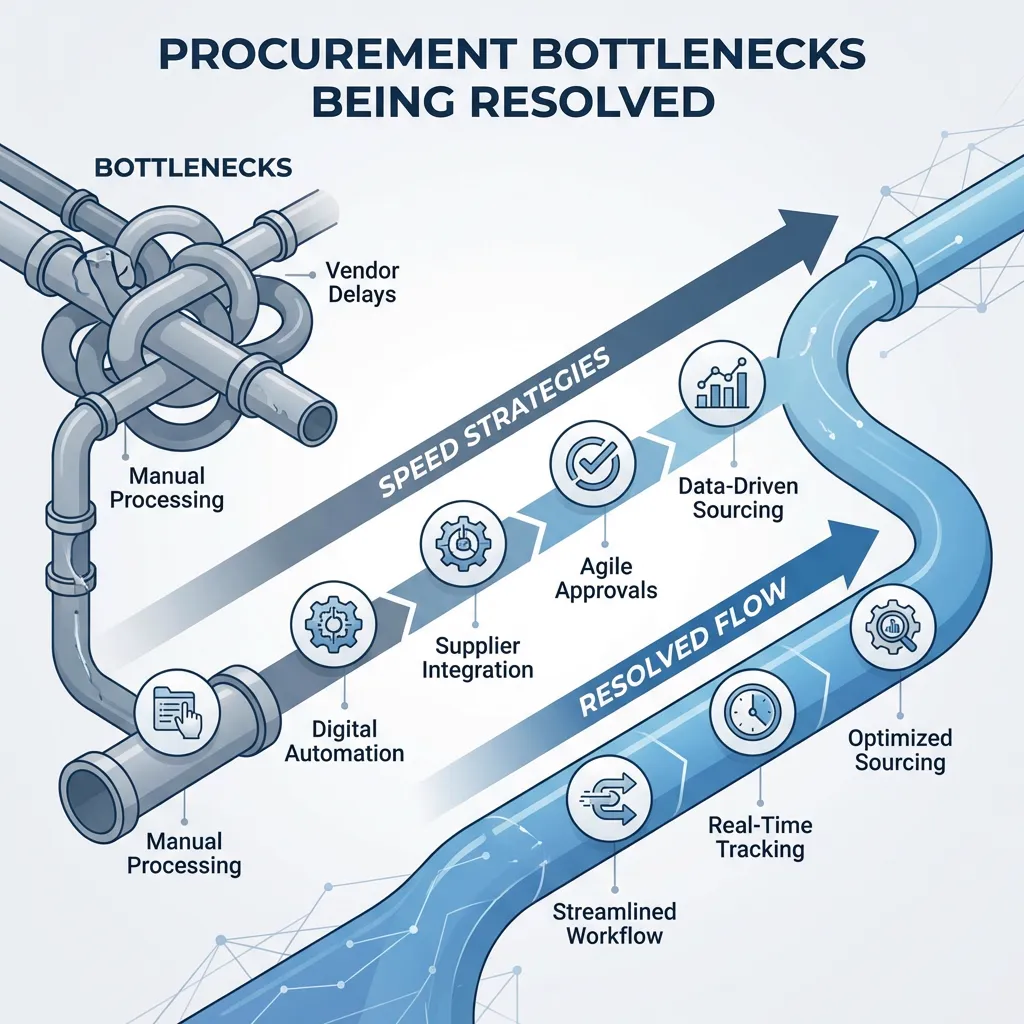
Quick Wins: Immediate Improvements
Parallel Processing
| Instead Of | Do This |
|---|---|
| Write requirements → then identify vendors | Research vendors while defining requirements |
| Complete technical eval → then start commercial | Evaluate technical and commercial in parallel |
| One approval → then next → then next | Parallel approval routing when possible |
| Wait for all responses → then start analysis | Begin analyzing as responses arrive |
Template Standardization
| Template | Time Saved |
|---|---|
| Standard RFP structure | 40-60% of RFP development |
| Evaluation criteria | 50-70% of criteria development |
| Common specifications | 30-50% of spec writing |
| Contract templates | 60-80% of legal drafting |
Technology-Enabled Acceleration
Automated Specification Comparison
| Manual Approach | AI-Powered Approach |
|---|---|
| Read each document | Upload all documents |
| Extract specifications manually | Automatic extraction |
| Create spreadsheet | Comparison matrix generated |
| Normalize units | Automatic normalization |
| Time: 4-8 hours/vendor | Time: 15-30 minutes total |
⏱️ Parallel vs. Serial Approval
Serial: Buyer → Manager (2 days) → Legal (5 days) → Security (5 days) → Finance (2 days) = 15 days
Parallel: Buyer → [Legal + Security + Finance simultaneously] = 5 days
Process Redesign
Simplify Evaluation Criteria
| Simplification | Impact |
|---|---|
| Fewer criteria | Faster evaluation, clearer decisions |
| Binary for must-haves | Quick pass/fail determination |
| Focus on differentiators | Skip evaluation of identical specs |
Right-Size the Process
| Purchase Type | Process Complexity |
|---|---|
| Routine, low-risk | Simplified, minimal approvals |
| Moderate value/risk | Standard process |
| Strategic, high-value | Full process with stakeholders |
| Emergency | Expedited with post-review |
The Pre-Approved Catalog Strategy
The fastest cycle time is zero. Build a catalog of pre-approved items:
- "If it's in the catalog and under $1k, auto-approve"
- "If it's off-catalog, full cycle"
- Result: Removes 40% of volume from approval queue
Measuring Improvement
| Metric | Target Direction |
|---|---|
| Total cycle time | Reduce |
| Time per phase | Identify problem phases |
| Queue time | Minimize |
| First-pass approval rate | Increase |
| Rework percentage | Decrease |
Speed Up Without Sacrificing Quality
Procurement cycle time reduction isn't about rushing—it's about eliminating waste, parallelizing work, and using better tools — start with our free Specification Checklist Generator to standardize the requirements step.
Free Procurement ROI Calculator → | Procurement Automation ROI Guide → | Customer Stories →
Frequently Asked Questions
Related Articles
The True Cost of Manual Procurement
Manual processes are bleeding your budget. We analyze the hidden costs of human error, slow processing, and employee burnout.
5 Procurement Best Practices for 2026
Stay ahead of the curve with these essential procurement best practices. From digital transformation to sustainability, learn how to modernize your sourcing.
Procurement Burnout: Hidden Costs
Manual specification review is burning out your procurement team. Discover the numbers behind the silent epidemic and how AI can help reclaim your team's time.
Procurement Automation ROI Guide
Learn how to calculate procurement automation ROI. Build a business case with metrics for time savings and error reduction.