

Why 74% of Procurement AI Projects Fail (It's Not the AI)
The real reason procurement AI fails is data, not technology. Learn what AI-ready procurement data looks like, the 5 most common data problems, and the phased path from data chaos to agentic procurement.
Rhea Kapoor
Head of Procurement Research, SpecLens
- 850+companies trust SpecLens
- 99%extraction accuracy
- 8 hrssaved per comparison
- AES-256encrypted · GDPR compliant
Your organization invested in a procurement AI platform. The demos were impressive. The vendor promised 40% efficiency gains. Six months later, the adoption numbers are mediocre, the automation keeps throwing exceptions, and the "AI-powered insights" your team is receiving look suspiciously like what your old spend reports already showed — just presented in a dashboard with better UX.
You're not alone. This scenario is so common in 2025-2026 that Gartner tracked it as a category-level phenomenon: generative AI in procurement has entered the Trough of Disillusionment — the setup we explore in our agentic AI in procurement guide. And the root cause, according to every major procurement research organization, is the same across almost every failed implementation: 74% of procurement leaders say their data is not AI-ready — and they deployed AI anyway.
The uncomfortable truth is that AI doesn't fail in procurement because the AI is bad. It fails because AI amplifies whatever it's given — and most procurement data is a tangled mix of duplicates, inconsistent taxonomies, siloed systems, and PDF-locked information that no algorithm can reliably work with. Garbage in, garbage out, but faster and at greater scale. (For the field-level view of where AI does work today, see our complete 2026 guide to AI in procurement.)
What You'll Learn:
- What "AI-ready procurement data" actually means
- The 5 most common data problems blocking AI ROI
- How to audit your procurement data readiness in one day
- The phased path from data chaos to agentic procurement
- What Digital Masters do differently — and the 3.2x ROI gap it creates
The Real Reason Procurement AI Projects Fail
When procurement AI initiatives underperform, the diagnosis often points to the AI tool itself — the wrong vendor, the wrong model, insufficient customization. Rarely does the post-mortem confront the actual problem: the AI was deployed on top of a data environment that wasn't ready for it.
Consider what AI-driven spend analysis actually requires to function:
- Every transaction needs a consistent supplier identifier — no duplicate supplier names, no variations by business unit
- Every transaction needs a consistent category code — no ad hoc descriptions, no unmapped spend
- Spend data needs to be aggregated across all business units, geographies, and payment systems into a single source
- The data needs to be current — a spend analysis that's 90 days behind cannot identify price anomalies or category risks in time to act on them
Most procurement environments meet zero of these four conditions across all spend. Some meet one or two for some spend. The AI tool is asked to classify, analyze, and produce insights from data that doesn't have consistent supplier names, doesn't have consistent categories, is spread across multiple ERP instances, and may be weeks or months out of date. The tool does its best — but its best on bad data is bad outputs, just produced faster.
The ROI Gap in Numbers
Deloitte's Digital Masters study quantifies exactly what data readiness is worth:
- Digital Masters (top-quartile data maturity): 3.2x ROI on AI investments
- Average organizations: ~1.5x ROI on AI investments
- Digital Masters allocate up to 24% of procurement budgets to technology — nearly double 2023 levels
- Hackett Group: world-class procurement teams run sourcing cycles 24% shorter and req-to-PO cycles 58% shorter because of structured data
What "AI-Ready Procurement Data" Actually Means
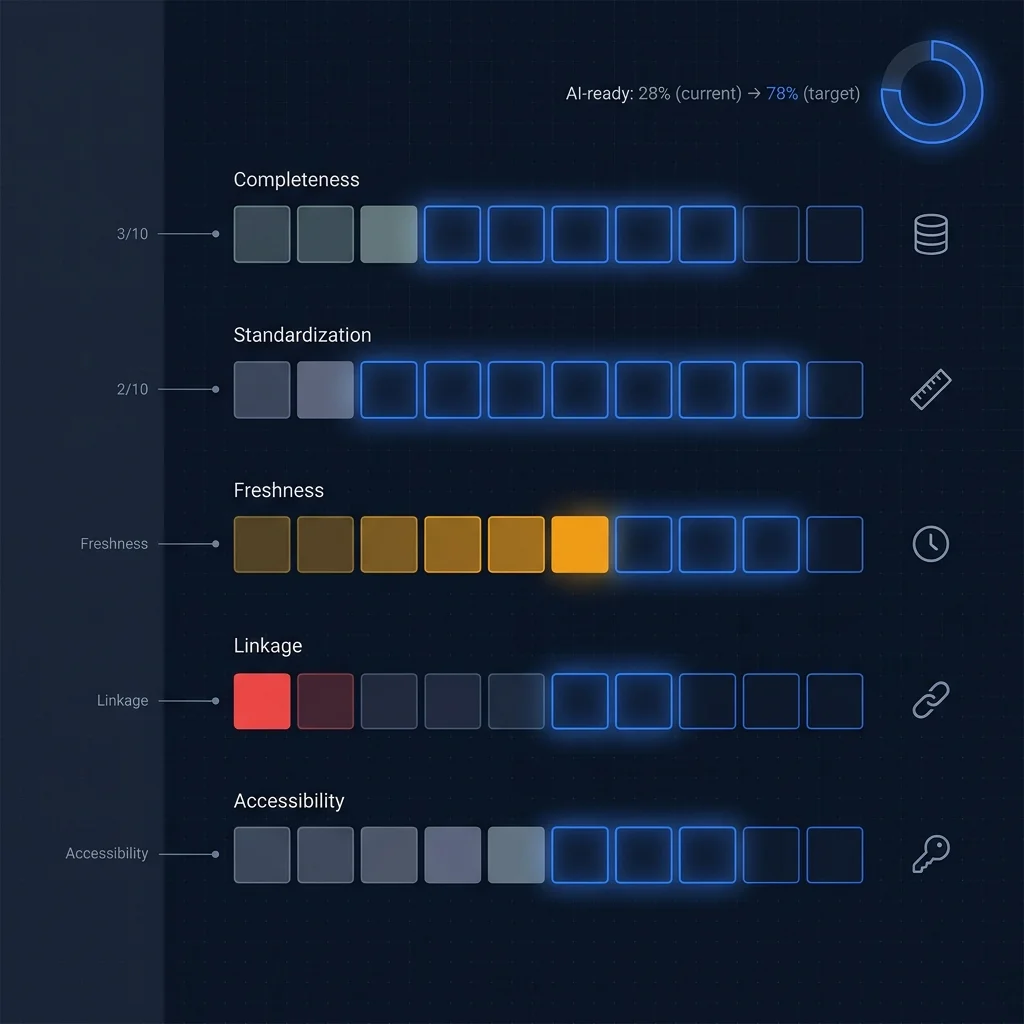
AI-ready procurement data has five defining characteristics. None of them are exotic — they're the same data hygiene principles that good data management has always required. What's changed is that the cost of not meeting them used to be "your reports are slightly inaccurate." Now the cost is "your AI initiative fails entirely."
1. Completeness
Every field that the AI needs to act on must be populated. Missing supplier names, blank category codes, incomplete order records, and contracts without metadata all create gaps that AI systems fall into. Completeness doesn't mean having every possible field populated — it means having the fields that matter for your use case populated without exception.
2. Consistency
"Apple Inc.", "APPLE, INC.", "Apple Computers", and "APL Inc." may all refer to the same supplier — but an AI system treating them as separate suppliers will fragment your spend analysis, undercount your supplier relationship value, and miss duplicate-vendor consolidation opportunities. Consistency requires a controlled vocabulary for suppliers, categories, and product descriptions that is enforced at the point of data entry, not retroactively cleaned.
3. Currency
AI-driven procurement insights are only as valuable as the data underlying them is current. A risk alert about a supplier that's already back online, or a price recommendation based on market data from six months ago, is worse than no AI at all — it creates false confidence. For AI to generate actionable outputs, spend data should be refreshed at minimum weekly, and supplier risk data should be monitored continuously.
4. Connectivity
Procurement data exists across multiple systems: ERP, sourcing platform, contract management, supplier portal, accounts payable, and sometimes dozens more. AI systems that can only access data from one of these systems produce incomplete analyses. True data connectivity means a unified data layer that pulls from all procurement-relevant systems into a single model that AI can query coherently.
5. Structure
Unstructured data — PDF contracts, email chains, scanned invoices, free-text specification documents — is the AI equivalent of raw ore: potentially valuable but not directly usable without extraction and refinement. AI-ready data is structured data: machine-readable fields, defined schemas, and queryable formats. Unstructured documents need to be processed through extraction tools before they can feed AI workflows — see OCR vs AI document analysis for the technology comparison and technical spec sheet analysis for the specifications-specific workflow.
The 5 Most Common Data Problems Blocking AI ROI
Problem 1: Siloed Systems with No Unified Spend View
Most mid-to-large enterprises have multiple ERP instances — acquired through M&A, grown through business unit expansion, or simply never consolidated. Spend data lives across SAP, Oracle, NetSuite, and legacy systems simultaneously. AI can't aggregate what it can't see. Organizations without a spend cube or data warehouse that consolidates cross-system spend are flying blind on category-level analytics — and their AI tools are too.
Fix: Implement a procurement data warehouse or spend analytics platform (Sievo, Coupa, GEP) that aggregates spend from all sources before deploying any AI analytics layer.
Problem 2: Inconsistent Spend Taxonomies
When different business units use different category codes, or when the same category appears under multiple names across systems, AI classification becomes guesswork. A common scenario: IT spend is coded as "Technology" in one ERP, "IT Services" in another, and "Professional Services" in a third. No AI classifier will correctly categorize this without a unified taxonomy enforced at the source.
Fix: Adopt a standard taxonomy (UNSPSC is the most common; custom taxonomies work if consistently applied) and enforce it at PO creation, not as a post-processing step.
Problem 3: Supplier Master Data Chaos
Supplier master data is often the worst quality data in the procurement ecosystem. Duplicate supplier records created by different departments, outdated contact and bank account information, missing tax IDs, and no consolidation of parent-subsidiary relationships are endemic. An AI system given bad supplier master data will produce spend analysis that is fundamentally wrong — overstating the number of supplier relationships and understating spend concentration.
Fix: Run a supplier master data deduplication project before any AI deployment. This is a one-time investment with perpetual returns. Dun & Bradstreet, EcoVadis, and Tealbook all offer supplier data enrichment services.
Problem 4: PDF-Locked Contract and Document Data
Contracts in PDF files on a SharePoint drive are not contract data — they're archived images of contract data. AI contract analysis, risk monitoring, obligation tracking, and renewal management all require structured contract metadata. Until contracts are in a CLM system with populated metadata fields, AI contract capabilities are theoretical.
Fix: Implement contract abstraction for the top 20% of contracts by spend value as a first phase. CLM platforms like Ironclad, Icertis, and Coupa Contract all offer AI-assisted abstraction tools that can extract key terms from existing PDFs.
Problem 5: Disconnected Supplier Performance Data
Supplier performance data — delivery performance, quality metrics, invoice accuracy rates, responsiveness scores — is often maintained in separate systems (quality management, ERP goods receipt transactions, email-based scorecards) that are never connected to the sourcing and spend analytics environment. AI-driven supplier selection and risk management requires this data to be integrated. Without it, AI supplier recommendations are based on historical spend patterns alone — and price has always been a poor proxy for supplier performance. (See our vendor scorecard KPIs guide and vendor risk assessment framework for the metrics that actually matter.)
Fix: Define 3-5 core supplier KPIs, identify where this data currently lives, and build or buy the integration that surfaces it in your sourcing and analytics platform — start from our Vendor Scorecard Template.
The Phased Path: From Data Chaos to Agentic Procurement
Data readiness is not a binary state — it's a maturity progression. Organizations that try to skip phases consistently fail. The sequence matters:
Data Foundation (Months 1-6)
- Consolidate spend data from all ERP sources into a single warehouse
- Implement and enforce a consistent spend taxonomy
- Deduplicate supplier master data and enrich with third-party data
- Begin CLM implementation for top-spend contracts
Analytics (Months 4-9)
- Deploy spend analytics with consistent category and supplier visibility
- Implement supplier performance scorecards with data from integrated systems
- Run first AI-assisted spend classification on clean data
- Establish baseline metrics: spend coverage, classification accuracy, on-time delivery rates
Automation (Months 7-15)
- Deploy AI-assisted sourcing tools for routine RFQs
- Implement intelligent invoice matching and exception routing
- Deploy AI-driven contract monitoring for renewals and obligations
- Automate tail spend purchasing below defined thresholds
Agentic (Months 12+)
- Deploy category-specific autonomous sourcing agents
- Implement agentic supplier risk monitoring with automated alerts and escalations
- Enable AI-driven should-cost modeling with real-time market data integration
- Deploy agentic spend compliance monitoring across business units
Your One-Day Procurement Data Readiness Audit
Before your next AI budget request or platform evaluation, run this audit to get an honest picture of your readiness. It requires pulling data that most procurement teams already have access to — the value is in looking at it through an AI-readiness lens rather than a traditional analytics lens.
| Audit Check | What to Measure | Target for AI Readiness |
|---|---|---|
| Spend coverage | % of total spend visible in your analytics platform | >85% |
| Classification rate | % of spend with a category code assigned | >90% |
| Supplier deduplication | % of supplier records that are unique (no duplicates) | >95% |
| Data freshness | Maximum lag between transaction and analytics visibility | <7 days |
| Contract data structure | % of contracts with machine-readable metadata (in CLM) | >70% by spend value |
| Supplier performance data | % of strategic suppliers with current performance scores | >80% |
Score each dimension as Ready (>80% of target), Developing (50-80%), or Not Ready (<50%). Any dimension scored "Not Ready" should be your first investment priority — ahead of any AI tool purchase.
The Uncomfortable Conclusion — and the Practical Path Forward
Procurement AI ROI is not primarily a technology problem. It's a data problem that has been consistently misdiagnosed as a technology problem — which is why procurement teams keep buying new AI tools and getting mediocre results from all of them.
The organizations achieving 3.2x ROI on AI are not using better AI than their peers. They invested in better data before investing in AI. That sequence — data first, AI second — is the non-negotiable prerequisite for procurement AI that actually delivers.
The good news: data foundation work doesn't require a massive transformation project. Start with spend consolidation. Fix supplier master data. Move your top 20% of contracts into a CLM. These three initiatives, executed in sequence, will create more AI-ready data than any number of AI platform purchases applied to the current environment. Quantify the savings up front with our free Procurement ROI Calculator and the Procurement Automation ROI Guide — and pair this with the supply-side resilience moves in supply chain resilience strategy 2026.
Structured Spec Data: AI Readiness Starts Here
One of the most impactful data quality improvements for technical procurement is moving from PDF specifications to structured, comparable spec data. SpecLens extracts and structures vendor specification data — making it machine-readable, comparable, and AI-ready from the first vendor interaction (see how it works).
Try SpecLens →Tags:
References
- 1.Deloitte — Global CPO Survey 2025 — 74% of procurement leaders say their data is not AI-ready (2025)
- 2.Deloitte Digital Masters Research — Digital Masters achieve 3.2x ROI vs 1.5x for average organizations on GenAI (2025)
- 3.Hackett Group — Procurement Performance Benchmarks — World-class procurement teams run sourcing cycles 24% shorter and req-to-PO 58% shorter (2025)
- 4.Mordor Intelligence — Procurement Analytics Market Report — Procurement analytics market growing at 17.4% CAGR in 2025 (2025)
Frequently Asked Questions
Related Articles
AI in Procurement: The Complete 2026 Guide
Complete guide to AI in procurement. Learn how AI transforms sourcing, spec analysis, vendor evaluation, and automation.
AI Vendor Scoring Systems
Learn how AI vendor scoring systems work for objective evaluation. Balance automation with human judgment for better procurement.
ChatGPT vs Claude vs Copilot for Procurement
Compare ChatGPT, Claude, and Copilot for procurement. Learn which AI works best for document analysis and vendor evaluation.
GenAI for Vendor Comparison (2026)
Discover how Generative AI is revolutionizing vendor comparison. From automated extraction to hallucination-free analysis, learn the future of procurement.