

Procurement Intake Management: The $190M Front Door Problem
Zip raised $190M, Omnea raised $50M — intake management is procurement's hottest new category. Learn what it is, why it matters now, and how to evaluate whether you need a dedicated intake platform.
David Chen
Senior Procurement Analyst, SpecLens
- 850+companies trust SpecLens
- 99%extraction accuracy
- 8 hrssaved per comparison
- AES-256encrypted · GDPR compliant
Every day, employees across your organization need to buy things. Software subscriptions. Consulting engagements. Marketing services. Office supplies. IT equipment. And every day, a significant percentage of those purchases happen outside your procurement process — through personal credit cards, direct vendor billing, a manager's approval via email, or a Slack message that never made it into any system.
This is the "front door" problem in procurement. And in 2025-2026, it has become one of the hottest investment categories in all of B2B software. Zip raised $190 million in a Series D round. Omnea raised $50 million in September 2025 after achieving 5x revenue growth in 12 months with customers including Spotify, Albertsons, and Wise. Gartner placed Intake Management at the Peak of Inflated Expectations in its 2025 Hype Cycle for Procurement and Sourcing — meaning the market has noticed, the hype has peaked, and real enterprise adoption is now underway.
This guide explains why intake management is being solved now, what good intake management actually looks like, and how to evaluate whether you need a dedicated intake platform or whether your existing ERP can close the gap. (For the wider buyer's-guide view, see best procurement software 2026.)
What You'll Learn:
- What procurement intake management is and why it matters
- The shadow procurement problem and its real costs
- Why this is being solved now (the perfect storm of AI + remote work)
- Platform landscape: Zip, Omnea, and how ERPs are responding
- What good intake management looks like in practice
- How to evaluate whether you need a standalone intake tool
- Implementation roadmap for procurement intake
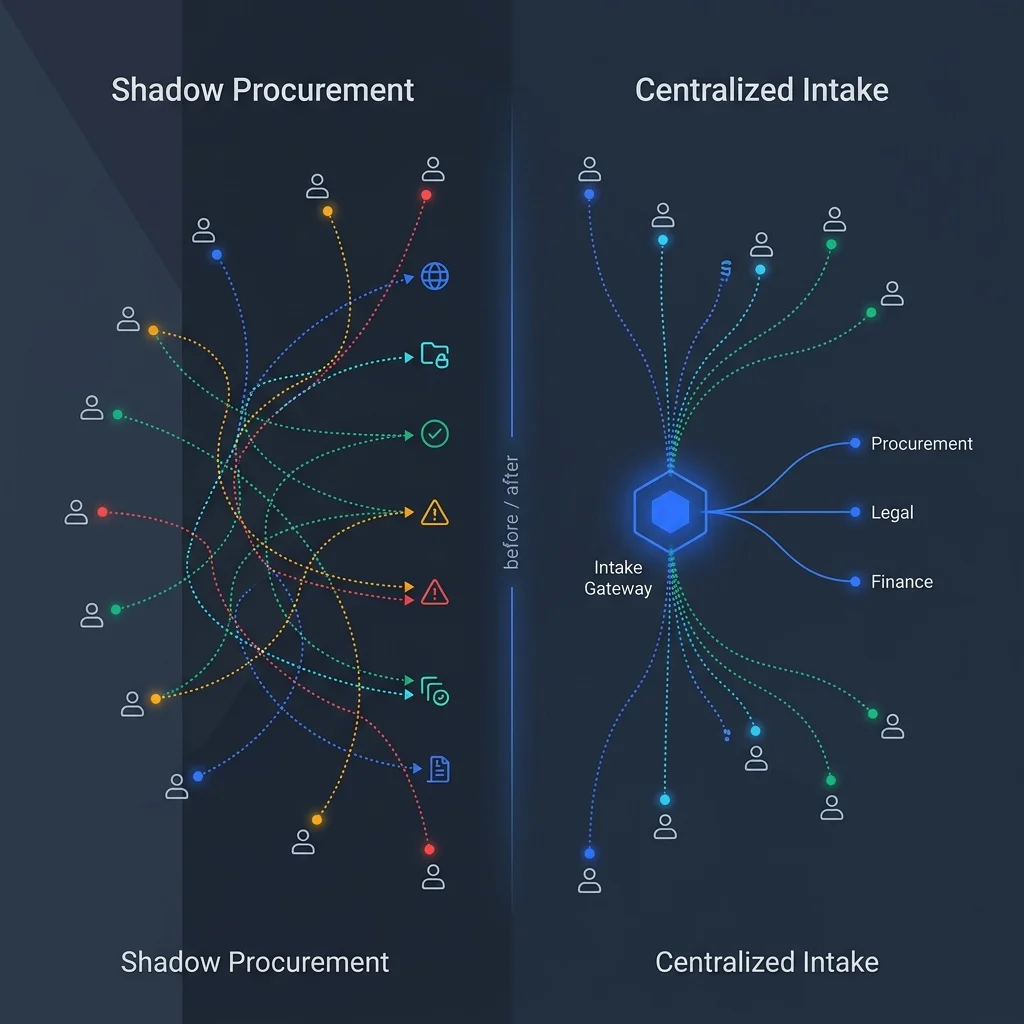
The Front Door Problem: Shadow Procurement at Scale
Procurement teams invest heavily in source-to-pay systems, supplier management platforms, and contract management tools. But all of that investment assumes that purchases actually enter the system in the first place. In most organizations, a significant — and growing — percentage don't.
Shadow procurement happens when:
- An employee needs software and signs up for a SaaS tool directly with a credit card rather than going through IT or procurement
- A manager approves a consultant engagement via email and the PO is created after the work has already started
- A department head renews a contract by replying "yes" to a vendor email, bypassing the contract management process
- An employee finds a cheaper option for office supplies on Amazon.com (personal account) rather than through the corporate Amazon Business account
- A new vendor is onboarded verbally, with legal and compliance review deferred "until things settle down"
None of these represent malicious behavior. They all represent the rational response of employees facing a procurement process that is slower and more friction-filled than the alternatives available to them. The problem isn't employee intent — it's process design. (We unpack the hidden cost layer in 15 hidden procurement costs and the cycle-time fix in reduce procurement cycle time.)
The Real Cost of Shadow Procurement
Spend visibility: Shadow purchases don't appear in spend analytics, making category management impossible and negotiating leverage meaningless.
Contract compliance: Off-process purchases may miss negotiated pricing, preferred suppliers, and compliance requirements — even when a preferred supplier exists.
Vendor security risk: SaaS tools adopted via credit card are rarely vetted for security, data privacy, or vendor financial health before data is shared with them.
Duplicate spend: Without visibility, organizations routinely pay for the same capability multiple times across different tools, departments, or business units.
Audit and compliance exposure: Off-process purchases create audit trail gaps that are painful during financial audits and potentially costly during regulatory reviews.
What Is Procurement Intake Management?
Procurement intake management is the discipline (and increasingly, the technology category) of capturing and routing every purchase request — regardless of source — through a consistent, friction-minimized process before any spend commitment is made.
A procurement intake system is the "front door" to your procurement function. It is the first touchpoint for any employee who needs to buy something, and its job is to:
- Capture the request in structured form — what is needed, why, at what cost, from which vendor, and by when
- Check for existing contracts — is there already a preferred or contracted supplier for this category?
- Route intelligently — low-value, pre-approved requests auto-approve; high-value or complex requests route to appropriate reviewers (procurement, legal, IT, finance, security)
- Maintain compliance — enforce budget thresholds, approval chains, and vendor requirements without manual policing
- Provide visibility — give procurement and finance real-time visibility into pending, approved, and committed spend
The key insight: intake management is not another procurement approval step — it's a smarter, faster front-end that makes the compliant path easier than the shadow procurement path. When intake is well-designed, employees prefer it over going around procurement because it actually saves them time.
Why This Is Being Solved Now
Intake management as a concept isn't new — procurement teams have tried to solve it for decades with intake forms, purchasing policies, and approval workflows built into ERPs. The reason it's being solved at scale now is a convergence of three factors:
1. The SaaS Proliferation Problem
The average mid-size enterprise now uses 200-400 SaaS applications. Each of these was acquired at some point — many of them outside the procurement process. The ease of SaaS adoption (credit card, instant access) has massively accelerated the shadow procurement problem in software categories specifically, where the traditional "submit a purchase request" process feels impossibly slow relative to the "sign up online in 5 minutes" alternative.
2. Remote Work Changed Procurement Dynamics
When employees work in offices, informal procurement coordination happens naturally — an IT person walks over to a manager's desk, a finance partner stops by a team meeting. Remote and hybrid work eliminated these informal channels, pushing more purchasing requests into unmanaged email threads and direct vendor engagement. Intake management platforms provide the digital equivalent of that informal coordination layer.
3. AI Has Made Smart Routing Possible at Scale
The reason previous intake tools failed to achieve adoption is that they added process without adding intelligence. They made employees fill out forms — and then the forms sat in a queue for procurement review that was just as slow as the alternative.
Modern intake platforms use AI to make the process genuinely faster for most requests: automatically identifying existing vendor contracts, auto-populating approval routing based on request characteristics, instantly approving requests that meet pre-defined criteria, and flagging only genuinely novel or high-risk requests for human review. The autonomous-routing layer is covered in detail in our agentic AI in procurement guide — and assumes the data foundation in procurement AI data readiness. When the intake process is faster than the workaround, adoption follows.
Platform Landscape: Who's Building Intake Management
Zip — The Market Leader
Zip has become the category-defining intake management platform, having raised $190 million in its Series D round. Zip positions itself as the "front door" for all purchases — a unified intake experience that routes requests to appropriate downstream workflows regardless of which procurement, legal, or finance systems are in place.
Zip's key differentiator: it integrates with existing procurement systems rather than replacing them. A request enters through Zip's interface, gets routed by Zip's AI, and then flows into the appropriate downstream system — Coupa, SAP Ariba, a contract management tool like Ironclad, or a ticketing system — based on the request type. This "orchestration layer" approach has driven strong enterprise adoption because it doesn't require organizations to rip out existing investments.
Omnea — The AI-Native Challenger
Omnea raised $50 million in September 2025 with investors including Insight Partners and Khosla Ventures. At 5x revenue growth in 12 months, it's the fastest-growing platform in the category. Omnea's differentiation is its AI-native architecture — rather than adding AI features to an existing intake workflow tool, Omnea was built from the ground up with AI orchestration as the core capability.
Omnea's customers include Spotify, Albertsons, and Wise. Their platform handles intake, vendor risk assessment, contract routing, and renewal management in an integrated flow — reducing the number of separate tools required for end-to-end purchase request management.
How ERPs Are Responding
SAP, Oracle, and Workday have all released or are developing intake management capabilities as part of their existing platforms. SAP's "Guided Buying" experience and Oracle's "Procurement Intake" module represent ERP-native attempts to close the front door gap.
The honest assessment: ERP-native intake solutions offer better integration with existing back-end systems but typically offer a less consumer-grade user experience and slower AI adoption than purpose-built intake platforms. For organizations with strong ERP investments and low-complexity intake needs, the ERP-native solution may be sufficient. For organizations with significant SaaS sprawl, complex approval routing, or high volumes of new vendor requests, purpose-built intake platforms typically produce better adoption rates and better outcomes.
What Good Intake Management Looks Like in Practice
The hallmark of well-designed intake management is that the compliant path feels easier than the non-compliant path. Here's what that looks like end-to-end:
| Step | Poor Intake (Status Quo) | Good Intake (Well-Designed) |
|---|---|---|
| Request initiation | Email to manager → informal approval → email to procurement | Employee submits request via Slack integration or web form in 3 minutes |
| Existing contract check | Manually search contract drive or ask procurement team | Intake system automatically surfaces existing contracts for the vendor/category |
| Routing decision | Procurement manually decides who needs to review | AI routes automatically based on spend amount, vendor type, data classification |
| Low-value approval | Same 5-day queue regardless of request size | Auto-approved within minutes for requests meeting pre-set criteria |
| High-value review | Parallel email chains to legal, IT, finance with no coordination | Parallel workflow in single platform; all reviewers see same request status |
| Vendor onboarding | Manual form, ad hoc documentation, delayed | Triggered automatically at approval; vendor self-service portal |
| Spend visibility | Finance discovers spend after invoice arrives | Real-time committed spend visibility for finance and procurement |
How to Evaluate Whether You Need a Standalone Intake Tool
Not every organization needs a purpose-built intake management platform. Use this decision framework to assess your need:
High intake volume
You process more than 500 purchase requests per month across the organization
Standalone platform scales better than ERP-native at this volume
SaaS sprawl problem
IT has identified 50+ shadow IT SaaS tools in use without procurement oversight
Strong indicator: SaaS intake is the primary use case for platforms like Zip and Omnea
Cross-system complexity
Different requests route to different downstream systems (Coupa, Ariba, Ironclad, Jira)
Orchestration layer platforms excel here; ERP-native tools struggle
Poor adoption of current process
Procurement estimates more than 20% of spend bypasses the current approval process
UX-driven standalone platforms improve adoption more reliably than ERP forms
Multiple legal entities or geographies
Approval routing varies by country, entity, or business unit with complex policy logic
Dedicated intake platforms handle policy complexity better than generic ERP workflows
Vendor risk visibility gaps
You've been surprised by vendor security incidents, financial failures, or compliance issues
Intake platforms with built-in vendor risk assessment close this gap proactively
If three or more of these apply to your organization, a standalone intake management platform will likely deliver measurable ROI within 12 months through spend visibility improvement, duplicate vendor elimination, and shadow IT discovery alone — model the savings with our free Procurement ROI Calculator and the framework in Procurement Automation ROI Guide. Pair this with the vendor risk assessment framework to operationalize vendor-risk gating at the intake step.
Implementation Roadmap for Procurement Intake
Rolling out an intake management system is as much a change management project as a technology project. The technology is rarely the bottleneck — getting employees to use it is. This roadmap reflects what successful implementations have in common:
Phase 1: Define and Document (Weeks 1-4)
- Map all current purchase approval workflows, including informal ones
- Identify the top 10 categories by volume of purchase requests
- Define auto-approval criteria for low-risk, low-value requests
- Document all stakeholder groups who need to be part of review workflows
- Identify which downstream systems intake needs to route to
Phase 2: Configure and Pilot (Weeks 5-10)
- Configure intake platform with approval workflows, budget thresholds, and routing logic
- Integrate with existing contract management system to enable contract reuse detection
- Pilot with a single business unit or department — pick one with a motivated champion
- Measure baseline metrics: request volume, approval cycle time, and shadow spend estimates
- Iterate on routing logic and form design based on pilot feedback
Phase 3: Roll Out and Measure (Weeks 10-20)
- Expand to all business units with enablement and training
- Communicate the "what's in it for me" to employees — faster approvals, not more bureaucracy
- Monitor adoption metrics: what % of purchases are entering through the intake system vs. bypassing it
- Identify and address the top 3 bypass reasons (usually: process too slow for urgency, confusion about when to use it, unknown existence of the process)
Phase 4: Optimize (Month 6+)
- Use intake data to identify spending patterns procurement didn't previously see
- Leverage request history to build category intelligence: which categories generate the most requests, which vendors appear most frequently, which approvals consistently require exception handling
- Automate vendor risk screening using intake data as the trigger
- Connect intake data to budget management for real-time committed spend visibility
The Bigger Picture: Intake as the Foundation for Strategic Procurement
Procurement intake management sounds tactical — it's about routing purchase requests, not about strategic sourcing or supplier relationships. But the organizations leading in procurement in 2026 understand that intake data is the foundation of strategic procurement. You cannot manage category spend you can't see. You cannot negotiate leverage with suppliers you don't know employees are using. You cannot build supplier relationships that are created through shadow channels.
The $190 million that Zip raised and the $50 million that Omnea raised in 2025 are not bets on a software feature — they're bets on a strategic shift in how enterprises manage the front door of their procurement function. For procurement leaders who want to move from reactive cost control to proactive spend strategy, solving the intake problem is the prerequisite — alongside the core procurement best practices for 2026.
Analyze Vendor Specifications Before Approving Purchases
Once purchase requests are captured through your intake process, SpecLens helps procurement teams quickly analyze vendor technical specifications and compare proposals — so approvals are based on verified specifications, not vendor claims (see how it works).
Try SpecLens →Tags:
References
- 1.Omnea — Series B Announcement — Omnea $50M Series B and 5x revenue growth in 12 months (2025)
- 2.Zip HQ — Series D Announcement — Zip $190M Series D and intake-to-procure platform growth (2025)
- 3.Oro Labs — Gartner 2025 Hype Cycle Analysis — Gartner 2025 Hype Cycle: Intake Management at Peak of Inflated Expectations (2025)
- 4.Gartner Peer Insights — Procure-to-Pay Suites — Procurement software market analysis and vendor ratings 2026 (2026)
Frequently Asked Questions
Related Articles
What Is Specification Intelligence? A Practical Definition
Specification intelligence is the procurement layer that extracts, normalizes, and compares technical specs across vendor documents. Definition, four pillars, use cases, and 2026 buyer's guide.
AI in Procurement: The Complete 2026 Guide
Complete guide to AI in procurement. Learn how AI transforms sourcing, spec analysis, vendor evaluation, and automation.
AI Vendor Scoring Systems
Learn how AI vendor scoring systems work for objective evaluation. Balance automation with human judgment for better procurement.
ChatGPT vs Claude vs Copilot for Procurement
Compare ChatGPT, Claude, and Copilot for procurement. Learn which AI works best for document analysis and vendor evaluation.