

Supply Chain Resilience: Why 80% Think They're Ready (And 95% Are Wrong)
Only 5% of companies have a comprehensive resilience strategy despite 80% claiming resilience. With tariff shock and $184M average disruption costs, here's how to build real supply chain resilience.
David Chen
Senior Procurement Analyst, SpecLens
- 850+companies trust SpecLens
- 99%extraction accuracy
- 8 hrssaved per comparison
- AES-256encrypted · GDPR compliant
Key takeaways
- 80% of executives believe their supply chain is resilient — but only 5% have a comprehensive strategy in place (Oliver Wyman 2025).
- Average cost of a major supply chain disruption is approximately $184M per event for large enterprises.
- Resilience requires mapping critical dependencies down to tier-3 suppliers — most maps stop at tier-1 and miss the real risk.
- Stress-test against specific scenarios (insolvency, port closure, sanctions, cyberattack) — paper plans never tested fail in real disruptions.
- Build resilience selectively: buffer inventory only for high-criticality, low-substitutability components — not blanket buffers everywhere.
Here is one of the most striking statistics in the 2025 procurement landscape: 80% of companies describe their supply chains as "very resilient." Yet in the same period, only 5% have a comprehensive resilience strategy in place — a sharp decline from 2024. Less than 4% plan to increase resilience budgets, and more than a third expect to cut them.
This is not a minor contradiction. It's a systemic delusion — and one that the 2025 tariff shock exposed in real time. When the U.S. government announced 25% tariffs on Canadian and Mexican imports and 10% on Chinese goods, the reaction from procurement teams was immediate and chaotic: emergency supplier searches, contract renegotiations, panicked category reviews. Seventy-seven percent of consumer goods companies were forced into reactive supplier contract renegotiations within weeks.
Organizations that had actually built resilience infrastructure absorbed the shock. Organizations that had merely described themselves as resilient discovered what resilience confidence without resilience strategy actually costs: $184 million per year, on average, in supplier disruption losses. (Run your own numbers through our Supply Chain Risk Assessment Template before the next shock.)
What You'll Learn:
- Why the resilience confidence gap is a liability, not a comfort
- What the 2025 tariff shock revealed about procurement vulnerability
- "Resilience by design" vs. reactive resilience — the critical distinction
- The four components of a real resilience strategy
- The reshoring reality check: why "just bring it home" isn't simple
- A 90-day resilience audit framework for procurement teams
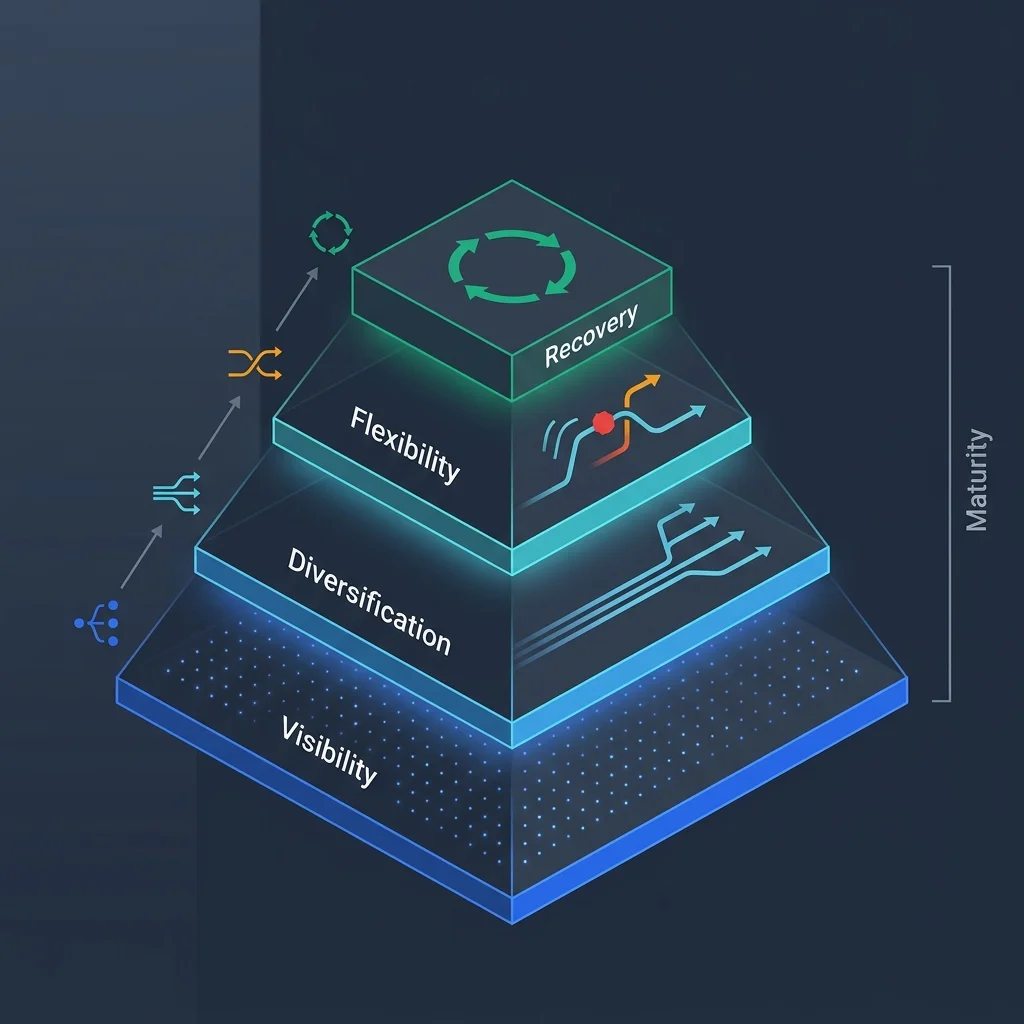
The Resilience Paradox: Confidence Without Infrastructure
How do 80% of companies believe they're resilient when the data says otherwise? The answer lies in how resilience is typically assessed: self-reported surveys, high-level continuity plans, and the absence of recent major disruptions. If your supply chain hasn't failed visibly in the last 12 months, it's easy to conclude that it's resilient. The problem is that this logic confuses the absence of disruption with the presence of resilience capacity.
True supply chain resilience is not defined by a quiet period — it's defined by your ability to absorb, adapt to, and recover from disruptions when they inevitably arrive. And the range of potential disruptions has never been broader: geopolitical tariff shocks, single-source supplier failures, extreme weather events disrupting logistics corridors, regulatory changes blocking specific commodities, and cybersecurity incidents affecting supplier networks.
The BCG/Inverto Procurement Trends 2026 report puts it plainly: organizations need to plan for "a baseline of ongoing disruption," not for isolated one-off events. The era of supply chain stability as a default assumption is over.
The Real Numbers Behind the Resilience Gap
What the 2025 Tariff Shock Revealed
The 2025 tariff announcements — 25% on Canadian and Mexican imports, 10% on Chinese goods — were not entirely unpredictable given the political environment. But the speed and breadth of the response from procurement teams revealed exactly how thin the resilience infrastructure was.
The organizations caught flat-footed shared common characteristics:
- Single-source dependencies in affected categories with no pre-qualified alternatives — a gap that a structured vendor risk assessment surfaces early
- No commodity exposure mapping — they didn't know which products contained affected materials until the tariffs hit
- Contracts without price adjustment clauses or clauses that were disadvantageous under sudden cost spikes
- No pre-built supplier qualification process — qualifying a new supplier from scratch takes 60-180 days in most categories. The Supplier Technical Evaluation Template compresses that to weeks once you've defined the criteria
- Spend data that wasn't sufficiently granular to identify tariff exposure at the component level — the same data-readiness problem we cover in why 74% of procurement AI projects fail
Organizations that absorbed the tariff shock with minimal disruption shared a different profile: they had multi-source strategies in place, pre-qualified alternative suppliers on standby, and spend data granular enough to model tariff impact within days of the announcement. They'd done the resilience work before the disruption — not during it.
Resilience by Design vs. Reactive Resilience
The most important concept in the BCG/Inverto 2026 procurement research is the distinction between reactive resilience — scrambling to respond when disruption hits — and resilience by design — building adaptability into procurement strategy proactively.
| Dimension | Reactive Resilience | Resilience by Design |
|---|---|---|
| Supplier strategy | Single source for lowest cost; dual-source when forced by disruption | Deliberate multi-sourcing with maintained relationships across sources |
| Risk monitoring | Manual, periodic supplier reviews | Continuous AI-driven supplier risk monitoring with early warning alerts |
| Supplier qualification | Qualify when needed; 60-180 day lead time | Pre-qualified alternative list maintained continuously |
| Disruption visibility | Learn of disruption from supplier after impact begins | Digital twin modeling identifies vulnerabilities before disruption |
| Spend analysis | Quarterly or annual spend analysis | Real-time spend visibility with geographic and supplier concentration metrics |
| Cost of resilience | Hidden: absorbed in emergency sourcing, expediting, lost production | Visible: accounted for in category strategy as a deliberate investment |
The distinction is not merely philosophical. The $184 million average annual disruption cost cited above is largely a cost of reactive resilience — it's the price organizations pay for not building resilience in advance. Organizations with resilience-by-design strategies report disruption costs running at 30-50% lower than industry averages.
The Four Components of a Real Resilience Strategy
1. Multi-Sourcing with Maintained Relationships
Multi-sourcing is not the same as having a backup supplier's contact information in a spreadsheet. Effective multi-sourcing means maintaining active, commercially relevant relationships with at least two qualified sources for every strategic category — see our vendor selection criteria checklist for the underlying evaluation framework. "Active" means placing regular business with both — even if the secondary source receives only 20-30% of volume. A backup supplier you've never actually ordered from is not a backup: it's an unvalidated hypothesis.
The cost of maintaining dual or multi-source strategies is real: secondary suppliers may be 5-10% more expensive, and managing relationships with more suppliers requires more procurement bandwidth. But this cost is predictable and controllable. The cost of reactive emergency sourcing is neither.
2. Regional Supplier Ecosystems
The 2025 tariff environment has accelerated a structural shift toward regional supplier ecosystems — building supply chains that are less exposed to geopolitical friction across trade boundaries. Forty percent of U.S. companies plan to relocate at least part of their supply chains to North America by 2026 according to Deloitte. European companies are making parallel shifts toward European sourcing for strategic categories.
Regional sourcing isn't universally optimal — for many commodity categories, the cost premium of regional sourcing cannot be justified. The key is category segmentation: identify which categories carry genuine geopolitical risk, which carry logistics risk, and which are cost-driven with stable supply profiles. Apply regional sourcing strategy selectively, not universally.
3. Digital Twins for Vulnerability Mapping
A supply chain digital twin is a model of your supply network — including tier 2 and tier 3 suppliers — that enables scenario simulation before disruptions occur. Organizations with digital twin capability can ask: "If our primary CNC machining supplier in Taiwan goes offline for six weeks, which products are affected, what's the revenue impact, and what are our response options?" — and get a data-backed answer in hours rather than weeks.
Digital twins are no longer exclusively the domain of global enterprises. Platforms like Resilinc, riskmethods, and Everstream Analytics offer supply network mapping and scenario simulation capabilities that are accessible to mid-market manufacturers. The minimum viable version is a tier-1 supplier map with revenue exposure analysis and a defined monitoring process. Layered AI-driven monitoring is covered in AI in Procurement: Complete 2026 Guide.
4. Pre-Vetted Supplier Lists with Rapid Activation
The single most actionable resilience investment for most procurement teams: build and maintain a list of pre-qualified alternative suppliers for every strategic category, with qualification current enough to activate within 2-4 weeks. This transforms disruption response from a 3-6 month supplier qualification process into a 2-4 week commercial activation — and is often the difference between a manageable supply disruption and a production stoppage. Standardize the activation criteria in a Vendor Scorecard Template so the swap is judgement-free.
Pre-vetting requires periodic maintenance: annual qualification refreshes, spot order placements to validate production capability, and relationship management to ensure suppliers remain interested in your business. Budget for this as a deliberate investment, not an overhead.
The Reshoring Reality Check
"Reshoring" and "nearshoring" have become procurement buzzwords in 2025-2026 — understandably so, given the tariff environment. But the practical reality of reshoring is more complicated than the strategic narrative suggests.
The primary challenge: modern manufacturing requires digital, robotics, and AI skills that the training and education system cannot supply at scale (see manufacturing & industrial procurement). Nearly 500,000 manufacturing jobs in the U.S. remain unfilled — not because companies aren't hiring, but because the workforce with the required skill sets doesn't exist in sufficient quantity. Building a "Made in America" supply chain for complex technical products requires either paying premium wages to a scarce skilled workforce, investing heavily in training programs with 2-4 year time horizons, or deploying automation that itself requires capital investment and specialized talent to operate. The quote-accuracy problem we cover in custom manufacturing procurement compounds the cost.
This doesn't mean reshoring is the wrong strategy — in many cases it's the right one for strategic categories with genuine geopolitical exposure. But it means procurement leaders need to evaluate reshoring with realistic cost models that account for labor market conditions, not just tariff cost comparisons. Use a full-lifecycle view via the free TCO Calculator and triangulate against should-cost analysis before committing. The category segmentation approach applies here too: reshore strategically critical categories where supply risk justifies the cost premium; maintain global sourcing for commodity categories with stable supply profiles and manageable risk.
The 90-Day Resilience Audit Framework
For procurement teams that want to move from resilience confidence to resilience reality, this 90-day framework provides a structured path:
Days 1-30: Exposure Mapping
Days 31-60: Strategy Development
Days 61-90: Infrastructure and Governance
Building Your Resilience Scorecard
Once your audit is complete, track these metrics on an ongoing basis to measure resilience maturity:
| Metric | At-Risk | Developing | Resilient |
|---|---|---|---|
| Single-source spend (% of total strategic spend) | >50% | 25-50% | <25% |
| Geographic concentration (top country as % of spend) | >60% | 40-60% | <40% |
| Supplier financial health monitoring coverage | <20% of suppliers | 20-60% | >60% (continuous) |
| Pre-qualified alternatives for strategic categories | <25% of categories | 25-75% | >75% of categories |
| Disruption response time (qualify new supplier) | >90 days | 30-90 days | <30 days |
The organizations in the "Resilient" column for these metrics are not the ones saying they're resilient — they're the ones that have built the infrastructure to prove it. In an era where the BCG/Inverto research characterizes ongoing disruption as "the new normal," that infrastructure is no longer optional. It's the cost of operating with confidence in global markets.
Know Your Supplier Specs Before Disruption Hits
Resilience requires knowing which suppliers meet your technical requirements — so that pre-qualified alternatives are actually validated alternatives. SpecLens helps procurement teams compare and verify technical specifications across multiple suppliers, making your pre-qualified supplier list actionable when you need it most. Pair this with the ESG data burden guide if compliance load is a primary risk vector for you.
Try SpecLens →Tags:
References
- 1.Oliver Wyman — Supply Chain Resilience Research — Supply chain resilience paradox: 80% claiming resilience, 5% with comprehensive strategy (2025)
- 2.BCG/Inverto — Procurement Trends 2026 Report — Procurement trends 2026: resilience by design vs reactive resilience (2026)
- 3.Deloitte — Global CPO Survey 2025 — 40% of US companies plan to relocate supply chains to North America by 2026 (2025)
- 4.SupplyChainBrain — Trade Policy Analysis — Tariffs reshaping global supply chains: 25% on Canada/Mexico, 10% on China (2025)
Frequently Asked Questions
Related Articles
5 Procurement Best Practices for 2026
Stay ahead of the curve with these essential procurement best practices. From digital transformation to sustainability, learn how to modernize your sourcing.
The True Cost of Manual Procurement
Manual processes are bleeding your budget. We analyze the hidden costs of human error, slow processing, and employee burnout.
Procurement Burnout: Hidden Costs
Manual specification review is burning out your procurement team. Discover the numbers behind the silent epidemic and how AI can help reclaim your team's time.
Procurement Automation ROI Guide
Learn how to calculate procurement automation ROI. Build a business case with metrics for time savings and error reduction.