
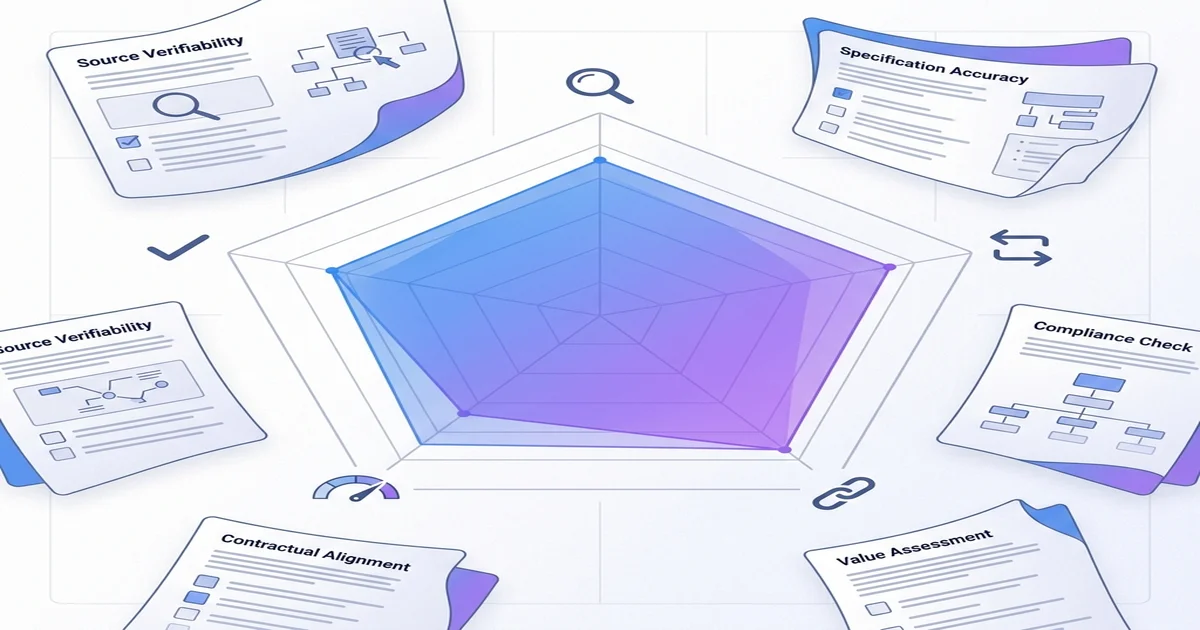
The Comparable-Spec Index: Vendor Comparison Framework
A 5-dimension scoring rubric for measuring whether vendor proposals are actually comparable. Coverage, Normalization, Citation, Confidence, Decision-Readiness — scored 0 to 20 with worked example.
Rhea Kapoor
Head of Procurement Research, SpecLens
- 850+companies trust SpecLens
- 99%extraction accuracy
- 8 hrssaved per comparison
- AES-256encrypted · GDPR compliant
Key takeaways
- The Comparable-Spec Index is a 5-dimension scoring rubric for vendor-comparison comparability — Coverage, Normalization, Citation, Confidence, Decision-Readiness — each scored 0 to 4, total 0 to 20.
- Score 16+ is decision-ready; 12-15 is approaching ready (address the lowest-scoring dimension first); below 12 means the comparison is not yet comparable.
- Manual comparison scores well on Citation but poorly on Normalization; general AI scores well on Coverage but poorly on Citation; specification intelligence scores well on Citation, Confidence, and Decision-Readiness.
- The Index is a rubric, not a tool — it scores the output of any comparison process and directs analyst attention to the dimensions that pay off most.
- The framework is named without a 3-letter acronym to avoid conflict with Construction Specifications Institute (CSI), a registered trademark in any procurement context that overlaps construction.
The Question Most Procurement Reviews Skip
In ten years of procurement work, the question that is most often missed is also the simplest: are we actually comparing apples to apples? Vendor proposals can look complete, organized, even thorough — and still fail to be comparable, because they use different units, omit critical specifications, cite performance under different conditions, or substitute "or-equal" products that are not equivalent at all. A procurement team that does not catch the mismatch ends up running an evaluation matrix that looks rigorous on paper but rests on incomparable inputs.
We built the Comparable-Spec Index — a five-dimension scoring rubric — so procurement, engineering, and finance can answer the comparability question with a number rather than a feeling. The Index applies to any multi-vendor evaluation across any industry, scores the comparability of the vendor responses (not the vendors themselves), and returns a 0-to-20 score with a defensible threshold for "ready for the decision meeting."
Quick Answer: What Is the Comparable-Spec Index?
The Comparable-Spec Index is a 5-dimension scoring rubric for measuring whether vendor proposals can be fairly compared. The five dimensions — Coverage, Normalization, Citation, Confidence, Decision-Readiness — each score 0 to 4, for a total of 0 to 20. A comparison scoring 16 or higher is decision-ready. A comparison scoring below 12 is not yet comparable and requires further normalization or vendor follow-up before the decision meeting. The Index applies to any multi-vendor evaluation across any industry.
Why Most Vendor Proposals Are Not Actually Comparable
Three illustrative examples drawn from cross-industry procurement patterns:
Storage IOPS at incompatible block sizes. One storage vendor reports random-read IOPS at a 4K block size; the next reports them at 8K with a 70/30 read-write mix. Both numbers are correct under the vendor's assumptions. Neither number is comparable to the other without the buyer running both vendors at the same workload definition.
MRI scanner field strength versus gradient performance. One imaging vendor leads with field strength in Tesla; the next emphasizes gradient slew rate in T/m/s and gradient amplitude. Both are real performance dimensions, but the value-analysis committee that compares Vendor A's field-strength specs against Vendor B's gradient specs is comparing different things.
EV commercial van range versus payload assumptions. One OEM reports range under a no-load test cycle; another reports range under a partial-payload realistic-fleet cycle. Range numbers in the same row of a fleet-procurement matrix mean different things — and the buyer who picks the highest published number gets the worst real-world performance.
Each of these mismatches is detectable. The Index makes the detection systematic.
Dimension 1: Coverage — Are All Mandatory Specifications Present?
Coverage measures the percentage of mandatory specifications present across all vendors. A vendor missing a mandatory specification cannot be fairly compared on that specification — the comparison either disqualifies the vendor or hides the gap.
Coverage Scoring (0 to 4):
- 0 — Less than 50% of mandatory specs present in all vendor responses
- 1 — 50-69% mandatory spec coverage
- 2 — 70-84% mandatory spec coverage
- 3 — 85-94% mandatory spec coverage
- 4 — 95%+ mandatory spec coverage; all gaps documented and addressed
Coverage is the dimension most often inflated by procurement teams under deadline pressure. The temptation is to treat a missing spec as a "the vendor will provide it" commitment rather than a gap. The Index forces explicit accounting. For deeper coverage on the gap-analysis methodology, see specification gap analysis.
Dimension 2: Normalization — Are Units, Terminology, and Conditions Standardized?
Normalization measures whether the units, terminology, and measurement conditions in the vendor responses have been brought to a common basis. A high Coverage score with low Normalization produces a matrix where every cell is filled but the cells in the same row do not actually mean the same thing.
Normalization Scoring (0 to 4):
- 0 — Multiple unit and terminology mismatches across vendors; conditions not specified
- 1 — Unit conversions partially applied; terminology mismatches present
- 2 — Unit conversions applied consistently; terminology mostly normalized; some condition mismatches remain
- 3 — Units and terminology normalized; all condition differences explicitly flagged
- 4 — Full normalization; non-comparable cells flagged as such rather than averaged or ranked
For the cross-industry mechanics of unit normalization, see unit conversion in procurement. A specification intelligence platform automates most of the Normalization work; manual normalization is possible but slower.
Dimension 3: Citation — Is Every Value Traceable to a Source Page?
Citation measures whether every value in the comparison matrix can be traced back to the originating vendor document with a page reference. A high-Coverage, well-Normalized matrix that loses the citation chain is not auditable — and an unauditable matrix is operationally unusable when a stakeholder challenges a specific number.
Citation Scoring (0 to 4):
- 0 — Values in the matrix carry no traceability; analyst must re-derive on challenge
- 1 — Vendor name attached but no page reference
- 2 — Page reference present for most values; some values uncited
- 3 — Every value carries vendor + document + page reference
- 4 — Click-through citation (matrix value links to the source page in the source document)
Citation is the single dimension that distinguishes audit-grade procurement comparisons from plausible-looking summaries. General-purpose AI tools score 0 or 1 on Citation by default; specification intelligence platforms score 3 or 4. The audit value of click-through citation grows with the size of the procurement audit population; for regulated industries (financial services, healthcare, government, defense), it is non-negotiable.
Dimension 4: Confidence — Are Low-Confidence Values Re-Verified?
Confidence measures whether the AI-extracted values carry confidence scores and whether low-confidence values have been re-verified against the source. A high-Citation matrix can still contain extraction errors at the value level if low-confidence cells were not flagged or re-checked.
Confidence Scoring (0 to 4):
- 0 — No confidence scoring; all values treated as equally certain
- 1 — Confidence scoring present but not surfaced in the matrix
- 2 — Confidence scores visible; low-confidence values not re-verified
- 3 — Low-confidence values flagged for human review; majority re-verified
- 4 — All low-confidence values re-verified against the source document and either confirmed or corrected
Confidence is the dimension that bridges AI-assisted comparison and the procurement reviewer's judgment. The matrix is the AI's output; the Confidence step is where the human re-asserts ownership of the high-stakes values.
Dimension 5: Decision-Readiness — Does the Output Surface Gaps and Recommendations?
Decision-Readiness measures whether the comparison output is ready for a decision meeting — surfacing material gaps, flagging non-comparable cells, and producing an exportable artifact suitable for the decision committee. A well-Cited, well-Normalized matrix that requires the procurement lead to write a separate executive summary fails the Decision-Readiness test.
Decision-Readiness Scoring (0 to 4):
- 0 — Raw matrix only; no gap analysis, no executive summary, no exportable artifact
- 1 — Matrix exportable; analyst must write the executive summary separately
- 2 — Matrix and basic gap analysis exportable
- 3 — Matrix, gap analysis, and executive summary exportable in Excel, PDF, or PowerPoint
- 4 — Decision-ready output with material variances ranked, recommendations explicit, and audit trail preserved on export
Decision-Readiness is where the matrix transitions from a procurement-internal artifact to a cross-functional decision tool. The decision committee — engineering, finance, operations — reads the executive summary and the variance ranking; the citation and confidence layers are available for deep-dive verification on contested cells.
The Full Comparable-Spec Index Scorecard
Five dimensions, each scoring 0 to 4. Total range: 0 to 20. Threshold guidance:
- 16-20: Decision-ready. The comparison is comparable, cited, and exportable. Proceed to the decision meeting.
- 12-15: Approaching ready. Identify the lowest-scoring dimension and address it before the decision meeting. Common gaps: Normalization or Confidence.
- 8-11: Not yet comparable. The matrix is misleading more often than it is helpful. Re-run the comparison with explicit attention to the failing dimensions; consider tooling changes.
- 0-7: Pre-comparison. The vendor responses cannot be fairly compared in their current form. Re-spec the RFP or follow up with vendors for the missing information.
Worked Example — Applying the Index to Three Storage Proposals
A 1,500-FTE financial services firm receives three storage RFP responses (illustrative scenario). The procurement lead scores the comparison after the initial analyst pass:
| Dimension | Score | Rationale |
|---|---|---|
| Coverage | 3 | 88% of mandatory specs present; one vendor missing recovery-time-objective detail |
| Normalization | 2 | IOPS reported at different block sizes across vendors; not yet flagged as non-comparable |
| Citation | 4 | Click-through citations on every value via the specification intelligence platform |
| Confidence | 3 | Low-confidence values flagged; majority re-verified by the procurement analyst |
| Decision-Readiness | 3 | Matrix and exec summary exportable; material variances not yet ranked for the architecture board |
| Total | 15 / 20 | Approaching ready; address Normalization (block-size mismatch) before decision meeting |
The Index surfaces the specific dimension blocking decision-readiness — Normalization at 2/4 — and the procurement lead has a concrete next action: re-run the IOPS comparison at a single block size and re-flag the original vendor numbers as not-comparable. After re-running, the comparison scores 17/20 and proceeds to the architecture board.
Without the Index, the same comparison goes to the architecture board at 15/20 with the Normalization gap unaddressed — and the architecture board either signs off on a flawed comparison or sends it back, costing two weeks of cycle time.
How the Index Plugs into the Existing Procurement Stack
The Index is a scoring rubric, not a tool. It scores the output of whatever comparison process the procurement team is running — manual spreadsheet, general-purpose AI, or a specification intelligence platform.
For the procurement lead running comparisons in Excel, the Index identifies which dimensions need more analyst time. Manual comparison routinely scores well on Citation (each value is sourced by hand) but poorly on Normalization (no automatic unit conversion) and Decision-Readiness (the executive summary is a separate write-up).
For the procurement lead using a general-purpose AI tool (ChatGPT, Claude, Gemini), the Index typically scores well on Coverage (the AI summarizes all the documents) but poorly on Citation (no page-level traceability) and Confidence (no per-value scoring).
For the procurement lead using a specification intelligence platform, the Index typically scores well on Citation, Confidence, and Decision-Readiness — and the analyst time goes into Coverage (vendor follow-up) and Normalization (resolving non-comparable conditions). This is where the Index matters most: it directs analyst attention to the specific dimensions where human judgment still pays off.
For the broader RFP scoring methodology that integrates the Index into a weighted vendor evaluation, see the RFP evaluation matrix template and the spec compliance verification guide.
How SpecLens Automates Each Dimension
SpecLens is one example of a specification intelligence platform; the Index is platform-neutral and applies to any tool that produces a vendor comparison. For SpecLens specifically:
- Coverage — RFP-baseline matching automatically identifies missing mandatory specs across all vendors.
- Normalization — Unit conversions are applied automatically where mathematically valid; non-comparable conditions are flagged rather than silently averaged.
- Citation — Every spec value links click-through to the originating page in the originating vendor document.
- Confidence — Each extracted value carries a confidence score; low-confidence values are surfaced for human re-verification.
- Decision-Readiness — The matrix exports to Excel, PDF, and PowerPoint with citations and confidence preserved; an executive summary surfaces material variances.
A Note on the Index Name
The Comparable-Spec Index is deliberately named without a three-letter acronym. The construction industry already uses CSI for the Construction Specifications Institute (publisher of MasterFormat and a federally registered trademark). To avoid confusion in any procurement context that overlaps construction — submittal review, bid leveling, building products — the framework is referenced by its full name or as "the Index." This is a stylistic choice rather than a substantive limitation; the rubric itself applies across all industries.
Score Your Next Procurement Comparison
Apply the Comparable-Spec Index to your next vendor evaluation. Score the comparison across the five dimensions before the decision meeting; if the total falls below 16, address the lowest-scoring dimension first. Run the comparison itself on SpecLens to maximize the citation, confidence, and decision-readiness scores automatically. For the broader RFP scoring methodology, see the RFP evaluation matrix template; for the category framing, see what is specification intelligence; for the data behind the framework, see the 2026 State of Specification Comparison.
Tags:
References
- 1.ISM — Institute for Supply Management — ISM Supplier Evaluation and Selection Criteria Guide (2025)
- 2.CIPS — Chartered Institute of Procurement & Supply — CIPS Global Standard for Procurement & Supply — competency framework (2025)
- 3.Loopio — RFP Metrics That Matter — Loopio RFP Metrics Guide — 22 proposal KPIs across volume, revenue, process (2025)
- 4.CSI — Construction Specifications Institute — CSI MasterFormat — Construction Specifications Institute (registered trademark) (2025)
Frequently Asked Questions
Related Articles
Spec Compliance Verification Guide
Learn how to verify vendor specs actually meet your requirements. Systematic compliance verification for accurate procurement.
Specification Gap Analysis Guide
Learn specification gap analysis to identify missing vendor information. Catch incomplete proposals before they become costly.
Technical Spec Sheet Analysis
Master technical spec sheet analysis for procurement. Extract critical specs, spot gaps, and compare vendor datasheets.
Unit Conversion in Procurement
Master unit conversion in procurement to avoid spec mismatches and costly errors. Includes conversion tables and formulas.