
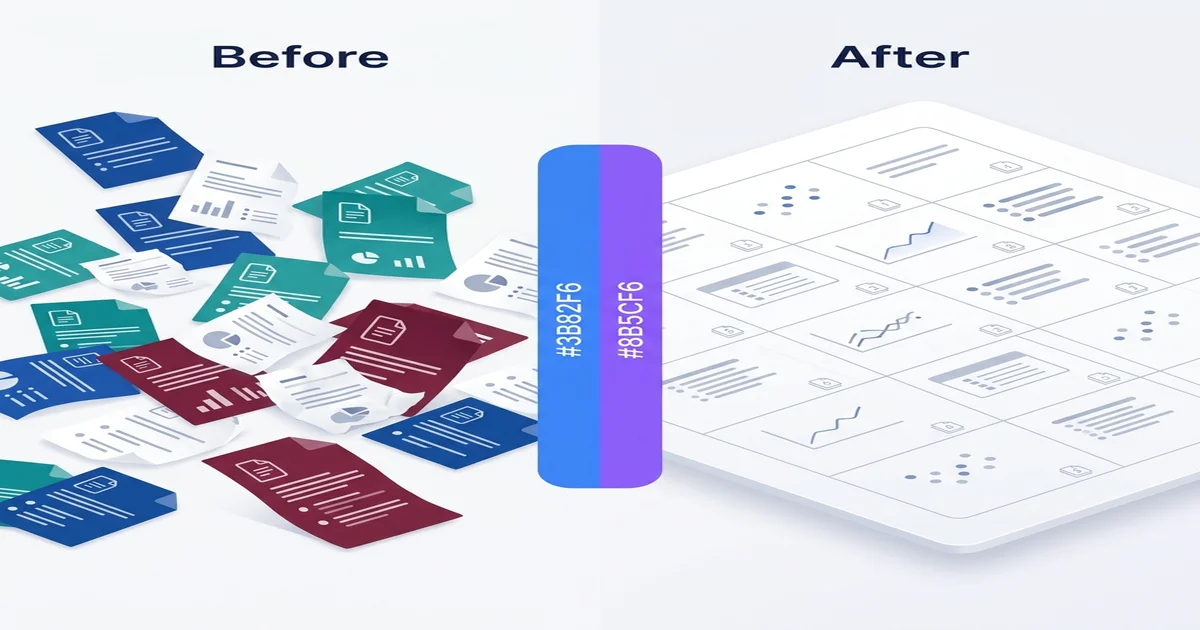
How to Compare Vendor Proposals with AI: 2026 Playbook
A 7-step AI-assisted workflow for vendor proposal comparison — replacing 8 hours of manual matrix-building with roughly 20 minutes of citation-backed analysis. Tool tradeoffs, normalization, gap analysis.
Rhea Kapoor
Head of Procurement Research, SpecLens
- 850+companies trust SpecLens
- 99%extraction accuracy
- 8 hrssaved per comparison
- AES-256encrypted · GDPR compliant
Key takeaways
- Define your must-have and nice-to-have evaluation criteria before opening any vendor document — fuzzy criteria is the biggest cause of slow comparison cycles.
- Match the tool to the task: general LLMs handle 2-vendor qualitative reviews; specification intelligence platforms handle 3+ vendors with citations, normalization, and exportable matrices.
- The unit and terminology normalization step is the most-skipped — and the most damaging when missed.
- Every spec value in the matrix should link click-through to a specific page in the source vendor document; without citations, the comparison is not defensible.
- Treat the AI matrix as the input to the procurement decision, not the decision itself — the committee still owns the call, AI just gives them a faster, more auditable artifact.
The 2026 Playbook for AI-Assisted Vendor Comparison
Five vendor PDFs land in your inbox on Monday. The decision meeting is Friday. The traditional answer is to assign team members to each vendor, build a spreadsheet, then spend two cross-functional meetings reconciling who said what about which spec. By Friday afternoon you have a recommendation that might be defensible — if no one asks where any specific number came from.
There is a faster way that is also more defensible — because every fact cites back to a specific page in a specific vendor document, and the comparison runs in roughly one-twentieth the time. This is the 2026 playbook for AI-assisted vendor proposal comparison, written for procurement and engineering teams that need to move fast without skipping the audit trail.
Quick Answer: How to Compare Vendor Proposals with AI
To compare vendor proposals with AI in 2026: (1) define your evaluation criteria before opening any vendor document; (2) upload all vendor PDFs, Word, Excel, and URL inputs to a specification-comparison platform; (3) tag your RFP as the baseline so the platform maps requirements to vendor responses; (4) review the auto-generated side-by-side matrix with citations; (5) normalize unit and terminology mismatches; (6) run gap analysis against the RFP; (7) ask natural-language questions to stress-test the comparison; (8) export to Excel, PDF, or PowerPoint for stakeholders. Total time: roughly 20 minutes versus 8 hours manually.
Why Manual Vendor-Proposal Comparison Breaks Down
Three failures recur in every manual comparison cycle.
Format mismatch. Vendor A sends a 70-page PDF datasheet; vendor B sends a Word response built from their RFP template; vendor C sends an Excel BoM with embedded URLs. A procurement analyst spends the first two hours just normalizing the documents into a working format before any actual comparison begins.
Specification mismatch. Vendors do not standardize on the same units, terminology, or measurement conditions. One storage vendor reports IOPS at 4K random reads; another at 8K mixed workloads. One mentions "effective capacity with deduplication"; another reports raw capacity. A procurement team that does not catch the mismatch ends up comparing two numbers that look similar but mean different things.
Citation loss. By the time the spreadsheet reaches the decision meeting, the source of any individual value is buried in a folder structure, a chat thread, or someone's memory. When a stakeholder challenges a number, the procurement analyst has to re-derive it from the original PDF — and the meeting stalls. The auditability problem is the single most-cited reason procurement teams reject AI-generated comparisons that do not carry citations.
ProcurementTactics walks through a comparable seven-step manual workflow that is rigorous but assumes hours of analyst time per comparison; Ramp's vendor-comparison-matrix guide covers four matrix types (basic side-by-side, TCO, weighted scoring, decision-making) for the same workflow. Both are excellent for context — and both are slower than they need to be in 2026.
Step 1: Define Evaluation Criteria Before Opening Any Proposal
The biggest cause of slow comparison is fuzzy criteria. If procurement has not agreed on what matters before opening vendor documents, every reviewer applies their own implicit weights and the team spends the cycle litigating the criteria instead of evaluating the vendors.
Before any vendor proposal opens, the procurement lead should write down: (a) the must-have specifications without which a vendor is disqualified, (b) the nice-to-have specifications that influence the decision but are not blockers, (c) the relative weights of must-haves and nice-to-haves, and (d) the decision authority for each criterion. The RFP evaluation matrix template covers the weighted-scoring methodology in depth, and the free vendor evaluation matrix template provides a starting point.
For complex RFPs, run the RFP complexity analyzer first — it scores the RFP across multiple dimensions and tells you whether AI assistance will pay off for this specific evaluation.
Step 2: Choose Your Tool — ChatGPT, Claude, or Specification Intelligence
Not every comparison needs purpose-built tooling. The honest tradeoff:
| Tool Class | When It Works | When It Fails |
|---|---|---|
| General LLM (ChatGPT, Claude, Gemini) | 2 vendors, 1-2 documents each, low audit-trail requirement, qualitative summary | 3+ vendors, 50+ pages, needs citations, needs unit normalization, needs exportable matrix |
| Spreadsheet + manual extraction | Highly regulated environments, simple commodity buys, junior analysts learning the workflow | Multi-format inputs, multi-vendor comparison, time pressure |
| Specification intelligence (e.g., SpecLens) | 3+ vendors, multi-format inputs, citation requirement, time pressure, gap analysis against RFP | Single-vendor narrative review (just read the document) |
| AEC submittal review (BuildSync, Part3) | Construction submittal-vs-spec compliance specifically | Cross-industry RFPs (these tools are AEC-only) |
Glean's document-understanding analysis notes that general AI models struggle to maintain context and connect themes across separate files — the exact failure mode that breaks vendor proposal comparison. Evolution AI estimates roughly one error or hallucination per page when ChatGPT compares documents at scale, which is why the citation pillar matters so much for procurement use. The full analysis is in ChatGPT vs Claude vs Copilot for procurement; a deeper category framing is in what is specification intelligence.
Step 3: Ingest Documents and Tag Them Properly
Two practical rules accelerate the rest of the workflow:
Rule 1: Upload everything as one comparison set. Do not run vendor A through one tool and vendor B through another — the platform cannot normalize across vendors if it cannot see them together. Specification intelligence platforms accept PDF, Word, Excel, PowerPoint, and URL inputs in a single comparison session.
Rule 2: Tag the RFP separately from vendor responses. If the platform supports an RFP-baseline mode, mark the buyer-side specification document explicitly. The platform then uses the RFP as the requirement spine and maps each vendor response to the requirements automatically. This step is the single biggest accelerator for gap analysis later in the workflow.
For multi-format documents, the OCR vs AI document analysis guide covers when scanned PDFs need pre-processing and when modern AI extraction handles them natively.
Free Spec Checklist for Your Next RFP
Generate a CIPS-aligned specification checklist for any product category in under a minute — no signup. Use it to define evaluation criteria before you open any vendor proposal.
Generate Checklist Free →Step 4: Normalize Units and Terminology — the Apples-to-Apples Step
This is the step that manual comparison most often skips. Vendors do not adopt a common standard, and reviewers do not always notice the mismatch. Three patterns recur:
Unit mismatch. kW vs HP, BTU vs watts, GB vs GiB, IOPS at 4K vs 8K, range under no-load vs full-payload. The specification intelligence platform should automatically convert where conversion is mathematically valid and flag where it is not. The unit conversion in procurement guide covers the most common mismatches by industry.
Terminology mismatch. One vendor calls it "high availability"; another calls it "continuous operation;" a third calls it "redundant configuration." The platform should map all three to a canonical field — and surface the mapping for buyer review rather than silently merging them.
Measurement-condition mismatch. Vendor A reports performance under one workload assumption; vendor B reports it under a different workload assumption. The values are both correct but not comparable. The platform should flag the mismatch as not-comparable rather than averaging or ranking the values directly.
For a deeper treatment of normalization as a discipline, see specification gap analysis and spec compliance verification.
Step 5: Run Gap Analysis Against Your RFP Baseline
Once the comparison matrix is normalized, run gap analysis: which required specifications did each vendor fail to address? Three categories of gap matter most:
- Silent omissions. The vendor did not mention the specification at all. These are usually the most damaging in post-award negotiation because the vendor can later argue the requirement was not in scope.
- Hedged commitments. The vendor responded with "Yes, with limitations" or "Available in future release." These look like compliance in a quick scan but degrade the apples-to-apples comparison.
- Implicit substitutions. The vendor proposed a different product or approach than what the RFP specified. In construction this is the "or-equal" problem; in IT it appears as substitute SKUs. The or-equal substitutions guide covers the verification methodology.
For RFP-response red flags more broadly, see RFP response red flags to watch for and the RFP compliance checklist.
Step 6: Use Ask-AI to Interrogate the Comparison
Once the matrix is built, the most valuable feature is natural-language interrogation. Procurement and engineering reviewers should be able to ask:
- "Which vendors meet the redundancy requirement?"
- "Show me where vendor B describes their service-level guarantees."
- "Which vendor has the lowest projected 5-year TCO?" (paired with the free TCO calculator)
- "Are there any specifications where vendor A and vendor C used different units?"
Each Ask-AI answer should carry the same citations the underlying matrix carries — clicking through should land on the originating page in the originating vendor document. This is the second-line audit trail that converts an AI-generated comparison from "plausible" to "defensible."
Step 7: Export and Present
Procurement does not present the matrix in the platform; procurement presents the matrix in Excel, PDF, or PowerPoint to a decision committee. The export must preserve:
- The full matrix with vendor columns and specification rows
- The page-level citation for each value
- The confidence score (so reviewers can decide which low-confidence values need human re-check)
- Any flags from the normalization and gap-analysis steps
- An executive summary suitable for the decision meeting
Decision committees rarely read the entire matrix. They read the executive summary, ask one or two questions about contested cells, and sign off on the recommendation. The export must support both the high-level summary and the deep-dive verification on the same artifact.
Worked Example: Comparing Three Storage Vendors
Picture the following scenario, drawn from a recurring procurement pattern in enterprise IT.
A 1,500-FTE financial services firm is evaluating a 1 PB primary-storage refresh. Three vendors have responded to the RFP: an all-flash incumbent, a hybrid challenger, and a software-defined newcomer. Each response is roughly 80 pages — datasheet, RFP response, security questionnaire, and pricing schedule. The procurement lead has 4 days before the architecture review board meets.
The manual workflow: assign one analyst per vendor, build a shared spreadsheet, hold three reconciliation meetings, present a partial recommendation. Total elapsed time: 22 person-hours across three reviewers.
The specification intelligence workflow: upload all 12 documents to one comparison session, tag the RFP as baseline, review the auto-generated matrix, ask Ask-AI to surface the top three differences, export the matrix and executive summary. Total elapsed time: 35 minutes for the procurement lead, plus 30 minutes of architecture-board review on the exported artifact. The architecture board sees the same citation-backed matrix the procurement lead saw, which collapses the question-and-answer cycle in the meeting.
Crucially, the specification intelligence workflow surfaces three issues the manual workflow would have missed: vendor A reports IOPS at 4K random reads while vendor B reports them at 8K mixed workloads (not directly comparable); vendor C's "effective capacity" assumes 4:1 deduplication which the firm's workload does not achieve; vendor B's "unlimited support" clause has a hidden 5-business-day response cap. Each issue is flagged with the originating page citation. None of these would have come out cleanly in a Friday-meeting summary.
Common Mistakes That Sink AI-Assisted Comparisons
Five mistakes recur in early adoption and each undermines the audit trail that justifies the AI workflow in the first place.
- Over-trusting AI without citations. Any value used in a procurement decision should be traceable to a vendor document page. If the platform produces values without citations, do not use them.
- Skipping unit normalization. The platform's unit conversion is only as good as the inputs. Spot-check at least three values per vendor against the underlying document before exporting. The unit conversion guide covers what to look for by industry.
- Ignoring "or-equal" substitutions. Vendors will sometimes propose substitute products that are not what the RFP requested. The platform should flag substitutions, but procurement still needs to verify the substitute meets the requirement. See the or-equal substitutions guide.
- Using consumer-tier AI on confidential data. Vendor proposals routinely contain confidential pricing and terms. Confirm the platform encrypts in transit (TLS 1.3) and at rest (AES-256), does not train shared models on customer data, and has clear retention defaults. SpecLens publishes its posture on the security page.
- Treating the AI matrix as the final answer. The matrix is the input to the procurement decision, not the decision itself. The decision still belongs to a procurement and engineering committee; AI-assisted comparison just gives them a defensible, time-efficient artifact to work from.
Compare AI vs Manual on a Real RFP
Run this workflow on your own RFP. Upload up to two vendor documents to SpecLens free and watch the platform produce a normalized, cited comparison matrix in under 15 minutes. For a side-by-side cost comparison of AI-assisted versus manual comparison, run the free ROI calculator against your team's current baseline. The full methodology for comparing product specifications is in the compare product specifications guide.
References
- 1.Ramp — How to Build & Use a Vendor Comparison Matrix — Ramp's vendor comparison matrix guide — 4 matrix types and methodology (2026)
- 2.Loopio — RFP Statistics & Win Rates — Loopio 2026 RFP Response Trends Report — 33 hours per RFP, down from 35 (2026)
- 3.Glean — Which AI Models Truly Excel at Document Understanding — Glean's document understanding analysis — multi-document context limits in general AI (2025)
- 4.Evolution AI — Use ChatGPT to Compare Documents — Evolution AI ChatGPT PDF comparison — hallucination rate per page (2025)
- 5.ProcurementTactics — Compare Proposal — ProcurementTactics — 7-step proposal comparison process (2026)
Frequently Asked Questions
Related Articles
GenAI for Vendor Comparison (2026)
Discover how Generative AI is revolutionizing vendor comparison. From automated extraction to hallucination-free analysis, learn the future of procurement.
AI in Procurement: The Complete 2026 Guide
Complete guide to AI in procurement. Learn how AI transforms sourcing, spec analysis, vendor evaluation, and automation.
What Is Specification Intelligence? A Practical Definition
Specification intelligence is the procurement layer that extracts, normalizes, and compares technical specs across vendor documents. Definition, four pillars, use cases, and 2026 buyer's guide.
ChatGPT, Claude, Perplexity for Procurement: Where They Hallucinate
Stress test of ChatGPT, Claude, and Perplexity on real procurement tasks. Where each model works (narrative, drafting, web research) and where each model fails (cross-document spec extraction, unit normalization, page-level citations).