
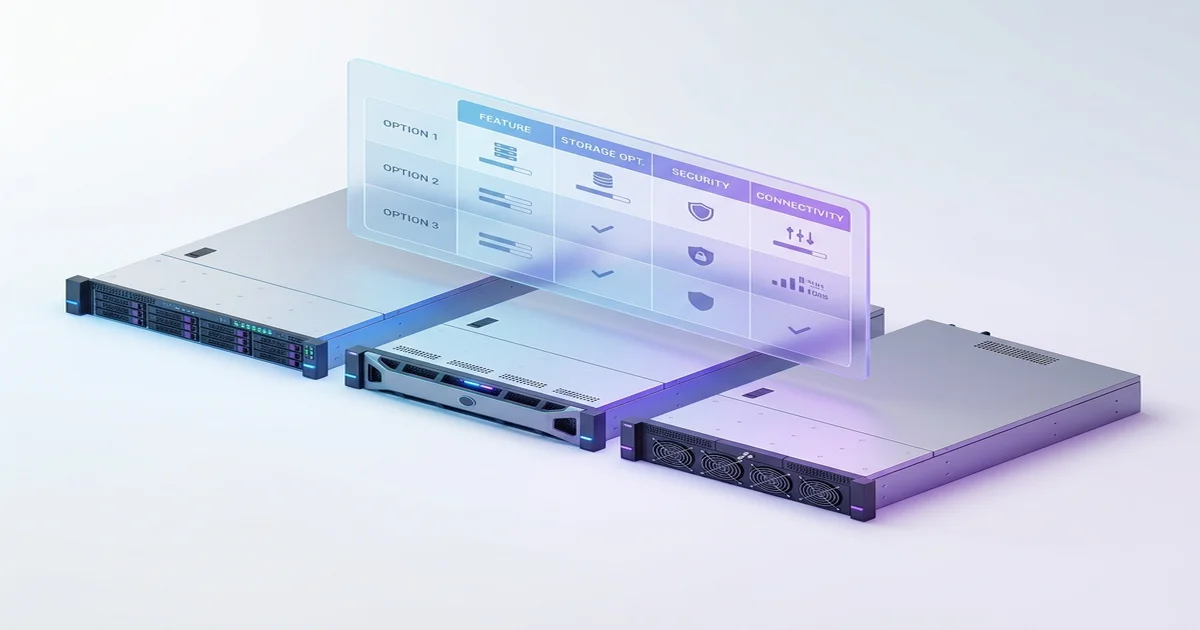
Dell vs HPE vs Cisco Server Comparison (2026 Procurement Guide)
Procurement-grade comparison of Dell PowerEdge R770, HPE ProLiant DL380 Gen12, and Cisco UCS C240 M8. Normalized specs, security features, consumption models, and 5-year TCO methodology.
Priya Sharma
Procurement Technology Lead, SpecLens
- 850+companies trust SpecLens
- 99%extraction accuracy
- 8 hrssaved per comparison
- AES-256encrypted · GDPR compliant
Key takeaways
- The 2026 flagship 2U trio — Dell PowerEdge R770, HPE ProLiant DL380 Gen12, Cisco UCS C240 M8 — share Intel Xeon 6, 8 TB DDR5-6400, and PCIe Gen5; differentiation is qualitative, not headline.
- Dell leads on installed base (#1 IDC OEM share at 8.3%); HPE leads on hardware-rooted security and consumption model (GreenLake); Cisco leads on integrated compute-and-fabric.
- Cisco UCS C240 M8 is the last UCS generation to support UCS Manager (UCSM) — organizations on UCSM should plan the Intersight migration into the procurement decision.
- The 6-to-10-week server RFP cycle is driven mostly by reconciling specs that were not written to be apples-to-apples — define benchmark conditions in the RFP and use specification intelligence to normalize responses.
- Look outside the trio for AI/HPC workloads (Supermicro), cost-sensitive standardized refresh (Lenovo, IEIT Systems), or workloads better suited to hyperscaler-direct procurement.
Why a Six-to-Ten Week Server RFP Should Take Four
Dell, HPE, and Cisco UCS all run Intel Xeon. They all sell rack and tower servers. They all promise five-nines uptime and silicon-grade security. So why does an enterprise server RFP take 6 to 10 weeks and involve 6 to 10 cross-functional contributors? Because vendor QuickSpecs are written to look favorable — not comparable. Industry guidance puts the average IT-vendor RFP timeline at 6 to 10 weeks; complex regulated procurements stretch to 12 to 16 weeks. Most of that time is reconciling specifications that were never meant to be compared in the same row.
We pulled current 2026 product positioning across the Dell PowerEdge R770, the HPE ProLiant Compute DL380 Gen12, and the Cisco UCS C240 M8 — the three flagship 2U rack servers in the current generation. We ran them through a procurement-grade normalization, and put the result side-by-side. Here is what we found, and how to repeat the analysis on your own configurations in roughly 35 minutes.
Quick Answer: Which Server Wins for Procurement?
As of mid-2026, the three flagship 2U enterprise rack servers are the Dell PowerEdge R770 (Dell 17G), HPE ProLiant Compute DL380 Gen12, and Cisco UCS C240 M8. All three use Intel Xeon 6 processors and DDR5 memory at up to 6400 MT/s, support up to 8 TB of memory, and offer dense NVMe storage configurations. Differences cluster in three areas: HPE leads on hardware-rooted security (Silicon Root of Trust plus FIPS 140-3 Level 3 BMC); Cisco leads on integrated fabric (UCS C240 M8 is the last UCSM-supported generation); Dell leads on installed base and reseller breadth. Procurement should pick on the area that matters most to the architecture, not on the server alone.
Why Server RFPs Are Slow — Four Areas Where QuickSpecs Make Comparison Hard
Not all of the slowness is meeting friction. A meaningful share is the actual difficulty of comparing what each vendor offers because the specs are written to favor the publisher.
1. Performance Benchmarks at Different Conditions
Vendor A reports throughput at one workload configuration; vendor B reports it at another. The headline numbers look comparable but rest on incompatible assumptions — block size, queue depth, mixed-vs-pure read/write ratios, cache state. The right answer is to specify the benchmark conditions in the RFP and require all vendors to respond on those conditions. Without that, the matrix is comparing values that should not share a row.
2. Effective Capacity Claims
Effective capacity claims include or exclude deduplication, compression, and thin provisioning. A vendor advertising "effective capacity" with 4:1 deduplication assumed is making a claim about a specific workload pattern that may not match the customer's. Specs should report raw capacity and effective capacity separately, with the assumed reduction ratio documented.
3. Security Features with Different Brand Names
HPE markets "Silicon Root of Trust." Dell uses "Silicon-Based Hardware Root of Trust." Cisco uses "Trust Anchor module." All three describe similar primitives — a hardware-rooted boot integrity chain — but the brand names obscure the comparison. Procurement teams that only count the differentiated brand-name features end up with a matrix that looks more differentiated than the underlying technology actually is.
4. Support and Firmware Licensing Tiers
Support contracts and firmware licenses are sold in tiers with different inclusions. The base tier covers different events on each platform. The mid tier upgrades different features. The premium tier adds different proactive monitoring. Effective comparison requires reading the support data sheet for each tier on each platform and matching them up by what is included rather than by what they cost.
The single most useful step a procurement team can take to compress the RFP cycle is to define the comparison conditions explicitly in the RFP. The second-most-useful step is to use a specification intelligence platform to normalize the vendor responses against those conditions automatically.
Dell PowerEdge R770 — The Volume Leader's Current Flagship
Dell is the worldwide #1 server OEM by revenue share — IDC's Q3 2025 server tracker put Dell at 8.3% global share, well ahead of the field. The PowerEdge R770 is the current 2U flagship in the Dell 17G generation, succeeding the R760 with Intel Xeon 6 processors (P-core or E-core variants) and PCIe Gen5 throughout.
Architectural posture: Up to two Intel Xeon 6 sockets; up to 32 DDR5 DIMM slots supporting 8 TB of memory; up to 40 NVMe Gen5 EDSFF E.3.S drives; PSU options ranging 800W to 3200W. Dell's OpenManage and iDRAC remain the management standard.
Strengths: Largest installed base, broadest reseller and integrator network, deepest third-party software certifications, largest pool of trained operators in most enterprise environments. The volume leader pricing on standard configurations is competitive precisely because Dell can amortize across the largest channel.
Limits: Less differentiated on the security and fabric narratives where HPE and Cisco invest more marketing. Dell's management and AI tooling are evolving but follow rather than lead the category narrative.
Ideal procurement scenario: Standardized rack refresh where breadth of operator skill, reseller competition on pricing, and third-party software certification matrix matter more than hardware differentiation.
HPE ProLiant Compute DL380 Gen12 — The Security and Consumption-Model Bet
HPE's current 2U flagship in the ProLiant Compute line is the DL380 Gen12, succeeding the Gen11 and shipping in 2026 with Intel Xeon 6 processors offering up to 144 E-cores or 86 P-cores per socket. iLO 7 management, 8 TB DDR5-6400 memory ceiling, and dense EDSFF E3.S NVMe configurations.
Architectural posture: Two Intel Xeon 6 sockets; up to 8 TB DDR5 across 32 DIMM slots at 6400 MT/s; up to 36 EDSFF E3.S NVMe drives or 20 SFF NVMe; PCIe Gen5 throughout. Industry-first FIPS 140-3 Level 3 certification at the BMC level.
Strengths: Hardware-rooted security narrative is the most-developed of the three platforms — Silicon Root of Trust across firmware, secure enclave on the BMC, FIPS 140-3 Level 3 certification. HPE GreenLake consumption model is the most-developed in the category — pay-per-use on-prem hybrid cloud is a real procurement option, not just marketing.
Limits: Per IDC Q3 2025 tracker, HPE's server share is below Dell, Supermicro, IEIT Systems (Inspur), and Lenovo — the volume leadership story belongs elsewhere. Procurement teams without a strong consumption-model use case may not capture the GreenLake premium.
Ideal procurement scenario: Regulated industries (financial services, healthcare, government) where hardware-rooted security and FIPS-level cryptographic certification matter, or organizations actively evaluating consumption-based on-prem infrastructure.
Cisco UCS C240 M8 — The Integrated Fabric Bet (and the Last UCSM Generation)
Cisco's current 2U rack server is the UCS C240 M8, succeeding the M7 with Intel Xeon 6 Scalable processors. Two configurations: SFF (small form factor) supporting up to 24× 2.5" SAS/SATA/U.3 NVMe; LFF (large form factor) supporting up to 12× 3.5" drives. Up to 8 TB DDR5-6400 across 32 DIMMs.
Architectural posture: Two Intel Xeon 6 sockets; same 8 TB DDR5 memory ceiling and PCIe Gen5 throughput as Dell and HPE. The differentiator is fabric — UCS integrates compute, networking, and storage through Fabric Interconnects (the new UCS 6600 Series adds 50G+ fabric in 2026) and X-Fabric on the X-Series modular system.
Strengths: Integrated fabric story is real — for organizations already running Cisco networking, the unified compute-and-fabric stack reduces management surface area meaningfully. Intersight management plane is well-developed.
Limits: Cisco does not appear in the IDC top-5 OEM server share list — the platform competes on integrated value, not box volume. Procurement-relevant note: the M8 is the last UCS generation to support UCS Manager (UCSM); future generations require Intersight. Organizations on UCSM today should plan the migration into the procurement decision.
Ideal procurement scenario: Organizations standardized on Cisco networking that want unified compute-and-fabric management, or already invested in UCS Manager and looking to extend the installed base before the Intersight migration.
Side-by-Side Procurement-Grade Comparison Matrix
The flagship 2U configurations across the three platforms, normalized to comparable categories. Spec values reflect publicly stated 2026 product positioning; verify against the current QuickSpecs PDF before any commitment.
| Specification | Dell PowerEdge R770 | HPE ProLiant DL380 Gen12 | Cisco UCS C240 M8 |
|---|---|---|---|
| Form factor | 2U rack | 2U rack | 2U rack |
| CPU sockets (max) | 2 × Intel Xeon 6 | 2 × Intel Xeon 6 | 2 × Intel Xeon 6 |
| Memory (max) | 8 TB DDR5 | 8 TB DDR5-6400 | 8 TB DDR5-6400 |
| DIMM slots | 32 | 32 | 32 |
| NVMe drives (max) | 40 EDSFF E3.S Gen5 | 36 EDSFF E3.S | 32 EDSFF E3.S (or 24 SFF) |
| PCIe generation | Gen5 | Gen5 | Gen5 |
| Hardware-rooted security | Silicon-Based Root of Trust | Silicon Root of Trust + FIPS 140-3 L3 BMC | Trust Anchor module |
| Management plane | iDRAC, OpenManage | iLO 7, GreenLake (consumption) | Intersight, UCSM (last gen) |
| Consumption model | APEX (available) | GreenLake (most mature) | Plus enterprise license agreements |
| 2025 worldwide OEM share (IDC Q3) | 8.3% (#1) | 3.0% (#5) | Not in IDC top 5 |
Procurement note on the IDC share figures: IDC's Q3 2025 server tracker reported a $112.4B worldwide server market — up 61% year-over-year — with Dell #1 (8.3%), Supermicro #2 (4.0%), IEIT Systems (Inspur) and Lenovo tied at #3-#4 (~3.7-3.6%), and HPE #5 (3.0%). Cisco competes on integrated value rather than box volume and does not appear in IDC's top-5 OEM list. Worldwide server revenue hit a record $444B for FY2025.
Five-Year TCO — What Procurement Should Model
The acquisition price is rarely the largest cost component over a 5-year server lifecycle. The full model includes:
- Acquisition — base server, configured DRAM and storage, optional GPU or accelerator cards
- Power and cooling — typically 20-30% of 5-year TCO at $0.10-$0.18/kWh; AI-heavy workloads push this share higher
- Rack space — opportunity cost of 2U in a power-and-cooling-constrained data center
- Support and firmware licensing — base, mid, and premium tiers vary across platforms
- Operations — staff hours per server per year, which depends heavily on management plane familiarity
- Refresh and disposal — end-of-life decommissioning, data sanitization (NIST 800-88 for IT equipment), and residual value
For the full TCO methodology including the free TCO calculator, see the TCO calculator guide. For the broader IT procurement workflow, see the IT hardware procurement guide and the cloud vs on-premise comparison.
Run This Comparison on Your Own Configurations
Upload three vendor QuickSpecs PDFs to SpecLens and produce a normalized matrix in under 15 minutes — citations preserved, units converted, gaps flagged.
See How It Works →Procurement Workflow — How to Run This RFP in Four Weeks, Not Ten
The 6-to-10-week baseline is not a law of physics; it is the result of a workflow that lacks normalization tooling. Five steps compress the cycle to roughly four weeks without skipping rigor.
- Define benchmark conditions in the RFP itself. Specify the workload profile, block size, queue depth, and security certifications the buyer requires. Vendors that respond with off-condition benchmarks should be flagged for clarification, not silently accepted.
- Use a baseline RFP template that maps to the comparison matrix the buyer will produce — see the free RFP template.
- Score the RFP's complexity upfront. Run the RFP complexity analyzer on the draft RFP to size the response volume and decide which AI tooling will pay off.
- Use specification intelligence on the responses. Upload all vendor QuickSpecs PDFs and RFP responses to a platform that extracts, normalizes, and produces a citation-backed matrix. The vendor proposal comparison playbook covers the workflow.
- Run the architecture-board approval against the matrix, not the responses. The matrix is the artifact the architecture board reviews; questions that arise traceback to the source page on demand.
When to Add Supermicro, Lenovo, IEIT Systems, or Hyperscaler-Direct
Three categories of buyer benefit from looking outside the Dell-HPE-Cisco trio.
AI and HPC workloads — Supermicro is the #2 worldwide OEM by IDC tracker share (4.0%) on the strength of GPU server specialization and rapid AI server time-to-market. Buyers running large-model training or inference at scale should benchmark Supermicro alongside the trio.
Cost-sensitive standardized refresh — Lenovo (#3-#4 IDC share) and IEIT Systems (formerly Inspur, also #3-#4) often price aggressively on standard configurations and are worth quoting against the trio for budget-pressured refresh cycles.
Hyperscaler-direct procurement — Some workloads make more sense colocated or hyperscaled rather than on-prem. The cloud vs on-premise procurement guide covers the decision framework. Compare the on-prem TCO with the equivalent AWS/Azure/GCP commitment before locking in a 5-year on-prem refresh.
The 6-to-10-Week RFP Baseline Is the Wrong Default
Server RFPs are slow because vendor QuickSpecs were never written to be apples-to-apples and procurement teams have not had tooling to enforce normalization. The right tools — a clear baseline RFP, the RFP complexity analyzer, a specification intelligence platform — compress the cycle to roughly four weeks while improving the audit trail. The Dell-HPE-Cisco comparison is the high-volume case, but the workflow generalizes to any 3-to-5-vendor enterprise IT evaluation.
For broader IT procurement context, see the IT & Data Center procurement page, the storage procurement solutions page, and the compare servers guide.
Compare Server Specs Apples-to-Apples
Run this comparison on your own configurations. Upload three vendor QuickSpecs PDFs to SpecLens free and watch the platform produce a normalized matrix in under 15 minutes — citations preserved, units converted, gaps flagged. Pair with the free TCO calculator for the full 5-year cost model and the RFP complexity analyzer to size the effort upfront. For the full procedural playbook, see the compare vendor proposals with AI guide.
References
- 1.Dell — PowerEdge R770 — Dell PowerEdge R770 product page — Dell 17G flagship 2U server with Intel Xeon 6 (2026)
- 2.HPE — ProLiant DL380 Gen12 — HPE ProLiant Compute DL380 Gen12 — 2U flagship with Intel Xeon 6 and FIPS 140-3 L3 BMC (2026)
- 3.Cisco — UCS C240 M8 Data Sheet — Cisco UCS C240 M8 data sheet — 2U rack server with Xeon 6 (last UCSM-supported gen) (2026)
- 4.IDC — Worldwide Quarterly Server Tracker — IDC Q3 2025 Worldwide Server Tracker — Dell #1 (8.3% share), Supermicro #2, HPE #5 (2025)
- 5.TechnologyMatch — RFP Process Timeline — TechnologyMatch — average IT vendor RFP timeline of 6-10 weeks (2025)
Frequently Asked Questions
Related Articles
Compare Enterprise SAN Specs: Dell PowerStore vs NetApp AFF vs Pure (2026)
Procurement-grade comparison of Dell PowerStore Gen 2, NetApp AFF A20-A1K, and Pure FlashArray (now Everpure after the Feb 2026 rebrand). Normalized specs, IOPS gotchas, effective capacity assumptions, and 2026 Gartner MQ leadership.
Construction Equipment Buying Guide
Navigate construction equipment procurement confidently. Learn heavy equipment specs, buy vs rent analysis, and vendor comparison.
Fleet Vehicle Procurement Guide
Master fleet vehicle procurement. Learn vehicle specs, TCO analysis, EV considerations, and comparison strategies for fleet purchasing.
Healthcare Equipment Procurement Guide
Master healthcare equipment procurement. Learn regulatory requirements, GPO considerations, and spec comparison for medical buyers.